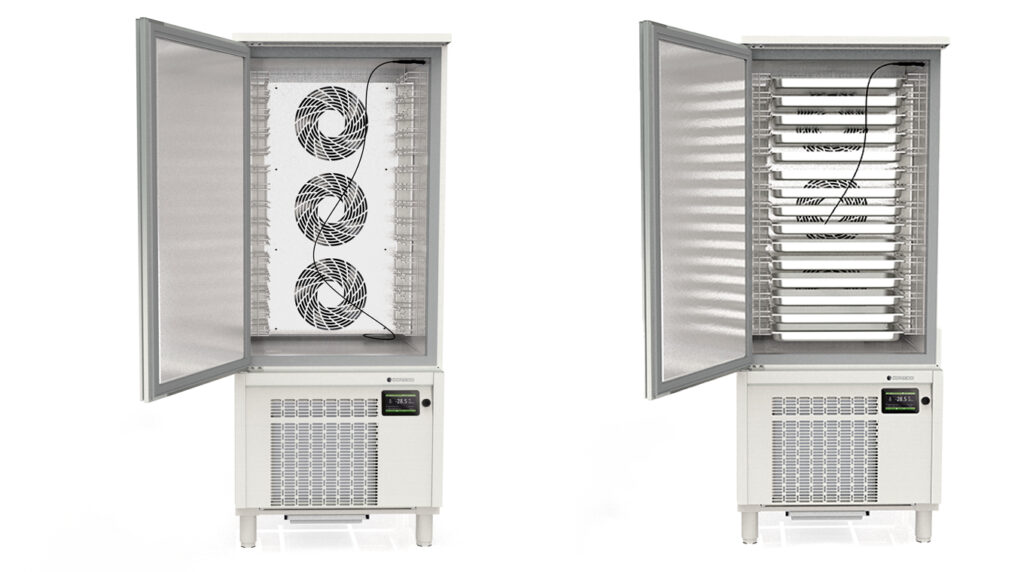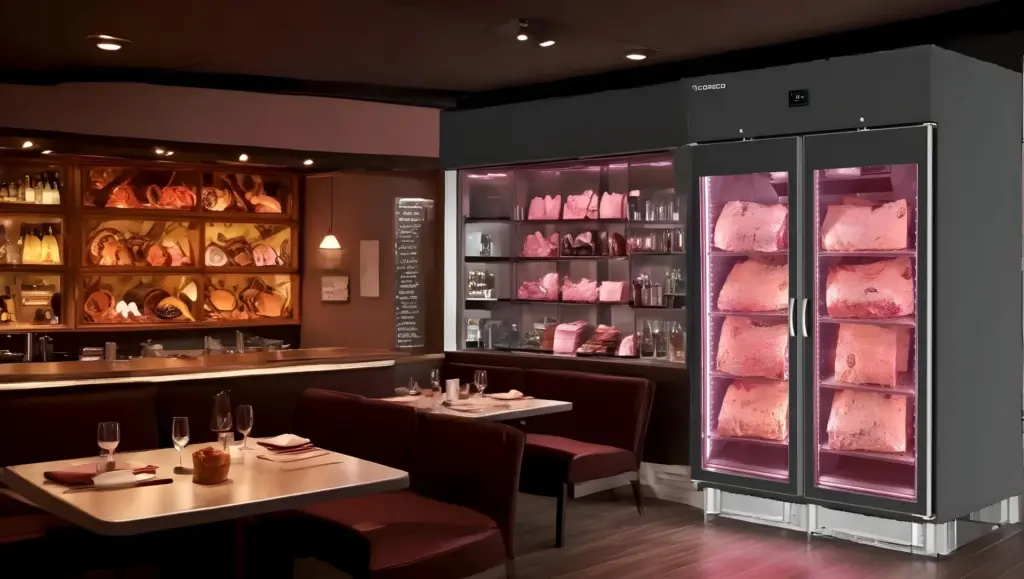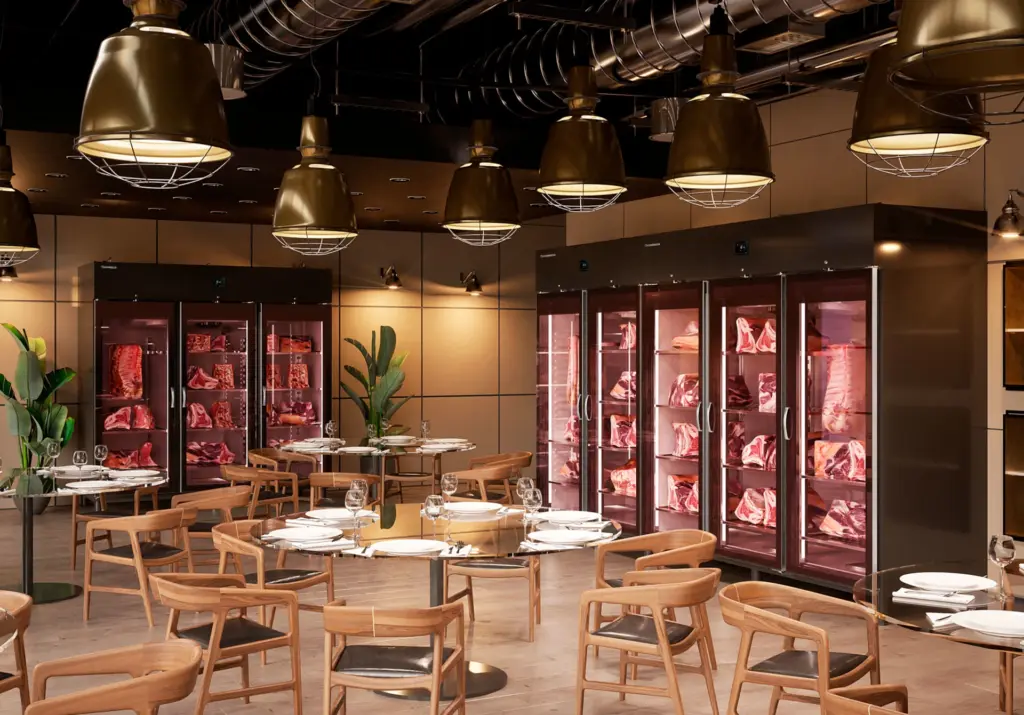




Connected professional refrigeration is not just about “having an app”. It is about being able to demonstrate, with reliable data, that the product is preserved correctly and that the operation reacts in time when something goes wrong. In practice, connected professional refrigeration records, alerts and provides useful evidence for food safety, consistency and cost control.
In the food service and organised catering sector, models such as the fifth range or the food process have become an operational necessity. They guarantee regularity, food safety and efficiency. In this context, refrigeration is no longer an auxiliary equipment but a critical infrastructure of the process.
The new role of connected professional refrigeration
Capacity alone is no longer the key. In environments with frequent openings and continuous work, four factors weigh more heavily:
- Control accuracy.
- Thermal stability in actual use.
- Recovery after openings.
- 24/7 reliability.
Without well-integrated, connected professional cooling, these models do not scale. Small but repeated deviations occur, leading to shrinkage, incidents and loss of control.
To understand the current regulatory and energy context, it is useful to review this article available in our blog, where you will find we talk about the trends for 2026 in professional refrigeration in the HORECA sector.
What's really changing in HORECA kitchens
In real projects, the same pattern is repeated: less margin for error and more pressure to justify every decision.
Three common changes:
- Fewer staff available.
- More compact spaces.
- Increased traceability and safety requirements.
According to the European Commission, hygiene and process control are key pillars in the food chain. The current rules provide for a single, transparent hygiene policy applicable to all foods and all food operators throughout the food chain.
In this environment, connected professional refrigeration brings stability because it reduces improvisation.
Two coexisting models and how connectivity influences them
Connected professional cooling does not apply equally to all projects. A distinction should be made between two scenarios.
Central kitchens and volume operations
Priority here is given to repetition, speed and control.
Standard criteria:
- Continuous production.
- Standardised processes.
- Orderly internal logistics.
- Comparison between centres.
What the cold connected brings:
It allows deviations to be detected before they become losses. In volume, every error is multiplied.
Signature restoration and demanding projects
In this environment, precision is paramount.
Standard criteria:
- Thermal stability.
- Accurate preservation.
- Lower tolerance to deviations.
- Reliability in service.
What the cold brings:
Connected professional refrigeration helps to detect a bypass when it is still solvable, not when it is already leaking.
Operational pill:
It is not about connecting for the sake of connecting, but anticipating what breaks the standard.
Why connected professional cooling is a silent infrastructure
Automation relies on data. If data is not used for action, connectivity remains a superficial layer.
Cold intervenes in:
- Reception and storage.
- Preparation.
- Replenishment.
- Sensitive conservation.
When the connected professional cooling works well, it is hardly noticeable. When it fails, it translates into downtime, shutdowns and operational stress.

If in your operation the critical product is particularly sensitive, you may be interested in reviewing good control criteria in specific processes, for example: https://gourmetcoreco.com/almacenamiento-alimentos-restaurante/
What data matters in connected refrigeration
Connectivity does not mean accumulating information. It means working with useful data.
| Datum | What it is used for in operation | What it serves as evidence for |
|---|---|---|
| Recorded temperature | Detecting early deviations | Demonstrate control and compliance |
| Alarms with history | Reduce reaction times | Recording incidents |
| Door events | Analysing usage habits and peaks | Explain thermal variations |
| Failure events | Identify technical causes | Traceability of incidents |
| Performance signals | Support preventive maintenance | Behavioural history |
Assumption: In multi-location chains, the greatest value is in comparing sites and correcting to a common standard.
If you need help defining what data and alarms make sense for your operation, talk to your dealer or installer or write to us at info@coreco.es.
Practical questions to land a connected project
Before investing, it is important to respond:
- What data do I need to act?
- Who receives the alarm?
- Which history should I keep?
Without these answers, connected professional refrigeration becomes less effective.
AI applied to cold: less promise, more utility
AI adds value when it prioritises alerts and detects patterns. Studies have already analysed the usefulness of real-time anomaly detection in cold chain transport using IoT technology.
Useful examples:
- Slower than usual thermal recovery.
- Repeated alarms in a specific band.
- Changes suggesting dirt or poor ventilation.
How to explain it:
If the data is reliable, the AI warns before the problem reaches the product.
What changes in day-to-day management
Connected professional refrigeration is changing the way we decide.
It is noted that:
- It is purchased for operational risk.
- Clear traceability is required.
- The burden of preventive maintenance is growing.
- Actual efficiency matters.
- The standard facilitates training.

You can request technical information through the dealer network: https://coreco.es/es/contacto/distribuidores/
Common mistakes in connectivity projects
Common mistakes:
- Requesting connectivity without defining objectives.
- Size by volume and not by rotation.
- Do not assign alarm managers.
- Install in hot or poorly ventilated areas.
- Failure to plan maintenance routines.
How to sum it up:
How to set up a project without complicating it
Initial criteria:
- Type of operation.
- Critical product.
- Evidence needed.
- Actual operation.
- Maintenance plan.
Three key decisions:
- Which data is essential.
- Which alarms are useful.
- How to review historical records.
Without clear processes, connectivity does not help.
Frequently asked questions
Not in the short term. More realistic is to automate repetitive tasks and better measure processes.
Because it facilitates standardisation, auditing and maintenance.
Recorded temperature, alarms with history and basic events.
Yes. Without reliable data, the analysis loses value.
Reduces wasted energy and wasted product.
Yes, with a different approach: more stability and less shrinkage.
Glossary
Professional refrigeration connected: refrigeration system with logging, alarms and monitoring for operational control.
Traceability: ability to record and demonstrate conditions over time.
Temperature recording: thermal history for operation and audit.
Alarms: warnings for temperature or time thresholds.
Gateway events: records of openings to analyse habits.
Preventive maintenance: planned review to avoid failures.
Real efficiency: performance in use, not just in theory.