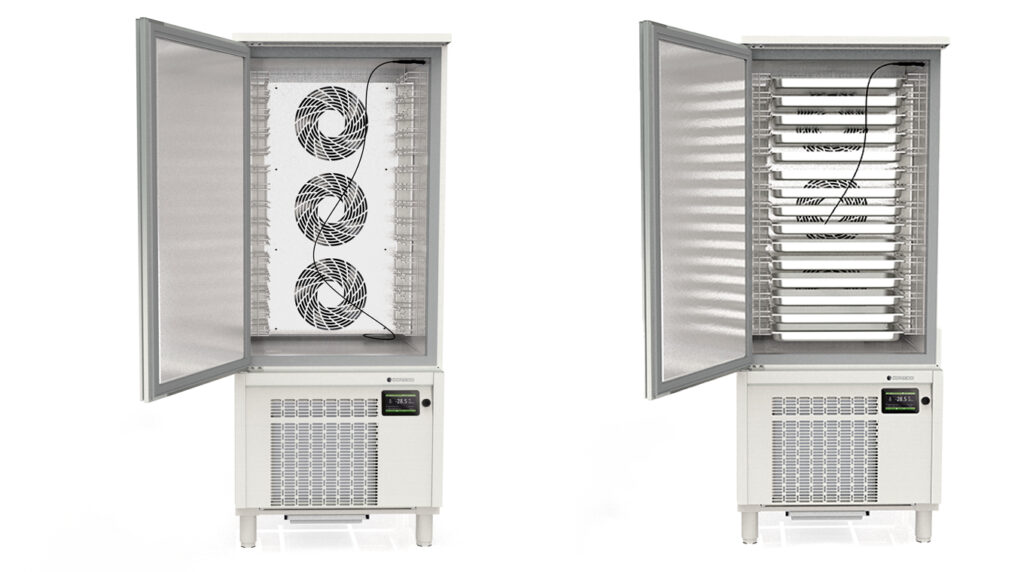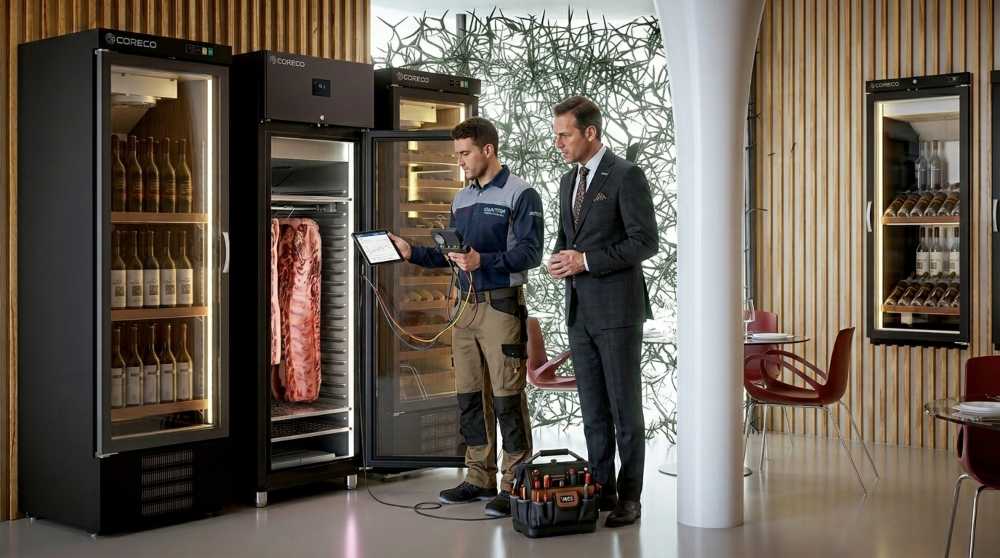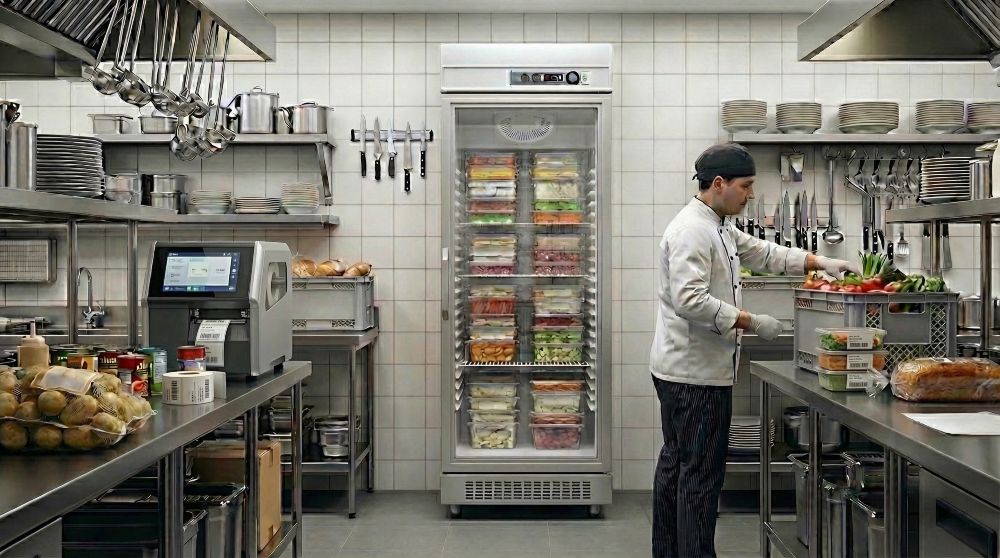




In many HORECA businesses, refrigeration is still purchased as a one-off investment. The entry price is compared, dimensions are checked, the finish is validated and the deal is closed. But the real profitability is not only played there. It is played later, every day, in consumption, in stability, in openings, in cleaning, in recovery after intensive use, in incidents and in shrinkage.
That's why the focus needs to change: refrigeration is not just a machine. It is a continuous cost line. Europe's own regulation has been pushing the market towards more efficient and comparable equipment for years, and the European Commission estimates relevant savings for commercial refrigeration users thanks to eco-design and labelling measures. At the same time, Eurostat shows that electricity for non-household consumers remains a sensitive line after the big jump in 2022, even if it has partially corrected afterwards.
Add to this the F-Gas 2024 framework, which already applies and accelerates the market transition around refrigerants, quotas and restrictions, and the purchasing decision is no longer just “what equipment do I put in” but “what cost will I get for years to come”.
In other words: refrigeration as an invisible fixed cost in HORECA is not a theoretical idea. It is a more realistic understanding of profitability.
When the purchase price no longer explains the real cost
There is a common mistake in HORECA projects: reducing the comparison to two budgets and assuming that the cheapest equipment is the most cost-effective option.
It doesn't usually work like that.
An equipment may enter with a better price and leave worse in operation if it consumes more, if it recovers worse after openings, if it forces more interventions, if it complicates cleaning, if it accelerates repeated small deviations or if it generates more stress in service. And these differences do not always appear in the first month. They appear over the course of the year, when the business is already up and running and it costs more to correct.
| Visible cost at purchase | Costs that appear later |
|---|---|
| Price of equipment | Cumulative energy consumption |
| Transport and installation | Breakdowns, technical visits and shutdowns |
| Commissioning | Product loss and silent shrinkage |
| Finish or aesthetics | Extra operating and cleaning time |
| Technical specifications | Future maintenance and service risk |
This connects directly to the approach of how professional refrigeration impacts on the real profitability of a HORECA business and also with how to sell industrial refrigeration equipment without relying on the data sheet aloneThe problem is often not the data in isolation, but what that data causes in actual use.
What is really going on in the day-to-day operation
In the kitchen, bar, lounge or preparation area, cold is not “noticeable” when it works well. It becomes visible when something is messed up:
- temperature takes longer to recover
- the door opens wider than expected
- the capacitor arrives dirty at the working peak
- the chamber is well dimensioned in litres, but badly dimensioned in use
- the critical product rotates worse than it looked on the surface
- conservation, support and exhibition are mixed in one team
- cleaning costs more time than the operational equipment can cope with
This is where the silent leaks start. They don't always come as a major breakdown. Sometimes they come as repeated small inefficiencies: more opening seconds, more frost formation, more compressor stress, more ambient heat around, more mess in replenishment, more product that “holds”, but worse.
The economic result usually shows up in four places: energy bill, service calls, lost gender and unproductive staff time.
Diagnostic questions to ask before making a decision
Before talking about references or ranges, it is worth stopping and looking at the operation.
Diagnostic questions
- What is the most sensitive product that will depend on this equipment?
- Is the team going to conserve, support service, exhibit or multitask?
- How many actual openings will you have at peak times?
- What ambient temperature will it withstand in normal use, not in ideal conditions?
- Does the expected turnover match the actual turnover of the business?
- What is the cost of one hour of downtime at that point in the process?
- What is the current decline and where exactly does it appear?
- How much of the problem is equipment and how much is installation, cleaning, charging or habit of use?
- Is there a record or just a perception?
- Are you comparing initial price or cumulative cost?
These questions are a game changer in the business conversation. They force us to move away from “how much does it cost?” to “what will it cost me to keep this decision alive? This change of framework is one of the most useful for distributor, installer and professional customer.
What to ask for in order not to decide blindly
If there is no minimum data, the purchase is made with too many assumptions.
Practical checklist
- type of business and actual usage band
- critical product and daily volume
- plan with openings, ventilation and access
- usual ambient temperature in the working area
- estimated number of openings per band
- loading, replenishment and closing times
- planned cleaning system
- preventive maintenance available or not
- history of incidents on the premises
- main decision criteria: consumption, reliability, aesthetics, capacity or control.
- expected lifetime of the installation
- forecast growth or change of business model
When this tab is missing, many purchases appear “correct in catalogue” and weak in operation. Therefore, it makes sense to also check the role of the professional refrigeration manufacturer in HORECA Gourmet projects y regulations in professional refrigeration and how they influence purchasing decisions in HORECA. The more clarity up front, the fewer expensive corrections later.
Where the ongoing cost is generated
Energy: the cost that repeats itself without asking for permission
Energy is not just a bill. It is an indicator of how the system is working.
Equipment can consume more than expected for several reasons:
- poor heat dissipation
- dirt in condensation
- very frequent openings
- unfavourable location
- insufficient insulation in practical use
- poor cycle control
- over-demand due to mixed functions
The European regulation insists precisely on this part: eco-design, labelling and comparability are not just a formal matter. They are a way to reduce uncertainty and push for less blind decisions. The European Commission includes professional refrigerated cabinets, blast chillers, condensing units and process chillers within these frameworks, and attributes to these measures relevant savings for commercial refrigeration users at EU level.
Breakdowns: they don't cost just for repairs
A breakdown rarely costs only the technical report.
It also costs in:
- reorganisation of the service
- committed gender
- unproductive equipment hours
- urgent purchases or transfers
- operating voltage
- attrition in the relationship with the final customer if the distributor responds
That is why, in a professional environment, reliability is not an abstract quality. It is an economic variable.
Shrinkage: the loss that is often not attributed to cold weather
Not all shrinkage comes from cold, but a lot of sensitive produce depends on its stability.
Sometimes loss is not “spoiled product”. Sometimes it is product that loses condition, shelf life, texture, perceived safety or consistency between services. That degradation costs money even if it is not always seen as a breakdown.
The classic mistake here is to think that as long as it “cools down” everything is fine. This is not always the case.
Operation: the human cost also counts
There are teams that force you to work around the team. And there are teams that help to organise the work.
The difference appears in:
- ease of loading and unloading
- cleaning
- product access
- control reading
- replenishment
- discipline of use
- reaction time to a diversion
That time is also a cost. It just doesn't always come out on a separate line.
Plausible example: two teams, two different outcomes
Assumption: A restaurant compares two solutions for positive preservation in the preparation area. Option A comes in cheaper. Option B comes in with better control, better cleaning accessibility and better recovery in heavy use.
If the business has high turnover, frequent openings and a demanding environment, it stands to reason that the cheaper option will end up generating more consumption, more operational stress and more small incidents. It does not take a major breakdown to lose money. It is enough with a system that every day forces to “compensate” with more attention, more time or more product at the limit.
This is the type of ongoing cost that is often left out of the initial budget.
What mistakes are made when buying cold just for price?
Mistake 1: comparing only the front card
Litres, power, price and finish are compared, but not the logic of actual use.
Mistake 2: not separating conservation from exposure
When the same team tries to solve too many functions, it tends to penalise some of them.
Mistake 3: ignoring openings and peaks
The camera “closes” well in plan, but not in service.
Mistake 4: leaving out maintenance and cleaning
The cost does not appear on day one, but it does.
Mistake 5: buying without a clear regulatory horizon
F-Gas 2024 and the efficiency framework mean that some decisions have more scope than others.
Mistake 6: treating cold as an accessory
In many HORECA concepts, cold supports rhythm, quality and margin. It is not peripheral.
The real role of professional refrigeration
It should be put simply: professional cooling alone will not fix a bad operation. But it does sustain processes.
It argues:
- thermal stability
- control
- repeatability
- lower operational risk
- better reading of incidents
- better organisation of work
So the right conversation is not “which machine delivers”. The right conversation is “which system helps this process to be stable and profitable”.
And this ties in with another clear evolution in the sector: the operation is increasingly demanding more control, more traceability and less delayed reaction. The connected professional refrigeration in HORECA kitchens: control and traceability is along these lines: detecting earlier, recording better and deciding less intuitively when the margin is tight.
How to convert theory into actual system operation
Step 1. Identify the critical point
Not all equipment weighs the same. It is necessary to identify which one affects the product, service or image the most.
Step 2. Measuring openings and actual loading
Without such a measurement, the dimensioning often falls short or is misdirected.
Step 3. Check installation and environment
Location, ventilation, heat sources, circulation and access greatly change the actual performance.
Step 4. Set minimum maintenance routine
Cleaning, visual inspection, joint control, loading order and alarm response.
Step 5. Separate responsibilities
What the user does, what the installer checks, what the SAT validates, what the technical manager must monitor.
Step 6. Review the total cost from time to time.
Not only consumption. But also incidents, wastage, downtime and ease of operation.
Recommended minimum operating routine
Diary
- check working temperature and visible deviations
- check loading order and abnormal openings
- confirm correct sealing and basic cleaning
Weekly
- check for visible dirt, drains and usage habits.
- detect small repeating patterns
Monthly
- review consumption, incidences and peak behaviour
- decide whether habit correction, installation or maintenance is needed
Quarterly
- assess whether the equipment continues to respond to actual use
- compare expected vs. observed cost
Dealer block: how to explain it to the professional customer
When the customer says “this one is worth less”, they are often not asking for a discount. They are asking for security to justify a decision.
A useful way of explaining it is this:
The price is paid once. The transaction is paid every day.
We're not just comparing a refrigerator unit. We're comparing how much it's going to cost you to keep, work on and fix for years to come.
If the equipment consumes more, recovers worse, or gives you more problems, the initial difference can be erased very quickly.
In professional cold, cheap and profitable do not always coincide.
The question is not what it costs to buy it. The question is what the total cost is when the business actually works.
This type of argument fits particularly well with customers who have already suffered at least one of these three pains: energy bill, downtime or shrinkage. And it matches what many dealers value when selling: reliability, repairability, technical support and the ability to defend the decision beyond the initial price.
What information should the distributor ask for in order to better dimension
- most sensitive product
- actual volume per band
- peak hours
- ambient temperature
- opening frequency
- role of the team within the process
- history of problems
- customer priority: consumption, control, aesthetics, reliability or price
- growth forecast
- maintenance available
On this basis, the conversation changes from “give me a price” to “give me criteria”.
What changes in practice
- It stops buying cold as a one-off expense and starts to be read as an ongoing cost.
- Energy is gaining weight, but not alone: it adds to breakdowns, shrinkage and downtime.
- Stability becomes an economic criterion, not just a technical one.
- Preventive maintenance is no longer “optional” if the margin is narrow.
- The distributor brings more value when it interprets use and risk, not just a catalogue.
- Regulation weighs more heavily because it affects efficiency, comparability and service horizon.
- Useful connectivity gains importance when it helps to detect deviations before losing product.
- Cost-effectiveness is improved when cold is integrated into the process, not when it is chosen in isolation.
FAQ
Why do we talk about invisible fixed cost and not just consumption?
Because the cumulative cost of cooling includes energy, yes, but also breakdowns, shrinkage, technical visits, cleaning, downtime and operational stress.
Is more expensive equipment always better?
No. The equipment that fits best with use, installation, maintenance and business purpose is the best value for money. The mistake is to believe that initial price alone explains profitability.
Where does the loss usually appear first?
Normally in consumption, repeated small deviations, worse work organisation or incidents that do not reach the level of a serious breakdown but wear down the operation.
How do you detect that I am buying wrong?
When the comparison is made only by file and price, with no critical product, no real openings, no environment and no routine of use.
Does regulation really affect the cost?
Yes, it influences minimum efficiency, comparability between equipment, future availability of certain solutions and cost of service associated with the regulatory framework.
What can the dealer do to sell more judiciously?
Ask for better information, translate total cost and don't just ask for isolated specifications. That's where it gains real value over a pure price comparison.
Is connectivity worthwhile in all cases?
Not always at the same level. But even a basic level of alarms, logging or visibility can help detect a silent loss earlier.
What should a HORECA business with repeated incidents check first?
Actual use, openings, cleaning, installation, ambient temperature and maintenance. Often the problem is not just “the machine”.
Glossary
Total cost of ownership (TCO)
Sum of the purchase cost and the accumulated cost of use, maintenance, incidents and operation.
Thermal recovery
Ability of the equipment to return to its working range after openings or loading.
Merma
Economic loss due to deteriorated, degraded or unusable product.
Ecodesign
European framework setting minimum efficiency and design requirements for certain product categories.
Energy labelling
A system that allows the comparison of certain equipment by efficiency and consumption criteria within the applicable regulatory framework.
F-Gas
European regulation on fluorinated greenhouse gases, with impact on quotas, restrictions and technological transition.
Coolant
Fluid that enables the refrigeration cycle. Its choice affects performance, safety, service and regulatory horizon.
Preventive maintenance
A set of checks and routines aimed at preventing failures before they lead to stoppages or losses.
Thermal stability
Ability to maintain consistent conditions in actual use, not just ideal conditions.
Traceability
Ability to record, track and justify relevant operational data, especially useful when control and evidence matter.
CORECO Integration
At CORECO we understand this point in a very concrete way: professional refrigeration must help distributors and installers to defend decisions with criteria, not just with a catalogue. That's why it makes sense to talk about operation, maintenance, control, regulations and profitability in the same conversation.
It is not about promising that one team “solves everything”. It is about recognising that a well-defined cold system reduces uncertainty, sustains processes and helps protect margin in businesses where every deviation ends up costing money.
Closing
When it is understood refrigeration as an invisible fixed cost in HORECA, the conversation changes.
You don't just buy a team anymore. You decide:
- how much operational risk is accepted
- how much consumption is carried over
- how much shrinkage is tolerated
- how much correction time is incorporated into day-to-day life
- and how much real margin is to be protected
Such a change of approach often improves both the technical and commercial decision.
If you are considering an installation or reviewing a replacement, talk to your dealer or trusted installer and consider the purchase from full cost, not just entry price. That's where a better decision usually starts.