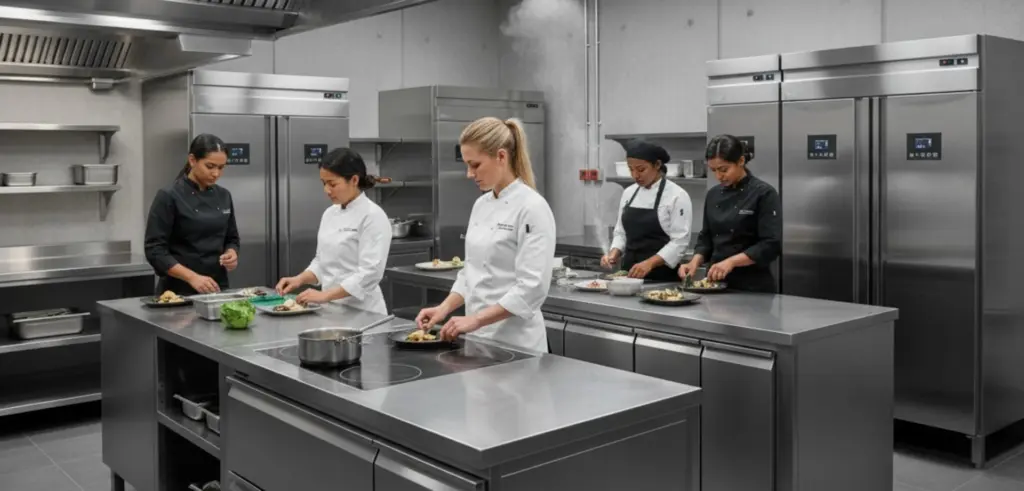




Trends in professional refrigeration in 2026 are changing due to three very specific forces: efficiency and regulation, intelligent control (monitoring and data), and business expectations (flexibility, operational speed and demonstrable sustainability). The practical consequence is that it is no longer enough to “cool well”: the equipment must consume less, be more controllable and sustain a more agile service in kitchen, living room and operations.
The essentials in 30 seconds
- The more realistic “trend”: measurable efficiency (kWh, performance, stability) and standard-ready equipment)
- The kitchen and the point of sale call for control and traceability: temperatures, alarms and maintenance with more judgement.
- The weight of operational formats as dark kitchens and more fragmented production: you need modularity and speed.
- Sustainability is no longer a slogan - you have to be able to explain and justify technical decisions and costs.
- If you buy for business, the winning approach is: sizing well, prioritising reliability and working with a distributor to ensure support.
In this article you will see:
- Which trends in professional refrigeration will be consolidated in 2026.
- What has changed in 2025 and will be decisive in 2026 (regulations, energy, new HORECA models).
- How this impacts on restaurants, gourmet shops, dark kitchens and food halls.
- Proposals for distributors, end customers and manufacturers not to be left behind.
At Coreco Gourmet we work precisely with this idea in mind: that cold ceases to be a line in the quality memory and becomes part of the business strategy of each client.
A new horizon for Professional Refrigeration
The professional refrigeration is experiencing a key moment in the HORECA sector. For years we have talked about energy efficiency, sustainability and better conservation, but in 2026 the context is changing: energy is more expensive, European regulations on energy efficiency are more stringent than ever. Ecodesign, energy labelling and F-Gas hardens, and the hospitality business models are evolving towards dark kitchens, food halls, gourmet experience shops and hybrid retail concepts..
In this article we analyse which trends in the industrial refrigeration What is really changing from 2026 onwards and what restaurants, gourmet shops, central kitchens, etc. should take into account when investing in professional refrigeration and how this also affects the role of distributors and manufacturers.
As a manufacturer with more than four decades of focus on the professional refrigeration for catering and food, Coreco is experiencing this transformation very closely: it works on a daily basis with HORECA distributors, who know their customers with central kitchens and gourmet businesses that need blast chillers, display cabinets, wine cellars y meat maturation cabinets able to respond to this new context.
From the line Coreco Gourmet, The focus is no longer just on industrial robustness and reliability, but on how each refrigeration solution helps to reinforce the customer's gastronomic proposition, optimise their internal organisation and ensure that the investment in refrigeration makes sense in the medium and long term in an increasingly demanding and diverse HORECA.
Many “trends” were not born in 2026... but are now becoming established
If you have been in the professional refrigeration sector for a long time, it is normal to have a feeling of déjà vu. Messages repeat themselves:
- “More energy efficiency”
- “More sustainability”
- “Better preservation and less wastage”.”
- “Equipment better integrated into the design of the premises”.”
And it is true: none of that was born in 2026. The Ecodesign for sustainable product regulation and European energy labelling standards have for years been pushing the market in the direction of more efficient and climate-friendly equipment.
The difference now is not so much in the headline of the trend as it is in:
- The intensity of the economic impact (high electricity bills).
- Regulatory pressure on efficiency and fluorinated gases.
- Consumer maturity, much more eco-conscious and willing to pay more for sustainable options.
- The emergence of new HORECA formats that did not exist a decade ago and require a different cold map.
In other words: the broad outlines of the discourse of the professional HORECA refrigeration are the same... but today they are less optional and much more strategic.
2. Background trends in the professional cold that were already in the background
Before getting into the new, it is worth recognising which trends have been established for years and will continue to be valid in 2026 and beyond.
2.1. Energy efficiency as a minimum standard
From 2021, the European Ecodesign (EU 2019/2024) and energy labelling rules for commercial refrigeration equipment have set minimum efficiency requirements and driven the most wasteful solutions out of the market.
This has led to:
- improve insulation,
- the design of evaporators and condensers is optimised,
- more efficient compressors and controls are introduced.
What years ago was a high-end technical argument, today is mandatory starting point.
2.2. Sustainability and refrigerant changeover
In parallel, the revision of the F-Gas Regulation and EU climate targets have prompted the substitution of many HFCs by natural refrigerants or lower GWP.
As we already told in our article on the industrial refrigeration industry in the face of change, The main objective of the F-Gas regulation is to reduce greenhouse gas emissions by promoting the use of low-GWP refrigerants. R290 and R600a hydrocarbons are viable alternatives that present an environmental advantage by having a considerably lower GWP compared to traditional refrigerants such as HFCs. (values well above 1400). This is in line with the EU's commitment to reduce its carbon footprint and promote sustainability in industry.
This has forced manufacturers and designers to rethink:
- refrigeration circuit designs,
- refrigerant charges,
- safety and handling,
- technical training.
It is not new in 2026, but it is entering a phase in which it is it will be rare to see teams that do not follow this logic.
2.3. Better preservation = less shrinkage = higher margin
The idea that “investing in a good cooling system reduces shrinkage” is not new either, but it is now better quantified: every kilo of product that does not spoil is euros that are not lost. In a context of rising costs of raw materials and energy, the chambers, display cabinets and blast chillers that allow:
- better stabilise the temperature,
- adjust humidity,
- reduce oscillations,
have a direct impact on the income statement of the business.
2.4. Equipment design as part of interior design
In the gourmet channel, hotels, gastronomic restaurants and wine bars, the aesthetic integration of professional refrigeration has been gaining importance for years: materials, lines, lighting, fog-free glass, etc.
The difference with previous stages is that now this is no longer limited to a few “designer” venues: it reaches many proposals of food halls, concept stores and gourmet experience shops.
If you want to learn more about these regulatory and refrigerant changes, you can also consult our resources on F-Gas and energy efficiency on the Coreco Gourmet blog.
3. What really changes from 2026 onwards
From here we get to the interesting part: what is going to take more real weight and how it intersects with the new HORECA.
3.1. Sustainability as a criterion of choice, not as a slogan
Several studies show that an increasing proportion of customers are willing to pay more for restaurants and propositions perceived as sustainable, with premiums ranging from 10 % to 20 % of the price, especially among younger generations.
That means that, for many businesses:
- reduce food waste,
- consume less energy,
- show transparency in processes,
is no longer just a moral or normative obligation: it is a competitive advantage.
And the professional refrigeration is fully part of that equation:
- efficient equipment = less consumption,
- better preservation = less discarded goods,
- durable and repairable solutions = less life cycle footprint.
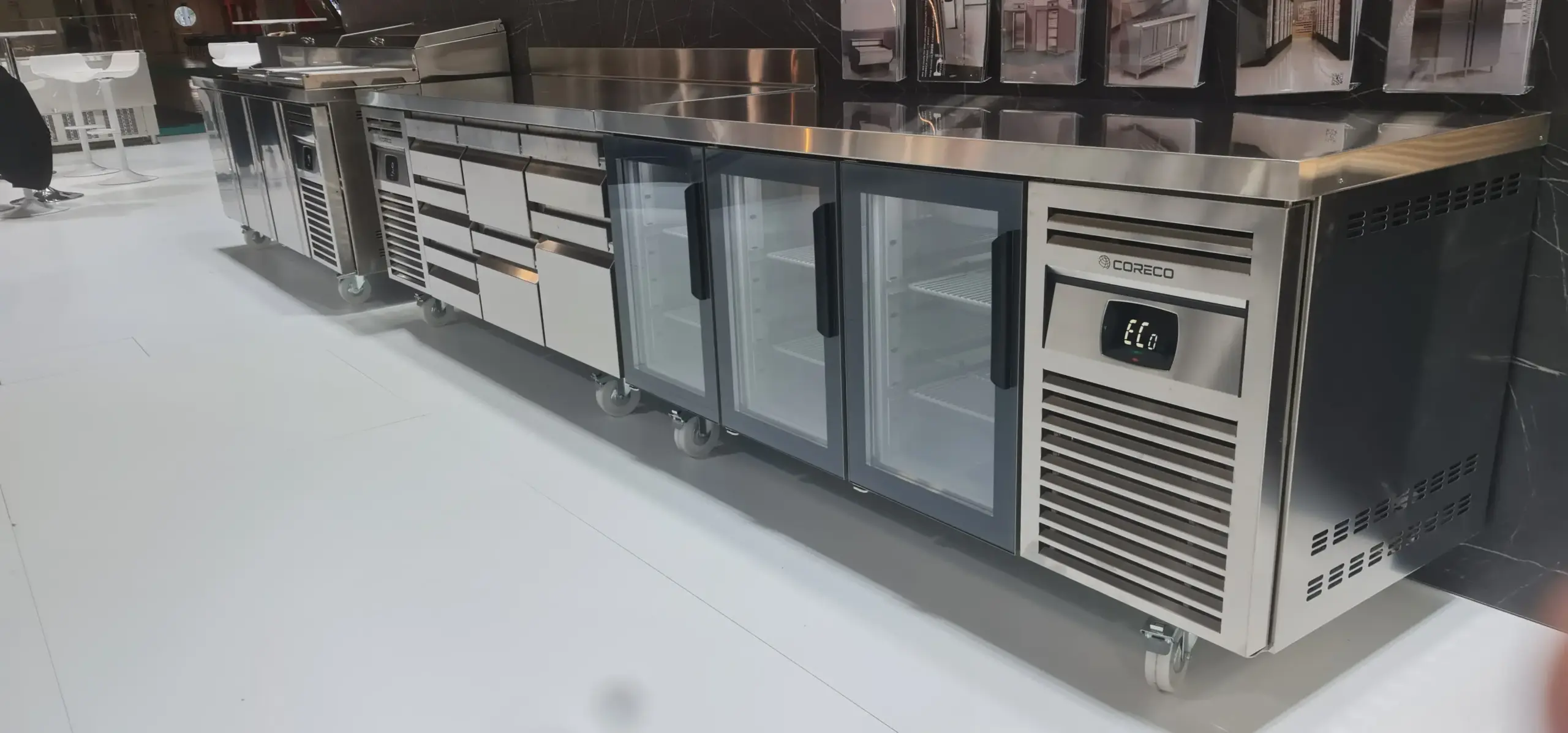
3.2. Digitisation of the back of house and connected kitchen
Digitalisation is no longer limited to reservations or POS. Increasingly, there is talk of connected kitchens: equipment that communicates data on usage, faults, consumption and temperatures, and which is integrated into management platforms.
In the case of professional refrigeration, this translates into:
- remote temperature control,
- alarms in case of deviations,
- automatic registration for audits,
- smarter preventive maintenance.
Not all businesses will use all the advanced features, but increasingly they will require “equipment readiness”, even if they start with basic usage.
3.3. The gastronomic experience at its core: see the cold, don't hide it.
The European hospitality industry is moving towards experiential eatingNot just to eat, but to experience a story, an atmosphere, a setting.
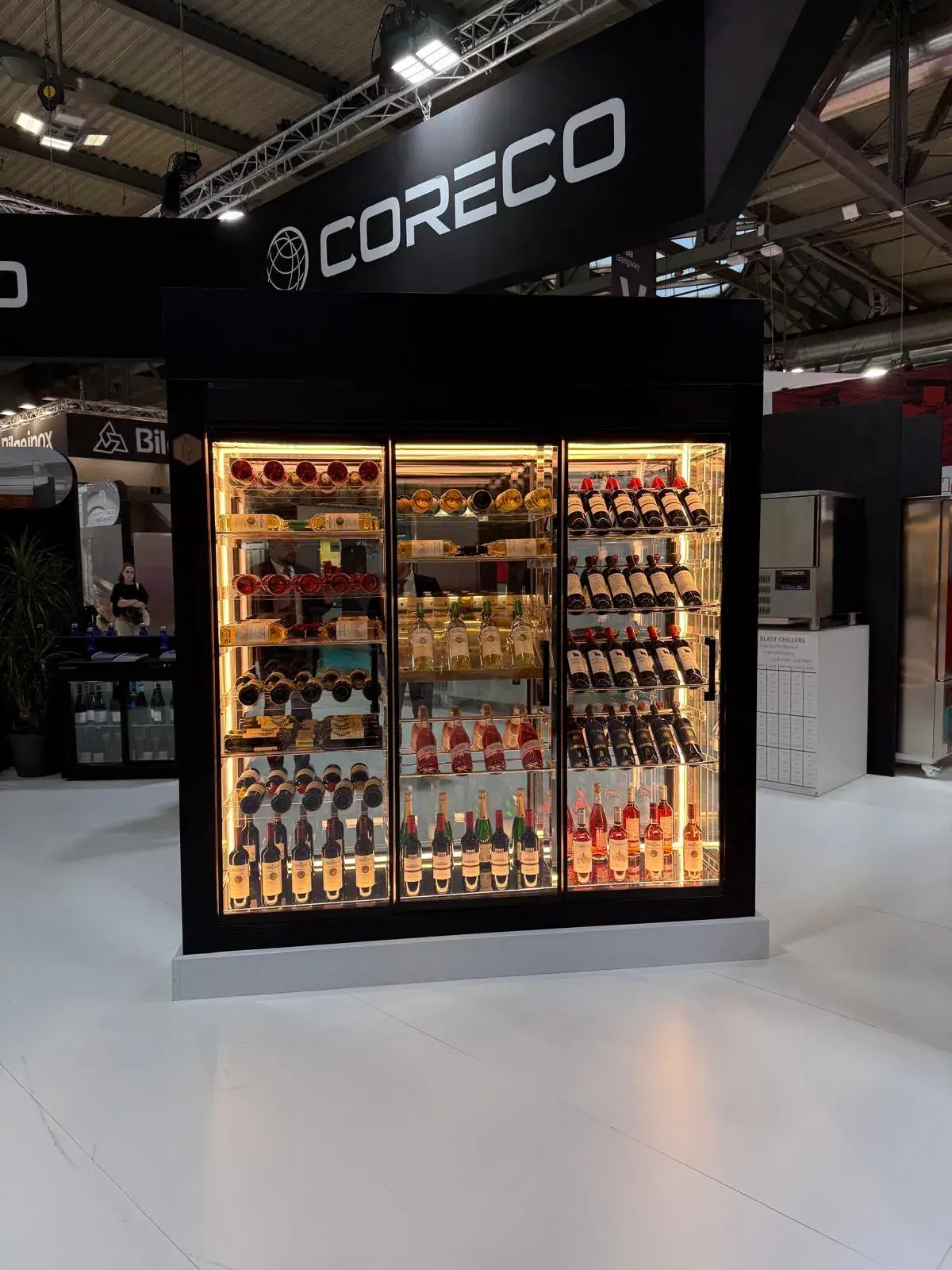
In this context, the professional cold:
- no longer always hidden in the back room,
- becomes part of the storytelling: maturation rooms at sight, product showcases, wine cellars integrated in the room.
This requires equipment:
- visually neat,
- easy to keep spotless,
- with lighting that enhances the product,
- with glazing and finishes in keeping with the level of the concept.
3.4. Multiplication of HORECA formats and hybrid models
The global HORECA market not only grows in volume, but also in format diversitys: expanding into dark kitchens, food halls, advanced delivery models, hybrid retail + tasting proposals and highly specialised concepts (mono-product, wine bars, wellness spaces, etc.).
Each of these formats has its own “cold map”:
- different capacities,
- different product flows,
- various visibility requirements,
- specific combinations of back and front.
From 2026 onwards, the discussion is no longer generic (“efficient cold”) but much more concrete: what combination of equipment these new concepts need in order to function well.
If you are a HORECA distributor and want to get ahead of these professional refrigeration trends, we can support you in creating the right industrial refrigeration ecosystem for your customers. Contact the Coreco Gourmet team and let's talk about your projects.
4. New HORECA concepts and their impact on professional refrigeration
Let's land how these models affect the design of chambers, cabinets, blast chillers, maturation rooms, cellars and display cabinets.
4.1. Dark kitchens and virtual brands: power, compactness and control
The dark kitchens / Cloud kitchens have established themselves as a key model linked to the growth of delivery in Europe.
Its features:
- small and expensive spaces,
- several brands sharing a kitchen,
- very high dependence on peak demand,
- almost no interaction with the customer in the lounge.
What do they ask of the professional cold?
- High-capacity chambers and cabinets on a compact floor plan.
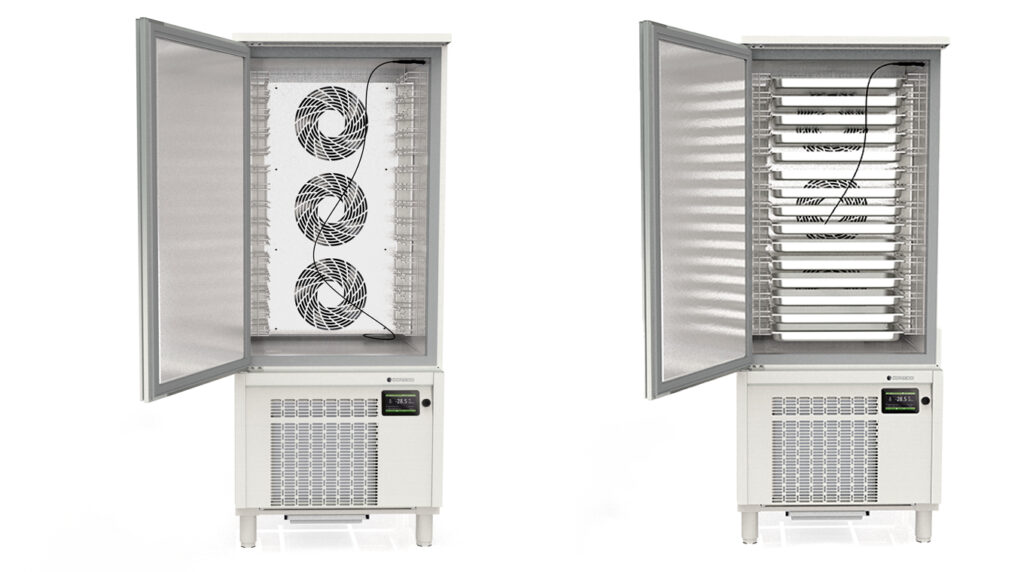
- Temperature Chillers that allow working in large batches and ensure food security in forward production.
- Very clear product flows: reception → chamber → preparation → blast chiller → storage → dispatch.
- Robust, easy-to-clean equipment with convenient access to critical components.
- Preferably, remote monitoring of temperatures and alarms to avoid massive invisible losses.
4.2. Food halls and gastronomic markets: modularity and visual harmony
The food halls and food markets bring together very different concepts in the same space: from premium burgers to sushi, bakery, Latin cuisine, speciality cafés and cocktail bars.
Implications for cold:
- need for solutions modulars that can be relocated or changed of use,
- relatively neutral but careful aesthetics that do not clash with diverse identities,
- display cases and display walls with a high level of visibility and accessibility,
- possibility of shared or multi-user cameras, with intelligent compartmentalisation.
The key word here is flexibility, without sacrificing durability and regulatory compliance.
4.3. Gourmet experience shops: cold as the centrepiece of the window display
More and more gourmet shops are operating as mixed spaces:
- sale of delicatessen products,
- tasting at the bar or at tables,
- tastings, small events and pairings.
These are premises where the customer buys product + story + staging.
In this context, professional cold has a dual role to play:
- Preserving at the highest level: cheeses, cured meats, meats, fish, pastries, chocolates, wines... each category with its own parameters.
- Communicating valueThe wine cellars show selection and order, the refrigerated murals invite you to explore, the display cabinets almost resemble jewellery boxes.
Here, a badly placed camera or a poorly lit display case not only preserves worse: breaks the gourmet discourse.
4.4. Wellness, health-focused and plant-based restaurants
Foodservice oriented towards health, wellness and more plant-based products continues to grow, with a focus on:
- fresh ingredients,
- homemade preparations,
- toppings and bases that regenerate during the day,
- menus that should appear light and “alive”.
For the professional cold this means:
- chambers and cupboards with a high turnover of fresh produce,
- great importance of the blender to ensure the safety of sauces, bases and preparations,
- refrigerated display cabinets designed for service lines (salads, bowls, cold dishes),
- special attention to product visibility and internal tidiness.
The challenge is to preserve and organise well without losing the feeling of extreme freshness that the customer expects.
4.5. Mono-product and ultra-specialised concepts
Gourmet fried chicken, smash burgers, bars focusing on wine, desserts, cheese or seafood, and so on. These ultra-specialised concepts are spreading all over Europe and have a particularity: live and die by the perceived quality of one type of product.
Therefore, the cold associated with that product:
- has to be finely tuned,
- often combines back and front (preparation chambers + showcases or ripening rooms),
- it must be scalable: easy to replicate the equipment mix if the concept opens up new premises.
Here, professional refrigeration is not a support: it is one of the most important pillars of the brand promise.
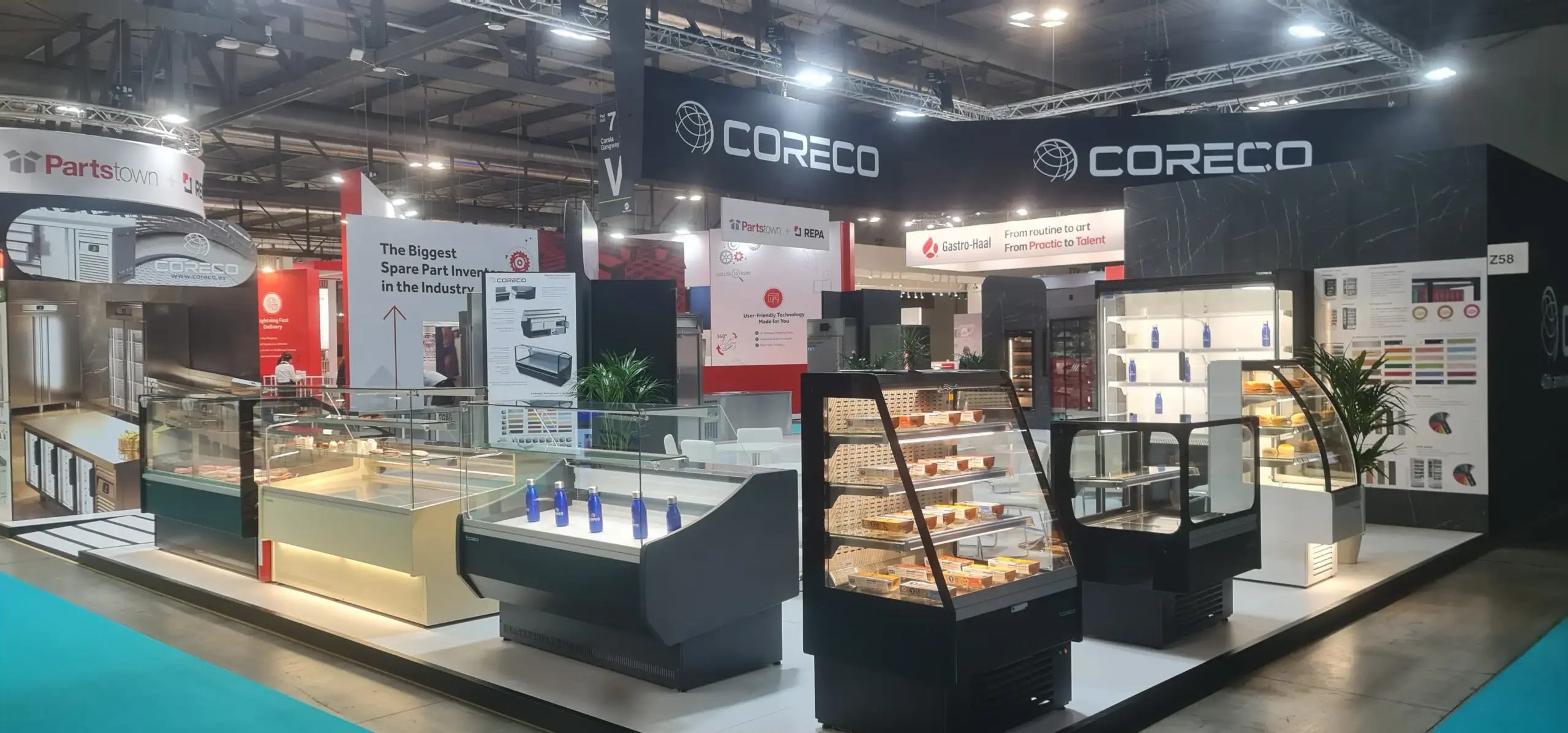
5. What a cold equipment that wants to be alive in 2030 must bring to the table today
If a business is going to invest now in chambers, cabinets, cellars or blast chillers, the question cannot be the same as it was in 2010. It has to be:
“What do I demand from this team to accompany my business model for the next 5-10 years?”
5.1. Adaptability to charter and model changes
Most businesses are no longer static:
- expanded charter,
- delivery,
- test events,
- mix retail and catering.
The cooling equipment must allow:
- reconfigure interiors (shelves, guides, GN),
- change part of the use (e.g. from simple storage chamber to semi-viewing chamber or from support to display cabinets),
- be integrated into possible reforms without becoming incompatible.
5.2. Decade-long regulatory preparedness
Under the current framework of Ecodesign, energy labelling and F-Gas, The business cannot risk buying something that will be out of business in a few years.
Therefore, when choosing refrigerators, display cabinets or wine cabinets, it makes sense to ask questions:
- What refrigerant do you use and what is your regulatory horizon?
- Does it already meet the efficiency limits required for new equipment?
- Is there transparency about its efficiency and consumption rate?
5.3. Basic data and simple alarms
Not every venue wants “Big Data from the cold”, but they do want to avoid surprises:
- basic temperature recording,
- open door or serious fault alarms,
- option to connect to monitoring systems as the business grows.
This not only helps to avoid losses due to incidents; it also simplifies internal and health audits.
5.4. Coldness that adds to the experience, not subtracts from it.
In gourmet concepts, high-end restaurants or experience spaces, cooling must also fulfil an aesthetic function:
- well-lit showcases,
- clean and non-fogged windows,
- integration into the design of the premises,
- a sense of order and neatness.
A poorly designed cabinet or camera can contradict the message of quality that the rest of the room is trying to convey.
5.5. Work organisation and stress reduction
Last but not least: a good professional refrigeration system helps to better organise production:
- allows you to make mise en place calmly and safely,
- reduces the stress of high volume services,
- facilitates the separation of room and delivery flows,
- frees up operating space at the bar and in the kitchen.
Here the temperature controller becomes a central part of many models: without it, it is difficult to work reliably on advanced productions and complex letters.
6. The new role of the HORECA distributor: from selling machines to designing refrigeration ecosystems.
In this scenario, the specialised distributor becomes more than just an intermediary: he becomes a partner that helps define the cold ecosystem of each business.
6.1. Understanding the business model rather than the catalogue
The distributor who generates the most value is not the one who recites references, but the one who asks questions:
- What is the weight of delivery in your turnover?
- Are you considering incorporating in-store sales?
- How many strong services do you have per day?
- Do you want part of the product to be visible from the living room?
From there, it builds a proposal for:
- chambers,
- wardrobes,
- downdraft facilities,
- showcases,
- caves,
that makes sense for that particular model, not a generic list.
6.2. Translating technical to business impact
The key is to move from:
- “this unit has such and such compressor, so many watts and such and such gas”.”
a:
- “This equipment will reduce your consumption by approximately X % compared to what you have now”,
- “You will throw away less product thanks to this temperature stability”,
- “You will be able to showcase this product in a much more attractive way”.
That is to say: translating specifications into results.
6.3. Anticipating trends and avoiding short-sighted decisions
A good distributor also protects the customer from:
- buy something on the cheap that will be out of compliance or out of regulation in a short time,
- oversizing equipment unnecessarily,
- choosing solutions that are inconsistent with business developments.
In a HORECA market that is growing but becoming more competitive and saturated, this advisory role is key.
In the Coreco Gourmet blog we continue to analyse how industrial refrigeration is evolving in the HORECA channel and what implications it has for professional teams. If you want to keep up to date, save this page and come back to visit us: the next articles will delve into specific solutions for dark kitchens, gourmet shops and food halls.
7. The role of the manufacturers: cold thought for the HORECA of the future
For manufacturers of industrial refrigeration and professional refrigeration the challenge is twofold:
- Technological and regulatory: design efficient equipment, compatible with future refrigerants and aligned with Ecodesign and labelling.
- Conceptual and design: understand that their machines are part of complex ecosystems and increasingly sophisticated gastronomic proposals.
7.1. Specific ranges by product type and business model
It will make less and less sense to talk about:
- “a wardrobe for everything”,
- “a standard camera”.
And more of:
- specific solutions for matured meat,
- display cabinets for bakery or ice cream parlour,
- wine cellars for wine and premium beverages,
- cabinets for drying sausages,
- equipment designed for back of dark kitchens,
- aesthetic lines for gourmet shop fronts.
7.2. Digital integration and connected services
It's not just about adding an IoT module:
- facilitate easy integrations with monitoring platforms,
- provide clear documentation of data and alarms,
- support distributors and large customers in the implementation of connected kitchens.
8. Conclusion: professional refrigeration as an infrastructure for the new HORECA
In short: many of the ideas that we hear about professional refrigeration for HORECA have been on the table for years. But the 2026-2030 context puts them on a different level:
- energy is more expensive,
- European standards are more demanding,
- the end customer values and rewards sustainability,
- HORECA models are much more diverse and complex.
In this scenario, the cold is no longer “an unavoidable cost”, but an "unavoidable cost". business infrastructure:
- conditions which card you can hold,
- What a waste you are,
- how coherent your experience in the courtroom is,
- how much you can grow in delivery, events or retail,
- and what real margin each line leaves you.
For this reason, talk of trends 2026 in professional refrigeration is not just about new technologies, but about something deeper: understanding what kind of hospitality we want to build, and what cooling systems we need to make that model profitable, sustainable and credible for years to come.
For distributors, manufacturers and HORECA operators, the opportunity lies precisely there: in moving from selling or buying “fridges” to designing and building "refrigerators". cooling ecosystems that keep pace with real business developments.
Checklist 2026: how to choose professional refrigeration without getting it wrong
Efficiency and costs
- Am I clear on the objective: to reduce consumption, increase capacity, improve stability or reduce waste?
- I compare teams by criteria measurable (estimated consumption, stability, recovery, insulation, control).
- I evaluate the total cost: energy + maintenance + downtime + lifetime (not just the price).
Actual operation
- The equipment fits my flow: openings/service, loading, replenishment, cleaning, peaks.
- The solution is modular and scalable if the business grows or the format changes.
Control and traceability
- Temperature control is clear, stable and easy to audit (if applicable).
- There is an alarm/monitoring option to prevent incidents (if the environment requires it).
Service and network
- I have defined who installs, who maintains and in what timeframe they respond (SLA).
- I confirm availability of spare parts and support through distributor.
Sustainability (without posturing)
- I can explain why this equipment reduces impact: consumption, coolant, durability and maintenance.
- Documentation ready: data sheets, manuals, good practices for use.
Frequently Asked Questions (FAQ)
1) What is the most important trend of 2026 in professional refrigeration?
The combination of efficiency + controlThe new technology: equipment that consumes less energy and, at the same time, allows for more stable operation, data and better planned maintenance.
2) What should I look at first if I want to reduce my electricity bill?
Correct sizing, type of use (peaks/openings), insulation/doors, control and operating habits. Actual efficiency often comes from equipment + use, not only from the token.
3) Is “monitoring” worthwhile for a HORECA business?
It depends on the risk: if an incident costs you product/service/image, monitoring (alarms/logging) may compensate. If your operation is simple, robust monitoring and good routines may suffice.
4) What changes with dark kitchens and more fragmented production?
More value is placed on modularity, The key criteria are: the speed to keep pace and solutions that can withstand intensive cycles. The key criterion is: the equipment adapts to the flow, not the other way around.
5) How do you demonstrate “sustainability” in a serious way?
With decisions that can be justified: consumption and performance, durability, planned maintenance, and technical documentation. Better “less kWh and fewer incidents” than generic claims.
6) What is the role of the distributor in the absence of direct sales?
It is the part that turns the equipment into a real solution: advice on sizing, correct installation, support and continuity. The important thing is to work with a network that guarantees responsiveness.
7) How do I know if I am oversizing or undersizing?
Look at actual peaks, product rotation, openings, ambient temperature, daily load and targets (storage vs. display). If in doubt, ask your distributor for a proposal with clear criteria and assumptions.
8) What should a “well-made” professional refrigeration proposal include?
Need, context of use, assumptions, recommended model, why it fits, installation requirements, maintenance plan and support conditions. Without that, it is easy to get it wrong.
Glossary (key terms)
- HORECA: hotels, restaurants and catering; professional use environment with peaks and high operational demands.
- Cold chain: continuous maintenance of safe temperatures from storage to service.
- Energy efficiency: cooling capacity with lower consumption; it should be evaluated in real use, not just in theory.
- Temperature control: temperature management and stabilisation system; key to quality and safety.
- Monitoring/telemetry: logging and alerts (temperature, faults, doors, etc.) to prevent incidents.
- Preventive maintenance: planned overhauls to avoid downtime and extend service life.
- Predictive maintenance: fault anticipation from data/usage (when sensorisation is present).
- Dimensioning: adjust equipment capacity and configuration to actual usage (product, turnover, peaks).
- Modularity: possibility to grow or adapt the solution by modules without redoing everything.
- Recovery time: speed with which the equipment returns to range after openings or charging.
- Refrigerated display: equipment designed to display product while maintaining temperature and aesthetics.
- Dark kitchen: delivery/production oriented kitchen, with intensive rhythms and specific needs.