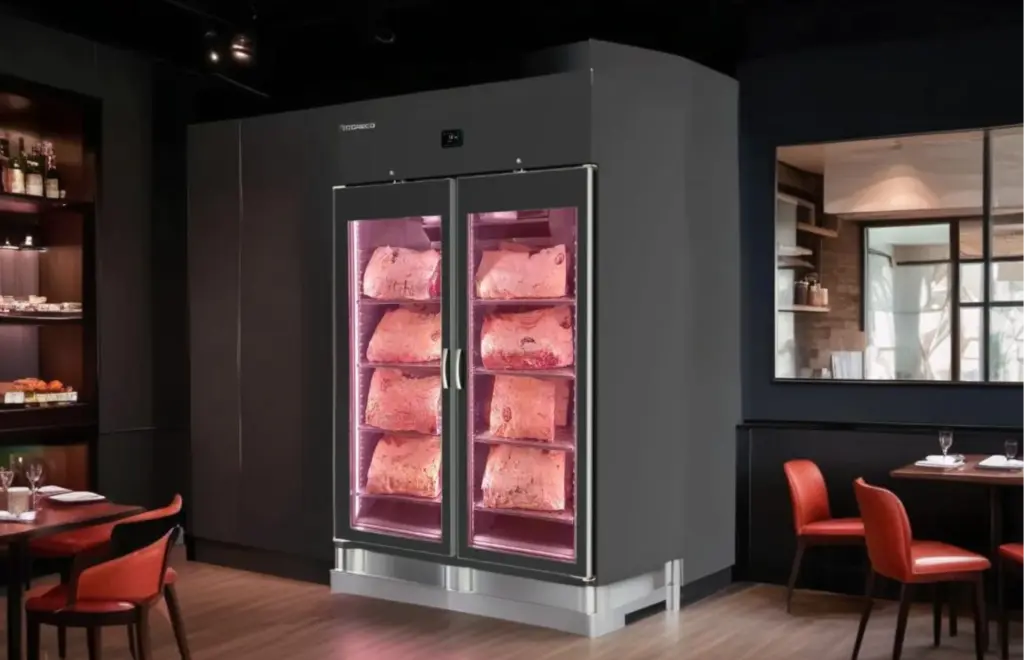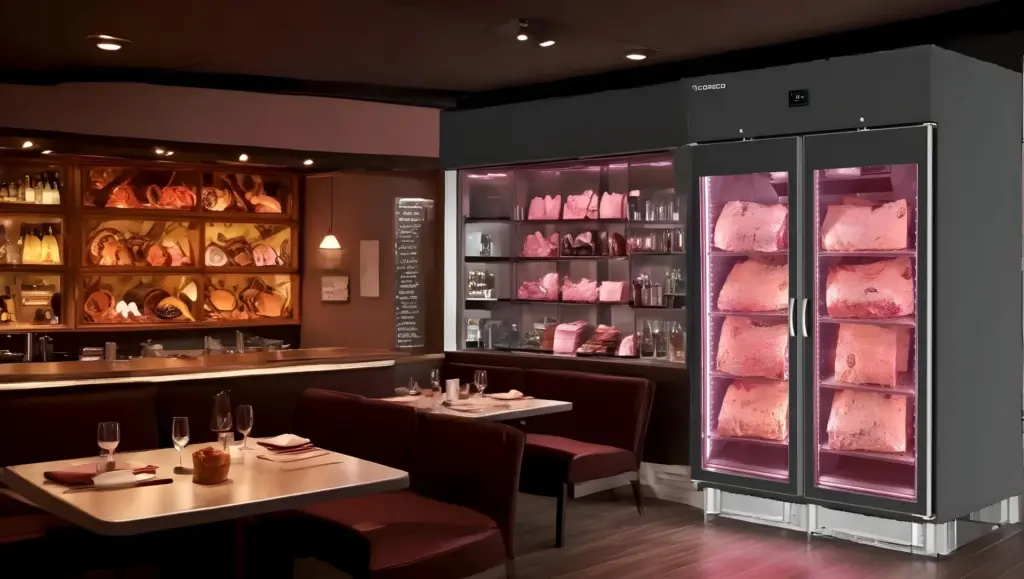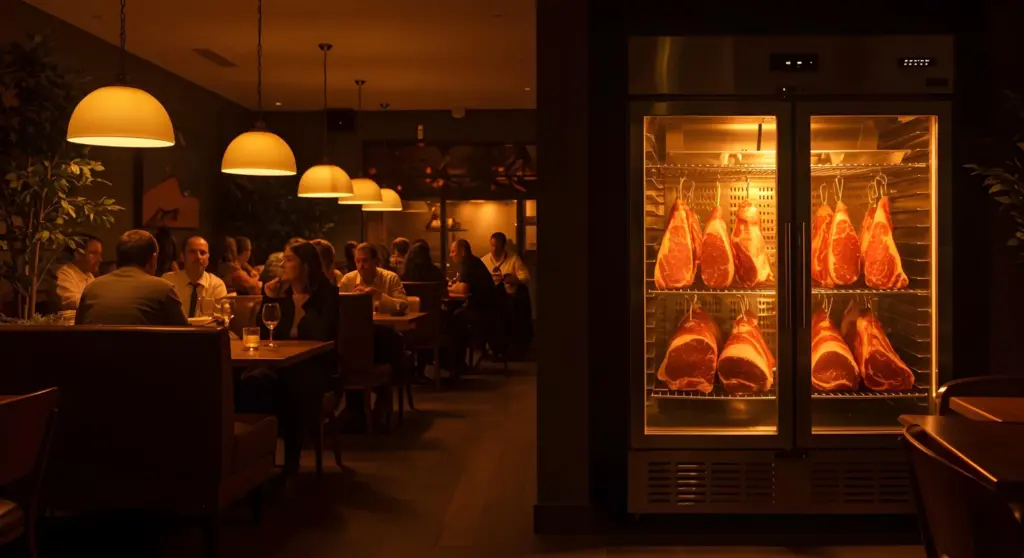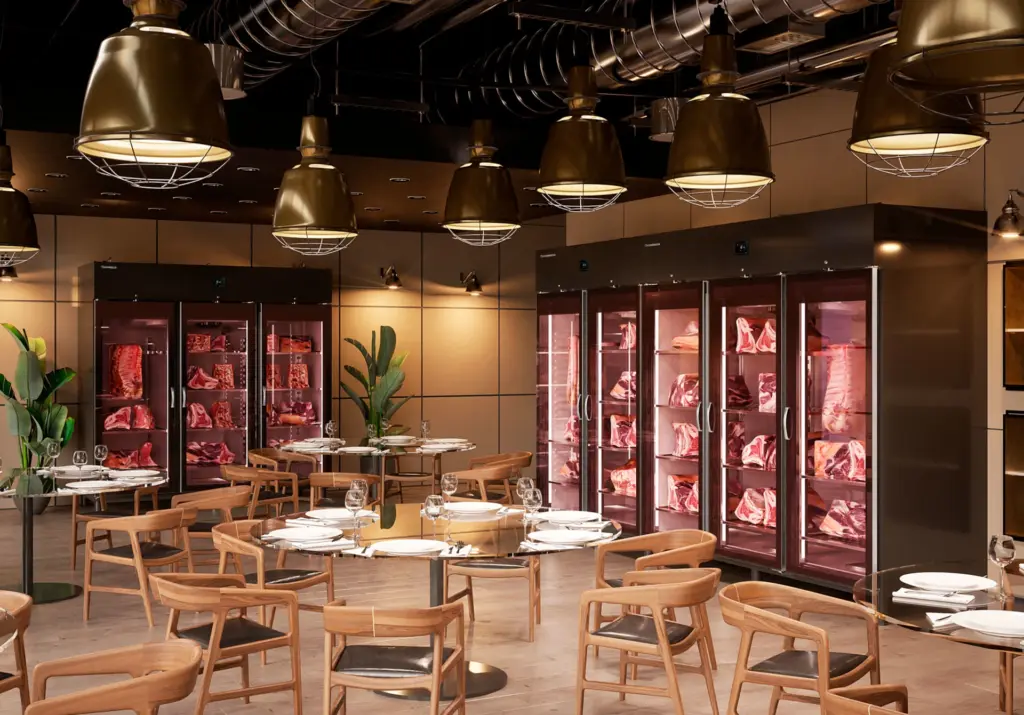




The meat ageing in restaurants It requires a systematic approach. It is not enough simply to include dry-aged meat on the menu or to install a display cabinet in the dining room. To handle this product professionally, the restaurant must organise its procedures for quality control, hygiene, handling and monitoring.
Quick reply
Best practice in meat ageing helps restaurants to operate with greater control and less improvisation. The aim is not to complicate operations, but to define what needs to be checked, who checks it, and how consistency is maintained between the kitchen, front of house, cleaning and product monitoring.
In a nutshell
- Maturation should be incorporated into the restaurant’s daily routine.
- Daily monitoring prevents hasty decisions.
- Cleaning is part of the process; it is not a secondary task.
- The kitchen and living room should follow a common design theme.
- The supplier and the installer can help to organise the practical use of the equipment.
Who is it aimed at?
This article is intended for restaurants, steak houses, hotels, distributors, installers and technical managers who already work with or wish to work with matured meat in a professional setting.
This isn’t a guide to choosing a wardrobe. For that, you should read the article on maturation cabinet for restaurants.
The focus here is different: how to manage the day-to-day aspects of maturation more effectively.
The maturing process does not end once the equipment has been installed
One of the most common mistakes is to think that the curing process is complete once the cupboard has been fitted.
Equipment is important, but the process doesn’t run itself. Matured meat requires a professional routine: checking, recording, cleaning, handling correctly and ensuring a minimum level of coordination between those involved.
In our experience, when a restaurant gets that routine right, everything becomes clearer:
- The kitchen knows which product is available;
- Sala understands what she can explain to the client;
- The maintenance team knows which points to check;
- management can better assess the actual turnover;
- The distributor or installer can provide support with further context.
What does it mean to foster maturity through best practice?
Working in line with best practice does not mean adding unnecessary red tape. It means reducing uncertainty.
A best practice is any guideline that helps keep the process under control: how parts are positioned, when they are checked, who cleans them, how an incident is reported, or what information the floor team needs to know.
In the meat ageing in restaurants, these criteria are particularly important because the product has gastronomic, economic and visual value.
How Master Ageing Controller helps with day-to-day monitoring
In CORECO Gourmet ageing cabinets, the Master Ageing Controller helps to monitor the essential parameters of the process and facilitates a more controlled ageing process. In the day-to-day running of a restaurant, this does not replace equipment checks or cleaning routines, but it provides a technical foundation for working with less improvisation.
For kitchen staff, front-of-house staff and technical managers, the key is to understand that technology is helpful when it forms part of a process: identifying items, monitoring openings, checking the condition of the cupboard and reporting any issues in good time.
Points to bear in mind in everyday use
1. General condition of the wardrobe
The restaurant should carry out a visual check of the general condition of the equipment and the produce. This does not involve carrying out a complex technical inspection every day, but rather identifying any obvious changes or situations that warrant further attention.
Key points:
- internal order;
- visible cleanliness;
- doors are closed properly;
- positioning of the parts;
- the absence of elements unrelated to the process;
- normal operation of the equipment;
- any changes that stand out.
If something doesn’t seem right, it is best to make a note of it and consult the relevant person within the organisation, the installer or technical support via the appropriate channel.
2. Fitting the parts
The positioning affects product tracking and internal air circulation.
It is advisable to avoid loading items haphazardly. Items must be arranged in an orderly manner, with sufficient space between them, and in accordance with the guidelines set out by the restaurant and the technical documentation provided.
Not all ingredients are prepared in the same way. That is why the kitchen team must be clear about what goes in, when it goes in, and for what culinary purpose.
3. Monitoring of openings
In a restaurant, the pace of service can mean that the cupboard is opened more often than necessary. This can affect the stability of the environment.
It is not a question of preventing the normal use of the equipment, but of using it sensibly:
- avoid unnecessary openings;
- organise the loading and collection of goods;
- do not use the cupboard for extra storage;
- to ensure that their role within the operation remains clear.
A maturing cabinet should not be used as a storage unit for just any product.
4. Hygiene and cleanliness
Cleaning arrangements must be agreed upon from the outset.
In a dry-aged environment, hygiene cannot be left to “whenever there’s time”. It must form part of the restaurant’s routine and be tailored to the actual use of the equipment.
It is advisable to define:
- who does the cleaning;
- when it is cleaned;
- which parts are checked;
- which products or methods are compatible with the manufacturer’s documentation;
- which incidents must be reported;
- which tasks require technical support or professional review.
To find out more about this, you can consult the guide on Cleaning a Dry Aged cabinet.
5. Product tracking
Every restaurant must have a clear way of knowing which cut is being prepared, since when, and for what purpose.
It can be done using a simple system, but there must be one in place.
The minimum information that should be monitored:
- date of entry;
- type of part;
- supplier or internal batch, where applicable;
- position within the cupboard;
- intended destination;
- person responsible for monitoring;
- relevant comments.
It is not a question of creating an excessive administrative burden. It is a question of ensuring that the process does not rely solely on the team’s memory.
The kitchen and living room should be designed to the same standard
Matured meat isn’t just for the kitchen. In many restaurants, it’s also explained to diners in the dining room.
That is why it is important for the kitchen and front-of-house staff to speak the same language. The front-of-house team does not need to become experts, but they must be able to describe the dishes clearly and without exaggeration.
Ideas worth sharing:
- What is matured meat?;
- why the restaurant runs it;
- what it brings to the culinary offering;
- why is it on display, if the cupboard is visible;
- What is the difference between preserving and maturing?.
If the team needs a simple starting point, it can refer to the article on Dry Aged meat maturation.
Common operational errors
Using the cupboard for other items
A maturing cabinet must serve a specific purpose. Using it as additional storage space can lead to clutter and make it difficult to keep track of contents.
Failure to identify the parts
If you do not know when a part arrived or where it is going, the process gets out of control. Identification does not have to be complex, but it must be consistent.
Improvising the cleaning
Cleaning must be assigned and scheduled. If no one knows exactly who is responsible, when it is done or what is checked, the routine breaks down.
Opening the cupboard at random
Openings are part of normal usage, but it is best to avoid them when they serve no purpose. In the boardroom, moreover, particular care should be taken when using them.
Giving the customer too much information
The tasting room should explain the product in a natural way, without turning the ageing process into an overly technical discussion or an exaggerated sales pitch.
Failure to report incidents
If your kitchen detects something unusual and fails to report it, the problem may get worse. A minor incident, noted in good time, helps you make better decisions.
Key information before organising your routine
Before setting out best practices, the restaurant should clarify the following points:
| Data to be checked | Why it matters |
|---|---|
| Type of meat processed | Helps with organisation, tracking and handling |
| Usual volume of parts | Load conditioning, cleaning and monitoring |
| Location of the cupboard | It affects access points, the lounge, the kitchen and maintenance |
| In-house manager | Make sure control doesn’t depend on everyone and no one |
| Frequency of use | It affects openings and cleaning |
| Paper in the letter | Helps to coordinate the kitchen and dining room |
| Team formation | Minimise incorrect or exaggerated explanations |
| Installer support | It helps to answer questions about use and maintenance |
For distributors and installers
For a distributor, this article can help explain something important: selling a maturing cabinet doesn’t end with the delivery of the equipment. Professional customers need to understand how they are going to use it.
Useful questions to ask before closing a project:
- Who will be the internal lead for the process?
- Will the cupboard be in the living room or the kitchen?
- Which pieces will we be working on?
- What turnover does the restaurant expect?
- How will each piece be identified?
- What cleaning routine will be followed?
- Does the front-of-house team need a basic explanation of the product?
- What information should the restaurant check in the manufacturer’s documentation?
- What points should the installer check during commissioning?
For the installer, the key is to check that the equipment can be used and maintained correctly in the actual space. Access, location, opening, ventilation and maintenance are practical points that should be checked before the project is finalised.
CORECO works through distributors and installers. In development projects, the professional channel helps to turn a culinary concept into a clear, reliable and sustainable operational model for the day-to-day running of the restaurant.
You can view the range of CORECO Gourmet meat maturing cabinets or expand on the general criteria in the article on Meat ageing cabinets for professional use.
Checklist of best practices for restaurants
Before preparing matured meat, it is advisable to check:
- The cupboard has a clear purpose.
- It is not used as auxiliary storage.
- The parts are correctly identified.
- There is one person responsible for monitoring this.
- The cleaning routine has been finalised.
- The kitchen and living room form a coherent whole.
- Decisions on openings are made on a case-by-case basis.
- Incidents are recorded and reported.
- The fitter has checked the location and accessibility.
- The team refers to the technical documentation where appropriate.
- The distributor is aware of the customer’s actual usage.
Technical closure
The meat ageing in restaurants It works best when the process is well-organised. The team is important, but so too are routine, hygiene, monitoring and internal coordination.
A restaurant that uses dry-aged meat sensibly doesn’t just need a suitable cabinet. It needs to know how it is going to use it, who is going to manage it and how it is going to integrate that product into its day-to-day service.