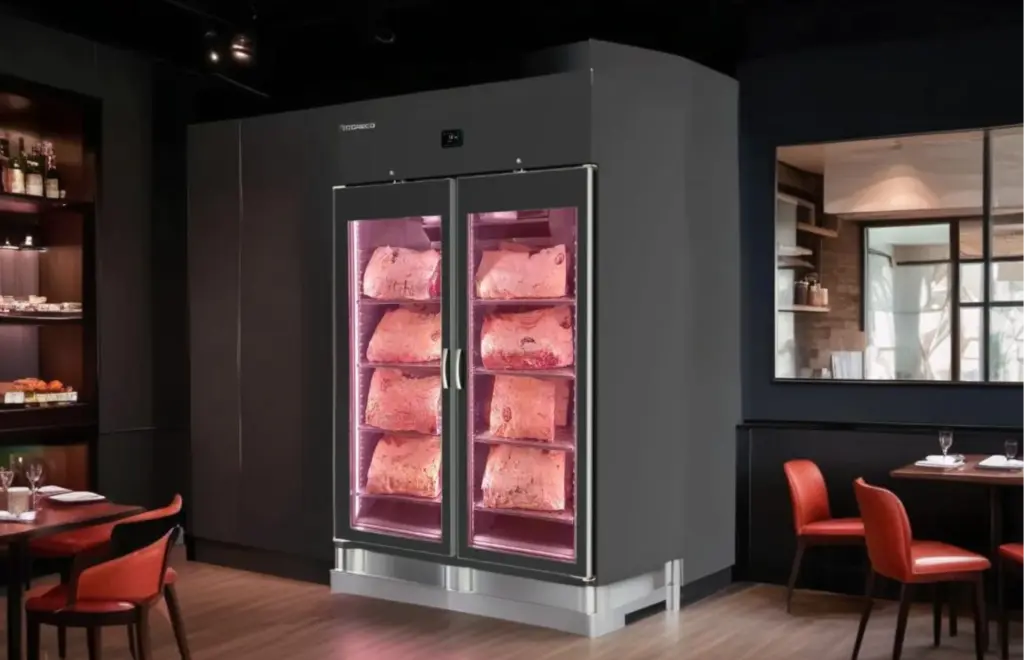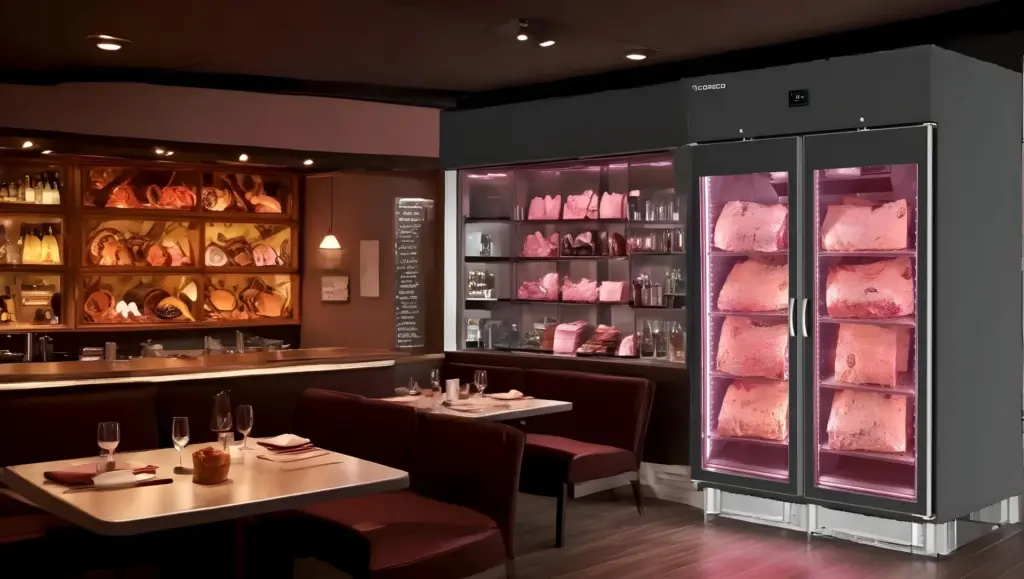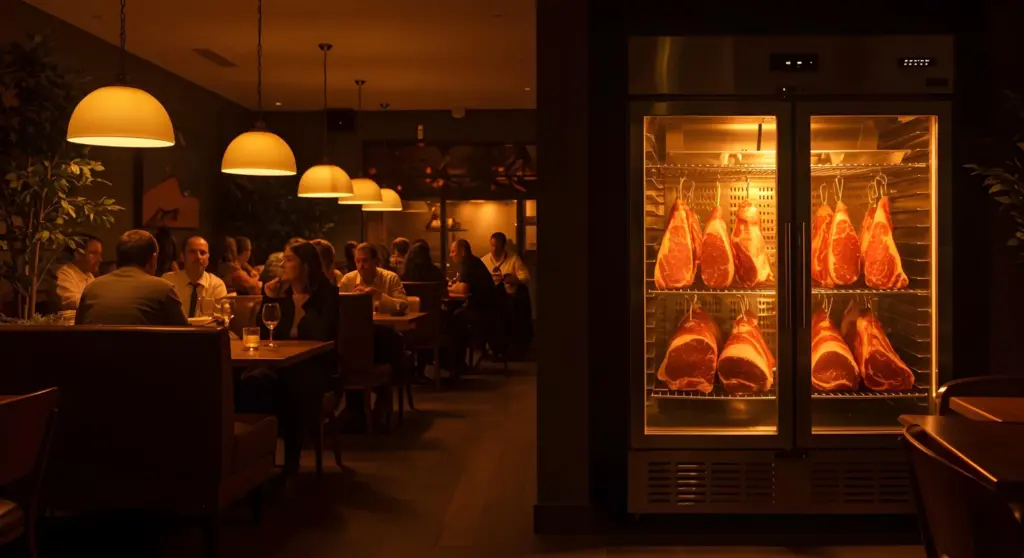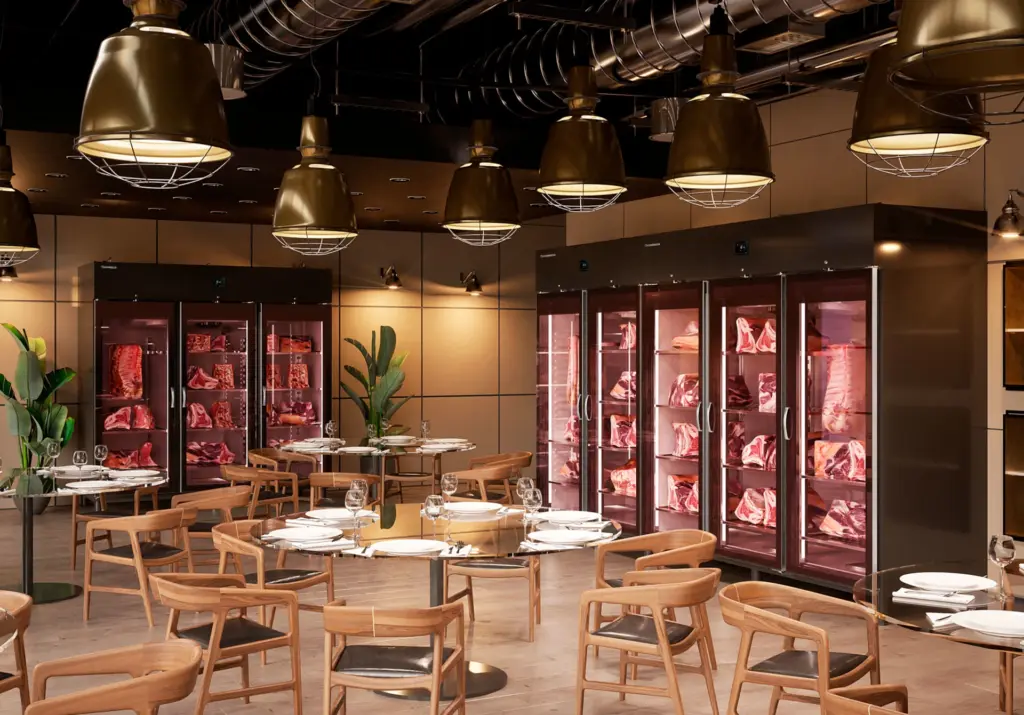




The matured meat display It can help customers better understand the value of the product before trying it. In a restaurant or specialist butcher’s, a clearly visible display cabinet does not “sell itself”, but it can support the professional explanation when the product, the dining area and the staff all work in harmony.
Key data
A display of matured meat is no substitute for expert guidance. The display cabinet helps to showcase the product, but its true value is conveyed through the process, quality control, hygiene and a team that knows how to explain it.
Quick reply
A display ageing cabinet helps to showcase the meat, organise the product narrative and reinforce the perception of control. Its value lies not only in attracting attention, but also in making visible a process that the restaurant or butcher’s shop must be able to explain clearly.
In a nutshell
- The cupboard is no substitute for the sales, front-of-house or counter staff.
- A clear presentation helps when the product is explained properly.
- Visibility must go hand in hand with cleanliness, tidiness and consistency.
- In a restaurant, it can enhance the customer experience.
- In a butcher’s shop, it can boost specialisation and build trust.
Who is it aimed at?
This article is intended for distributors, fitters, restaurants, specialist butchers, hotels, steak houses and HORECA professionals who wish to understand the visual and commercial role of the maturing cabinet.
This is not a guide to choosing equipment. For that, you should refer to the article on maturation cabinet for restaurants or the general guide on Meat ageing cabinets for professional use.
A visible wardrobe doesn’t sell on its own
It is worth setting the record straight on a common misconception: a maturing cabinet does not sell on its own.
It can catch the eye. It can spark a conversation. It can convey expertise. But it needs context.
The customer needs to understand what they are looking at:
- what sort of meat it is;
- why it is maturing;
- what the process achieves;
- how it fits into the menu or the butcher’s range;
- What is the difference between storing meat and maturing meat?.
Where such an explanation exists, the display of matured meat is helpful. Where it does not, the cabinet may remain an eye-catching feature, but one that is underused.
Technical control is also part of what is shown
When a dry-ageing cabinet is on display in a dining room or at a counter, it doesn’t just showcase meat. It also showcases a way of working. In CORECO Gourmet dry-ageing cabinets, the Master Ageing Controller helps to control the essential parameters of the process, providing a technical foundation for the product on display.
For restaurants or butchers, this allows them to explain aged meat in a more informed way: it is not just a visually appealing cut, but a product that has been prepared in a controlled environment and designed for professional use.
What are the benefits of aged meat?
1. It makes the product stand out
Matured meat has a striking visual appeal. Whether in a restaurant or a butcher’s shop, displaying it can help customers appreciate the work that goes into the product.
But the display must be well-organised. An open-fronted cabinet requires careful attention to the arrangement of the items, cleanliness, the lighting of the space and the message accompanying the product.
2. It helps to explain the process
The ageing process can be difficult to understand for a customer who is not familiar with dry-aged meat.
The cabinet makes it easy to track the process:
- This meat is not simply stored;
- is in a controlled environment;
- has a development time;
- is part of a specific culinary concept.
If you need an introduction, you can follow the link to the article on Dry Aged meat maturation.
3. Reinforces the sense of control
Displaying the product in a specific cabinet can convey a sense of order and specialisation. But that impression only works if the equipment is clean, well-positioned and in keeping with the space.
A cupboard that is visible but in poor condition, poorly positioned or used as an extra storage space can have the opposite effect.
4. Assist with front-of-house or counter duties
In a restaurant, the display cabinet can help the front-of-house team explain the menu. In a butcher’s shop, it can help the butcher discuss cuts, ageing and culinary uses.
The key is for the team to communicate in a simple, technical and natural way. There’s no need to exaggerate. It’s enough just to explain things clearly.
Restaurant and butcher’s shop: different uses of the display area
The display of matured meat does not serve exactly the same purpose in every shop.
| Restaurant | Specialist butcher’s shop |
|---|---|
| Enhance the customer experience | Strengthens specialisation and advisory services |
| It can be integrated into a room | It can form part of the counter or sales area |
| Help explain the letter | Helps to explain pruning and ripening |
| It has both culinary and visual appeal | It has technical, visual and commercial value |
| This requires coordination with the kitchen and front-of-house staff | Requires product knowledge and customer service skills |
In both cases, the display cabinet must be suited to the business’s actual use. The display should not be treated as decoration, but as part of a way of working and presenting the meat.
What you need to know before displaying matured meat
Before installing a freestanding wardrobe, it is worth checking a few things.
Which product is going to be displayed?
Not every item has the same visual appeal or the same significance within the product range. The business needs to know what it wants to showcase and why.
What message is going to be conveyed?
The demonstration should be accompanied by a simple explanation. If the customer asks a question, the team should answer confidently, without getting bogged down in unnecessary technical details.
Who’s going to explain it?
In a restaurant, this will usually be the front-of-house staff. In a butcher’s, it will be the counter staff. In both cases, it is important that the message is consistent with the kitchen, management and technical standards.
How will the presentation be organised?
Presentation isn’t just down to the display cabinet. Internal organisation, cleanliness, placement and the way the product is presented to the customer also play a part.
What limits should not be promised
It is not advisable to promise specific results, reduction figures, increases in sales or unvalidated features. The value should be explained in terms of the product, the process and its professional use.
Common mistakes
To say that the wardrobe “sells itself”
It’s an appealing phrase, but not very precise. The display cabinet helps to showcase and explain. Sales depend on the product, the team, the sales pitch and the customer experience.
Turning the exhibition into décor
The display cabinet may have a visual impact, but its function should not be limited to decorating the premises. It should form part of a product offering.
Not training the front-of-house or counter staff
If a customer asks a question and the team cannot answer it, the presentation loses its impact. The explanation must be brief, clear and coherent.
Failing to ensure visible cleanliness
When the wardrobe is on display to the customer, cleanliness has both a technical and a visual aspect. The customer’s perception depends very much on this.
Using the cupboard for other items
A maturing cabinet must serve a specific purpose. Using it as additional storage undermines its purpose and makes it harder to manage.
For distributors and installers
For a distributor, this article can help steer the conversation with business customers in a different direction. Rather than suggesting that “the display cabinet sells the product”, it is better to explain that the display cabinet helps to showcase the product and make a stronger sales pitch.
Useful questions:
- Does the customer want to place the cupboard in the living room, on the counter or in the utility area?
- Which product would you like to showcase?
- Who’s going to explain this to the end customer?
- Is matured meat actually part of the menu or the selection?
- Is there a visible cleaning routine?
- Does the location make it easier to use and maintain?
- Is the marketing message in line with the actual process?
- What technical information must the manufacturer provide via the channel?
For the fitter, the display also has practical implications. A visible cupboard must be able to be fitted, opened, cleaned and maintained properly. It is not enough for it simply to fit in visually with the space.
CORECO works through distributors and installers. In meat-maturing projects, the professional channel helps to ensure that the display of matured meat makes sense from a technical, visual and operational perspective.
You can view the range of CORECO Gourmet meat maturing cabinets to review the solutions available in this range.
Checklist for a coherent exhibition
Before using the cupboard as a visible part of the business, it is advisable to check:
- Matured meat is a key part of the range.
- The front-of-house or counter staff can explain it to you.
- The cupboard is not used as an extra storage space.
- The location makes it easy to use, clean and maintain.
- The interior layout is neat and tidy.
- Particular care is taken to ensure that the premises are visibly clean.
- The message avoids exaggeration and unsubstantiated promises.
- The kitchen, living room and bar all follow the same criteria.
- The distributor understands the customer’s objective.
- The fitter has checked the actual conditions of the space.
Technical closure
The matured meat display It can add value when it helps to explain the product more clearly. It does not replace professional judgement, but it does make that judgement visible.
A well-positioned, clean maturing cabinet that is in keeping with the business’s concept can boost customer confidence. But its purpose is not simply to “sell”. Its purpose is to facilitate a better conversation: about the product, the process, quality control and specialisation.