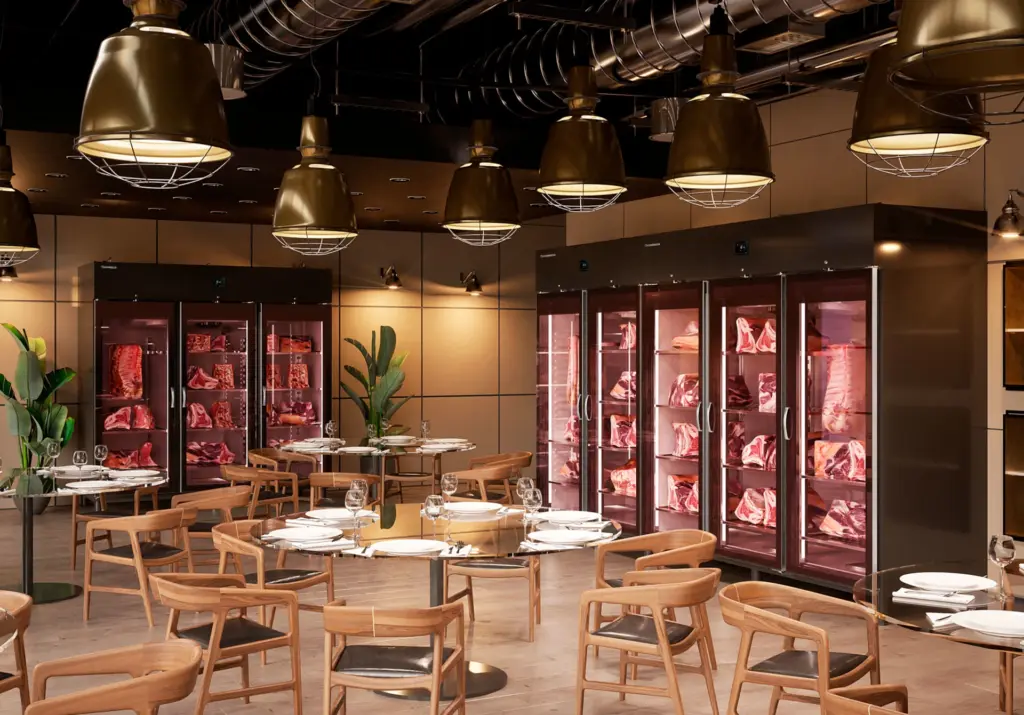




A maturation cabinet for restaurants It should not be chosen solely on the basis of aesthetics, capacity or visual impact. The decision must be based on its actual use: what meat will be prepared, how often it will be used, where the equipment will be installed, who will operate it and what role it will play within the restaurant’s culinary concept.
Key data
A maturing cabinet for a restaurant should be chosen on the basis of the menu, stock turnover, location and working procedures. It should not be chosen solely on the basis of capacity or its visual presence in the dining room, although these are undoubtedly important considerations; they should be a factor, but not the key factor.
Quick reply
A restaurant needs a maturation cabinet when matured meat forms an integral part of its menu, its operations and the way it presents its produce. If the equipment is viewed merely as a decorative feature, it is easy to choose one that is too large, select the wrong location or create unrealistic expectations.
In a nutshell
- The wardrobe must be in keeping with the menu, not just the décor of the premises.
- Location has an impact on service, maintenance and customer perception.
- The planned rotation is key to making an informed choice.
- Cleaning must be planned for from day one.
- The distributor and installer should check the actual usage before making a recommendation.
Who is it aimed at?
This article is intended for distributors, installers, technical managers and HORECA professionals who need to assess a meat-maturing project in a restaurant.
It can also help restaurants, steak houses and hotels that wish to incorporate dry-aged meat in a professional manner, without basing their decision solely on image.
The starting point: what role will matured meat play in the restaurant?
Before choosing a wardrobe, it’s worth asking yourself one simple question:
Will matured meat be a key feature of the menu or just an occasional option?
A restaurant specialising in meat is not the same as an establishment that occasionally includes one or two meat dishes on its menu. Nor is preparing cuts of meat in full view of diners the same as carrying out the process in a back-of-house area.
The kitchen units must be chosen to reflect that decision. In our experience, when the project is organised around the menu and the operational requirements, the choice of equipment becomes much clearer.
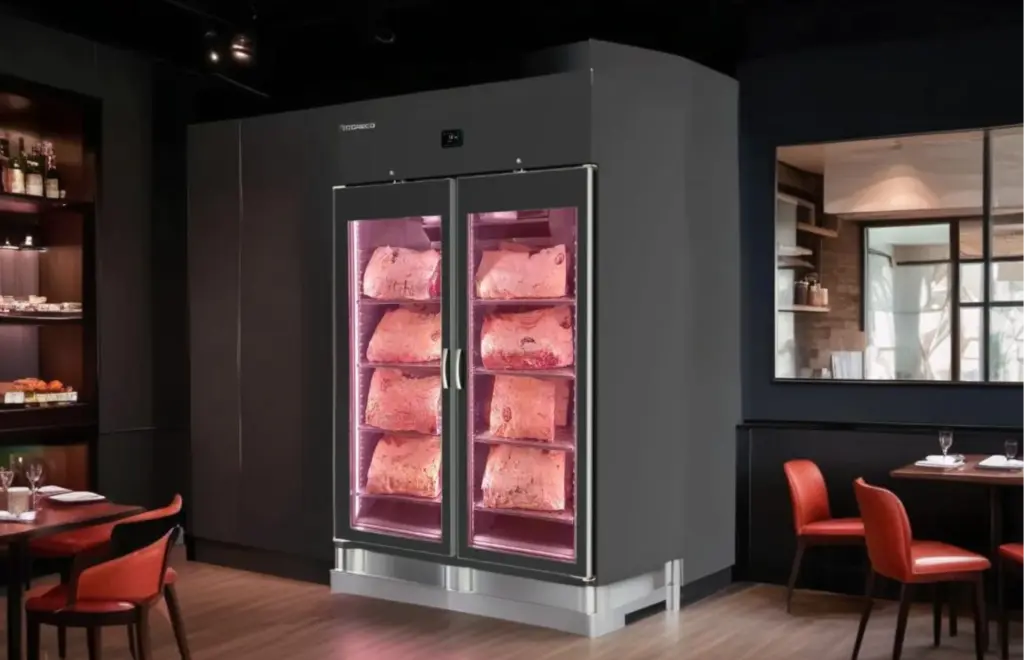
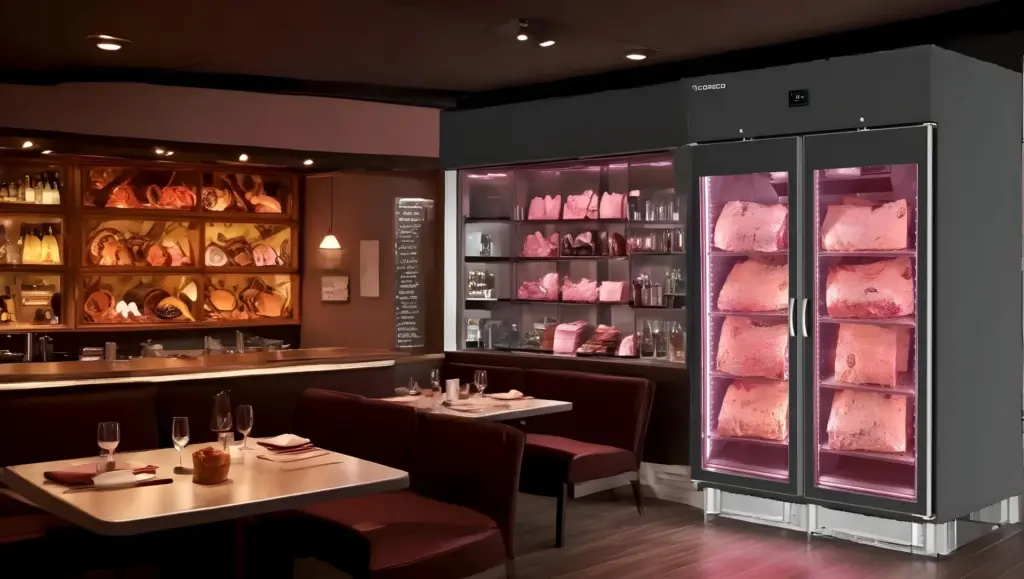
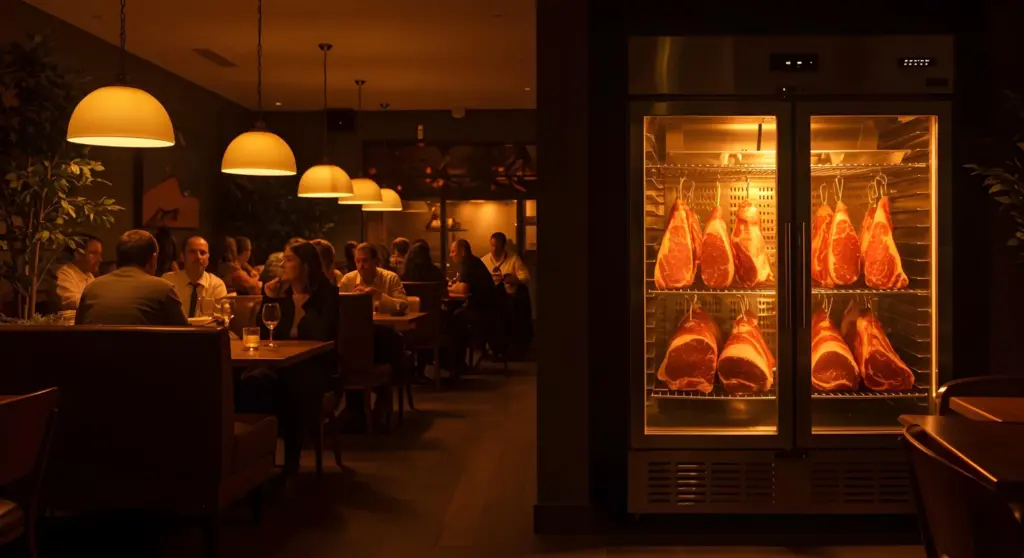
A display cupboard is not just a display unit
In a restaurant, the display cabinet can play an important visual role. It can help to showcase the product, build trust and reinforce the perception of specialisation.
But we shouldn’t reduce it to just that.
A meat maturation cabinet has to work properly. Visibility is an added bonus when the process is well organised. If there are no standards in place for the product, stock rotation, cleaning and monitoring, simply being able to see what’s going on won’t solve the problem.
| If the wardrobe is in the living room | If the cupboard is in the utility area |
|---|---|
| It must be integrated into the customer experience | It must facilitate employment, access and maintenance |
| Product presentation is becoming increasingly important | Internal operations are gaining in importance |
| Visible cleanliness is particularly important | Organising the process is a priority |
| You can help the front-of-house team explain the menu | It can assist with cooking and food preparation |
The decision is neither better nor worse in itself. It depends on the restaurant’s concept.
What does a Master Ageing Controller bring to a restaurant?
In a restaurant, Master Ageing Controller helps ensure that the ageing cabinet operates with more precise control over the environment. Its value lies not in replacing the chef’s judgement, but in ensuring that temperature, humidity, air and time form part of a more stable and adjustable process.
For the distributor or installer, this point is useful in explaining that a dry-ageing cabinet for a restaurant should not be chosen solely on the basis of capacity or its appearance in the dining room. It must also meet the level of control required to handle dry-aged meat professionally.
What to consider before choosing a maturing cabinet for a restaurant
1. Type of restaurant
The first criterion is the type of business.
A steak house, a fine-dining restaurant, a hotel or a brasserie don’t all operate in the same way. Each will have a different turnover rate, a different level of exposure and its own way of describing the meat to customers.
Before recommending a team, it is worth understanding the concept behind the restaurant.
2. The role of matured meat on the menu
The ageing process must be linked to the culinary offering.
If the menu focuses on meat, the cold store will play a more strategic role. If matured meat is only mentioned occasionally, a more tailored solution may be required.
The useful question is not just “which cupboard will fit it?”, but “what role will the product play?”.
3. Planned rotation
Stock turnover affects the choice of equipment, procurement planning and how the product is handled.
It is worth checking:
- how many pieces are expected to mature;
- how often they will be restocked;
- which cuts will be used;
- whether there will be periods of higher demand;
- whether the equipment is intended for display, processing or both.
It’s not about asking for a perfect forecast. It’s about avoiding a decision based solely on a visual impression.
4. Location of the equipment
The location determines how it is used on a day-to-day basis.
Please check:
- access for loading and unloading;
- door opening;
- distance from the kitchen or living room;
- visibility for the customer;
- ease of cleaning;
- environmental conditions;
- future maintenance.
For the installer, this point is particularly important. Choosing the right equipment can be compromised by an impractical location.
5. Cleaning and maintenance routine
Cleaning shouldn’t be put off until later.
In the kitchen, hygiene is an integral part of day-to-day operations. The restaurant must plan who cleans, when cleaning takes place and how the condition of the equipment is checked.
It is worth explaining this point from the outset, without sounding alarmist and without placing the blame on the customer. It is simply part of the professional process involved in maturing meat.
You can find out more about this topic in the guide on Cleaning a Dry Aged cabinet.
6. Front-of-house staff and customer briefing
If the cupboard is visible, front-of-house staff should be able to explain the basics:
- What is matured meat?;
- why it’s in the cupboard;
- what the process achieves;
- what is the difference compared with meat that has simply been preserved;
- why the restaurant has added that dish to the menu.
The display cabinet can help to showcase the product more effectively, but it is no substitute for a professional explanation.
If the customer needs an introduction, they can refer to the article on Dry Aged meat maturation.
Common mistakes in restaurants
Choosing the wardrobe just because it looks good in the living room
Aesthetics matter, but they cannot be the only criterion. The equipment must be suited to the process, the space and the way of working.
Buying more capacity than is needed
An oversized wardrobe may seem like a sensible choice, but if you don’t rotate your wardrobe regularly, it can make things more complicated.
Failure to coordinate the kitchen, dining room and facilities
The project encompasses several areas. The kitchen prepares the produce, the dining room presents it, the layout determines how it is used, and management defines the culinary concept.
Not planning for cleaning from the outset
If the cleaning isn’t organised, problems will arise later on. It’s best to discuss this before installation.
Promising results without knowing the product
Maturation depends on the meat, the process, the equipment, handling and operational procedures. That is why it is best to avoid making firm promises.
Key facts to consider before making a decision
Before recommending a maturing cabinet for a restaurant, it is advisable to ask the customer for the following information:
| Data to be checked | Why it matters |
| Type of restaurant | Define the true role of matured meat |
| Draft letter | Helps to assess turnover and usage |
| Location of the cupboard | This affects the dining room, kitchen, cleaning and maintenance staff |
| Customer visibility | It determines the design, presentation and explanation |
| Number of items | Focus on the necessary skills |
| Cleaning routine | Avoid operational problems later on |
| Previous experience | It helps to manage expectations |
| Installation available | Helps the installer assess feasibility |
For distributors and installers
For a distributor, the key is not to sell the cupboard as a stand-alone item. The value lies in coordinating the decision with the restaurant.
It is worth asking first:
- what the restaurant hopes to achieve with the matured meat;
- whether the cupboard will be for display or for technical purposes;
- what rotation do you expect;
- which pieces he is going to work on;
- how much space is available;
- who will manage the product;
- who will be responsible for the cleaning;
- What information do you need to check against the manufacturer’s technical data sheet or documentation?.
For the installer, the most important factors are usually to be found in the actual space: location, access, ventilation, maintenance and conditions of use.
CORECO works through distributors and installers. In restaurant development projects, the professional channel helps to translate a culinary concept into a coherent technical solution.
You can view the range of CORECO Gourmet meat maturing cabinets or expand the criteria in the guide on Meat ageing cabinets for professional use.
Technical closure
A maturation cabinet for restaurants The choice must be based on the realities of the business: the menu, turnover, location, dining area, cleanliness and maintenance. Once these points are clear, the team ceases to be merely a visible element and becomes part of a more structured professional decision-making process.
Ageing meat in a restaurant can add value to the product and enhance the customer experience, but only if it is carried out methodically, with careful control and technical expertise.