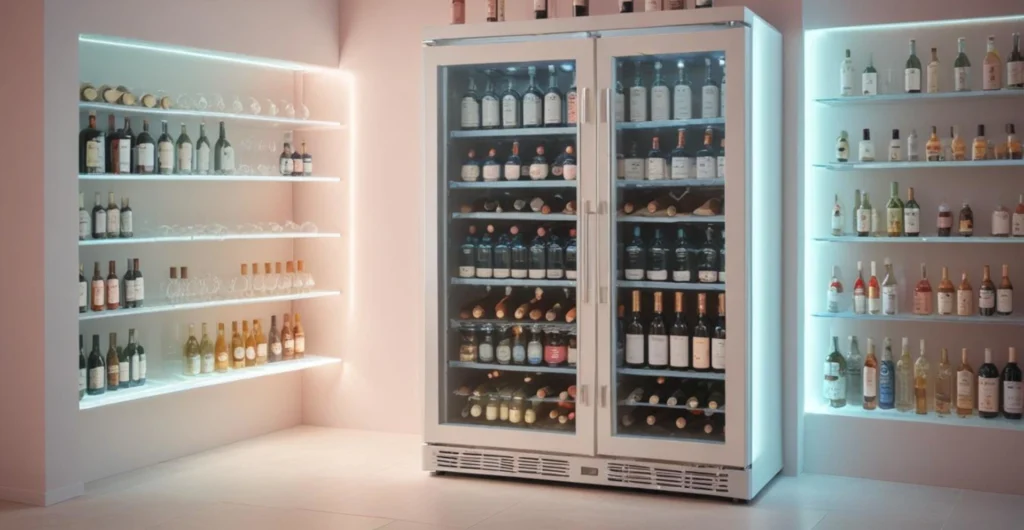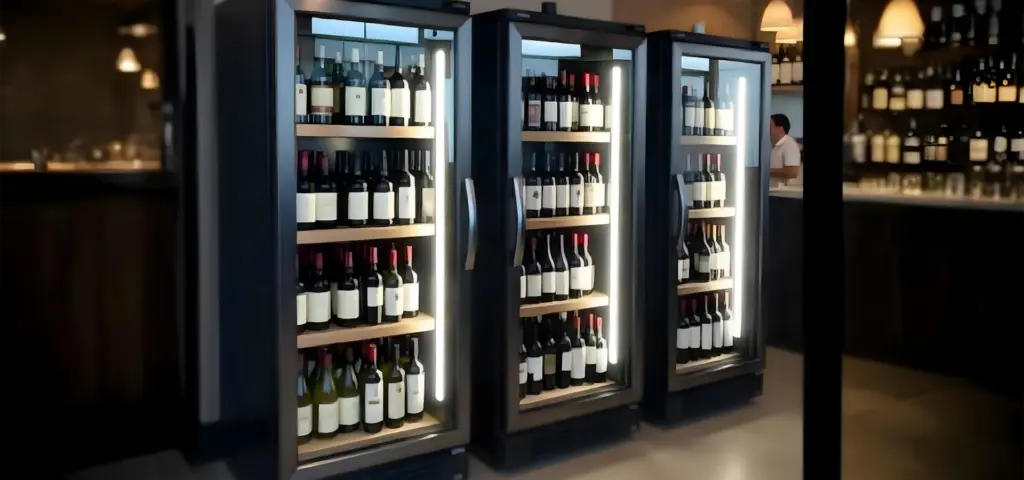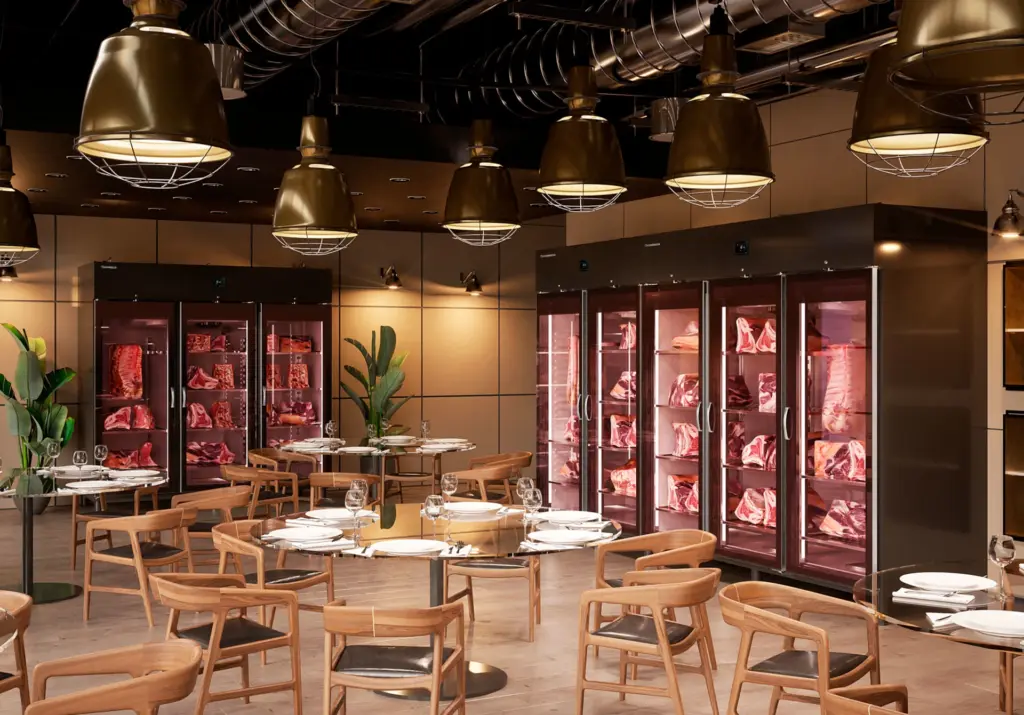




An efficient wine cellar is not only defined by the number of bottles or the aesthetics of the cellar. In a restaurant, it works well when wine is brought in, stored, located, served and replenished without friction. In other words: when space, capacity and operation work in the same direction.
If you need a general background on maintenance, use and choice of equipment, you should start with this one. guide to the use of wine cellars in restaurants and gourmet shops. In this article we will focus on another part of the problem: how to design an efficient wine cellar in your restaurant in terms of space, implementation, capacity and operational flow.
What is an efficient restaurant cellar
An efficient wine cellar is one that responds well to the real use of the business. It is not just a question of conserving wine, but of making it compatible with the service, the rotation of references, the space available and the experience that the restaurant wants to offer.
In practice, an efficient winery should help to:
- Keeping wine tidy and traceable.
- Avoid unnecessary travel during the service.
- Better separate operational stock from support stock.
- Reduce unnecessary openings, errors and manipulations.
- Integrating wine preservation into the real logic of the restaurant.
When this is not defined, the wine cellar ceases to be a system and becomes a sum of bottles distributed between bar, cupboards, kitchen and warehouse.
Restaurant cellar design: what to decide before choosing equipment
Before thinking about a specific wine cellar, it is advisable to define the role that the cellar is going to play in the restaurant. This preliminary step usually has a greater impact on the quality of the result than the technical specifications alone.
Diagnostic questions
- Does wine have an important commercial role or is it more of an accompanying function?
- Does the card rotate quickly or does some of the stock remain for weeks or months?
- Does the restaurant sell more by the glass, by the bottle or mixed?
- Is the wine actively recommended in the room or is it less consulted?
- Does the operation need quick access or is quiet preservation more important?
- Is there space to separate visible and support stock?
- Should the winery be visible or should it work in the background?
What the winery design should cover
| Decision | What needs to be defined |
|---|---|
| Function | Conservation, servicing, display or a combination of all three |
| Location | Lounge, bar, back office or mixed solution |
| Capacity | Operating stock, support stock and growth margin |
| Flow | Reception, storage, replenishment and service |
| Integration | How the team lives with the space and with the staff |
Space for a wine cellar in a restaurant
Space is not just a question of metres. It is also a question of routes, ambient temperature, accessibility and work logic. An efficient warehouse starts to be defined when you decide where it should be.
When to take some of the wine to the cellar
The wine room makes sense when the wine is part of the customer experience, when the recommendation weighs in the sale and when the visual presence helps to reinforce the restaurant's proposal.
It can work well in these cases:
- Restaurants with a carefully selected and visible wine list.
- Wine bars or concepts where wine plays a leading role.
- Restaurants that want to use the wine cellar as part of the ambience or the story of the place.
But it also has demands:
- More openings.
- More exposure to the rhythm of the service.
- More need for visual order.
- More discipline in replenishment and cleanliness.
When to take the warehouse to the back office
The back office tends to fit better when stability is a priority, when the stock is larger or when the restaurant needs to work more calmly on internal replenishment and order.
It is often useful in these scenarios:
- Restaurants with a significant part of the wine out of sight of the customer.
- Operations with more support references than exposure references.
- Premises where the room does not allow a clean integration of the equipment.
When a mixed solution is appropriate
In many restaurants, the most effective solution is not to choose between the dining room and the back office, but to divide functions.
For example:
- A part of the wine visible and accessible for immediate recommendation or service.
- Another part in support for replenishment, slow references or larger stock.
This logic often helps to balance image, conservation and operations.
Quick comparison: lounge, back office or mixed model
| Location | When it fits | Advantages | Limitations |
|---|---|---|---|
| Room | Wine is part of the experience and part of the sale. | Visibility, recommendation, image | More openings and more visually demanding |
| Back office | Premium conservation, order and support stock | More stability and internal control | Less direct trade effect |
| Mixed | Combining service and conservation | Better balance between operation and image | Requires more organisational criteria |
Capacity of a wine cellar in a restaurant
One of the most common mistakes is to calculate the cellar by theoretical number of bottles. This gives an initial orientation, but does not solve the operation.
The useful capacity depends on more than that:
- Actual number of active references.
- Rotation of each wine family.
- Bottle formats.
- Need for in-service access.
- Separation between operational and support stock.
What actually needs to be calculated
Rather than just thinking “how many bottles will fit”, it is better to calculate three layers:
- Operational stock
Wine that must be ready for sale or regular service. - Support stock
Wine that replenishes the operation, but need not always be accessible. - Room for manoeuvre
The space that avoids saturation when the menu changes, a special purchase comes in or the turnover increases.
A useful reference for thinking about capacity
| Scenario | What you usually need |
|---|---|
| Short chart and high rotation | More access and less volume tied up |
| Carta media and mixed sales | Balance between access, tidiness and some support stock |
| Broad or more specialised menu | More organisational criteria and better separation between visible and back-up |
Do not mix capacity with density
Filling a cellar to capacity does not mean using it well. When the organisation makes it difficult to locate bottles, restock or work with different formats, capacity is no longer an advantage but a problem.
Operational flow of wine in the restaurant
An efficient wine cellar is not only designed from storage. It is designed from the entire wine journey within the restaurant.
Basic flow to be ordered
- Reception
Where the wine goes in and who reviews it. - Ranking
How it is separated by type, rotation or destination. - Location
What part will be visible stock and what part will be supportive. - Replenishment
When and how the wine moves from the support to the operational area. - Service
How the bottle reaches the waiter or the exit point without detours. - Control
How to detect out-of-stock, out-of-stock or out-of-stock references.
What happens when the flow is not defined
- Bottles distributed at various points without clear criteria.
- Too many openings of the same cava.
- Staff looking for references while on duty.
- Late or improvised replenishment.
- More risk of errors and less consistency in the charter.
Wine cellar implementation: how to integrate the wine in the back office
It is not just a question of “putting in a cellar”. It is about deciding how the team should coexist with the space and the daily work.
Room integration
When the cellar is in the room, the implementation must be taken care of at the same time:
- The visual reading of wine.
- Movement of personnel.
- Accessibility during service.
- Aesthetic coherence with the premises.
In this type of project, the equipment does not only act as storage. It is also part of the perception of the restaurant.
Back office integration
In the back office, the focus changes. The important thing is that the team helps you work better:
- Convenient access.
- Clear replenishment.
- Order by family or rotation.
- Less exposure to unnecessary openings.
Mixed integration
When there is a visible and a supporting part, the main criterion is that both areas are connected by simple logic. Otherwise, the system becomes unnecessarily complicated.
What to check during implementation
- Distance between the warehouse and the service point.
- Proximity to hot spots or high traffic areas.
- Easy to open and refill.
- Real visibility of important references.
- Compatibility with the furniture and the routing of the room equipment.
How refrigerated wine cellars fit into an efficient wine cellar
In this article it is not appropriate to repeat the whole part on general use and conservation, because it is already dealt with in the main guide to wine cellars for restaurants and gourmet shops. The important thing here is to understand the role of the cellar within the system.
A well-integrated refrigerated cellar can help:
- Give stability to the benchmarks that matter most.
- Separate better conservation and service.
- Visually arrange a part of the chart.
- Reduce improvisation in daily work.
If you would also like to review the family of related solutions, you can see it at wine cooling.
What data should be collected before planning the winery?
| Datum | What it is used for |
|---|---|
| Number of active references | Define the actual size of the letter |
| Rotation by type of wine | Helping to decide on access versus storage |
| Sold by the glass or by the bottle | Change the logic of the operational stock |
| Available space | Conditions implementation and route |
| Level of customer exposure | Help in deciding room, support or mixed model |
| Bottle formats | Affects usable capacity and organisation |
| Staff who will handle the wine | Influences the user-friendliness required by the system |
Indicative example
A restaurant with a menu of 40 references decides to display part of the wine in the dining room. The first idea is to concentrate everything in a single visible cellar. On paper, it looks tidy. In practice, it is not always so.
If the rotation is uneven and some of the items are sold very infrequently, putting everything in the same solution can generate two problems: too many openings on the same equipment and an internal organisation that is not very agile for service. In such a case, it usually works better to separate a visible part for active sales and a support part for replenishment and slower stock.
Indicative example, not a substitute for a specific case analysis.
Common mistakes when designing an efficient restaurant wine cellar
| Problem | Probable cause | What to check | Recommended action |
|---|---|---|---|
| The wine cellar looks good, but works badly | It was designed from aesthetics and not from operation. | Routes, access and replenishment | Redefine functions by zone |
| Lack of useful capacity | Calculated by theoretical bottles | Formats, rotation and actual stock | Recalculate from actual usage |
| Staff waste time searching for wine | No clear organisation | Grouping by families or output | Reorder operational stock |
| There are too many openings | All the wine is concentrated in a single area | Service, replenishment and support | Separate operational and back-up area |
| The wine is poorly integrated into the premises | Implementation with space was not thought through | Location, circulation and furniture | Stake out position and reading of the equipment |
What changes in practice when the winery is well resolved
- Wine is localised more quickly.
- The service becomes more fluid.
- Replenishment becomes simpler.
- The charter is managed in a more orderly fashion.
- Improvisation in the room is reduced.
- Space works best for the team.
- The commercial recommendation is more natural.
- The dealer can size more judiciously.
Distributor block
How to explain it to the professional client
- An efficient warehouse depends not only on the equipment, but also on how it is integrated into the operation.
- Space and the wine's path weigh as much as capacity.
- A visible cellar does not always solve the whole system.
- Separating operational and support stock usually improves the result a lot.
- When the implementation is well thought out, the wine sells and works better.
What information to ask for in order to size well
- Number of active references.
- Average turnover by type of wine.
- Type of service: glass, bottle or mixed.
- Space available in room and support.
- Distance to the service point.
- Need for visibility vis-à-vis the customer.
- Bottle formats.
- Actual priority of the project: image, conservation, agility or balance between them.
Quick checklist for designing an efficient winery
- I have defined whether the cellar should conserve, serve, display or combine functions.
- I know which part of the wine should be operational and which part should remain as a support.
- I have reviewed the actual route of the wine within the restaurant.
- I have assessed whether it is a room, a back office or a mixed solution.
- I have calculated useful capacity and not only theoretical capacity.
- I have taken into account bottle formats and rotation.
- I have checked accesses, openings and repositioning.
- I have thought about how the equipment will coexist with the space.
- I have checked the decision with the dealer or installer.
- It is clear to me who will manage the winery on a day-to-day basis.
Frequently asked questions
Is an efficient wine cellar the same as a good wine cellar?
No. The cellar is a part of the system. The efficient cellar also depends on space, organisation and operational flow.
Is it always advisable to put the wine cellar in the room?
No. It makes sense when the wine is an active part of the experience and the restaurant can sustain that exposure well.
Which tends to work best: lounge, back office or mixed?
It depends on the business. In many cases, the mixed solution is the most balanced solution because it spreads functions.
How do I know if I lack capacity or lack organisation?
If the problem is not only space, but also search times, excessive openings or confusing replenishment, organisation is often lacking rather than litres.
Should all the wine be at the same point?
Not necessarily. Many operations improve when they separate operational and support wine.
Which weighs more here: conservation or service?
Both matter, but in this piece the focus is on how to make them coexist within the restaurant operation.
Where do I see the general part on use and maintenance?
In the guide to the use of wine cellars in restaurants and gourmet shops and, for the comparison of solutions, in keep wine in a bottle rack or refrigerator.
Glossary
Efficient warehouse
Wine storage and serving system that performs well in space, capacity and operation.
Operational stock
Set of bottles that must be available for regular service.
Support stock
Bottles that serve to replenish operational stock without always being on the front line.
Implantation
How the equipment is integrated into the actual restaurant space.
Useful capacity
Real usable space to work with, not just theoretical volume.
Back office
Internal support area where the client does not interact directly with the team.
Exhibition
Use of wine or equipment as a visible part of the venue proposal.
Operational flow
The wine's journey from reception to service.
What to be clear about before deciding
If the goal is to create an efficient wine cellar in your restaurant, the question should not only be which wine cellar to buy. The right question is how you want the wine to work within the business.
At CORECO, we often see that the difference between the right solution and a really useful solution lies in this point: defining the system well before choosing the equipment. When the space, capacity and flow are clear, it is much easier to integrate a warehouse that conserves well, works in an orderly fashion and really accompanies the service.
Check this data with your dealer or installer before deciding. If the cellar is planned from actual use, it is also easier to get the implementation, capacity and routing right.