



Professional refrigeration for the HORECA business model should not be viewed as a decision based solely on the choice of equipment. It should be viewed as an operational decision: what products need to be stored, how they are handled, when the business is busiest, and what level of temperature stability each area requires.
An à la carte restaurant, a hotel with a buffet, a dark kitchen, a central kitchen or a gourmet shop may share some of the equipment, but they do not share the same pace, the same opening hours, the same turnover or the same service model. That is why, when the business model changes, so too does the correct way of sizing cold rooms, cupboards, refrigerated display counters, blast chillers or specific storage solutions.
If you’ve already read how professional refrigeration impacts on the real profitability of a HORECA business, here we translate that idea into a very specific decision: how to tailor the cooling to the business’s actual operations so that the installation makes sense from day one and continues to do so over time. And if you want to explore the financial side in more detail, it’s also worth looking at refrigeration as an invisible fixed cost in HORECA.
The basic idea is simple: it is not a question of choosing “more equipment” or “less equipment”. It is a question of choosing the right equipment, distributed effectively and for the right reasons.
Why it is important to base sizing on the reality of the business
In our experience, many projects do not so much need a longer list of references as a more accurate understanding of the operation.
Before comparing capacities, dimensions or finishes, it is worth understanding at least the following variables:
- which product is being stored;
- how much it rotates;
- what real opportunities each team will have;
- where the hotspots will be;
- what peak loads the installation must be able to handle;
- which part of the cold is in the background and which part forms part of the visible space;
- how much scope there may be for growth or changes to the menu in the coming years.
When this analysis is carried out properly, the conversation changes. It no longer revolves solely around what it can accommodate or what the initial cost is, but around the workflow it supports, the workload it handles and the stability it provides on a day-to-day basis.
The cold chain map: the product’s journey takes precedence over the reference
A useful way to start is to draw up a ‘cold map’ of the business.
We’re not just talking about linear metres or litres. We’re talking about distance.
A basic cold map should include at least the following
| Area | Main function | What you should check |
|---|---|---|
| Reception | Receipt and initial organisation of the product | Delivery frequency, waiting times, unloading |
| Storage | Stock management | Rotation, categories, vacancies, stability |
| Production | Food preparation and kitchen support | Accessibility, tours, support for practical work |
| Despondency | Controlled temperature reduction | Batches, lead times, bottlenecks |
| Service | Support for the pass, cross or clearance | Intensive opening hours, quick access, restocking |
| Living room or visible area | Customer-facing maintenance | Order, visual clarity, consistency with the space |
| Dispatch | Organised product launch | Pace, advance preparation, operational continuity |
This helps you make better decisions because each stage of the process requires a different approach. A cabinet for everyday use is not the same as one designed for storing wine. A storage cabinet is not the same as a maturation cabinet, where control of the process and the duration of storage completely alter the requirements.
Questions that help to gain a better understanding
Before finalising a proposal, it’s often helpful to take a moment to answer a few simple questions.
About the product and turnover
- Which product is more sensitive?
- What comes out every day, and what lasts the longest?
- Is production ahead of schedule?
- Is the work carried out in batches?
- Are there any categories that should be separated?
On the pace of work
- Where is the peak in service demand?
- How many openings can a cupboard have in the critical zone?
- Is it restocked from the back several times a day?
- Are there significant seasonal fluctuations, banquets or promotional campaigns?
On space and installation
- Where will each team be based?
- How well is the area actually ventilated?
- Are there any hotspots nearby?
- Is there sufficient space for maintenance?
- What happens if the business grows or changes part of its offering?
These questions don’t complicate the purchase. They make it clearer.
Not all HORECA models use cooling in the same way
Traditional restaurant
In an à la carte restaurant, refrigeration is usually divided between storage, mise en place and back-of-house support.
It’s not always necessary to expand in size here. Often, it’s a question of organising each team’s role more effectively.
What usually works best
- cold store or cool room for stock;
- refrigerated cabinets or tables near work areas;
- distinction between fast-moving stock and stock held in reserve;
- a reduction if there is advance production;
- short distances between preparation, storage and serving.
The aim is not to cram the kitchen full of equipment. It is to ensure that a single refrigeration unit is not required to perform too many different functions at once.
Hotel with a buffet, events or banquets
In hotels, the problem is not usually just capacity, but variability.
There are peak times, restocking, breakfasts, banquets, back-of-house operations, internal rounds and moments when a single deviation affects many people at once.
What should be prioritised
- cameras distributed according to service requirements, not just for the main kitchen;
- specific support for a buffet or satellite service;
- operating margin for events and groups;
- waste when production is carried out in batches;
- reasonable redundancy at the most critical points.
In this type of project, proper sizing means accommodating variation without turning every peak into a voltage surge.
Catering and central kitchen
Here, refrigeration forms part of the production infrastructure.
The workflow is usually more demanding and more sequential:
receipt → storage → preparation → slaughter → storage → dispatch
If one of these stages falls short, the problem isn’t always apparent at first, but it eventually manifests itself in delays, bottlenecks or a loss of control.
Which usually weighs more?
- actual abatement capacity;
- distinction between pre-conservation and post-conservation;
- accessibility for cleaning and maintenance;
- clear routes;
- batch orders and time slots.
It’s not just about how much it can hold. It’s about how much the product can move without disrupting operations.
Dark kitchens and compact models
In these projects, space is more limited, but the demands are no less.
The installation should help to compact the soil without causing a mess.
It is particularly worth checking this
- actual usable capacity of the cupboards;
- ease of cleaning;
- access to maintenance;
- flow separation;
- alarms or basic monitoring of critical equipment;
- future growth if the business expands its brands or service lines.
In these settings, good capacity planning is usually that which prevents the premises from always operating “at full capacity”.
Gourmet shop with tastings
Here, the cold preserves, shapes and also enhances the experience of the product.
That is why it is important to draw a clear distinction between two levels:
- the cold that sustains the operation;
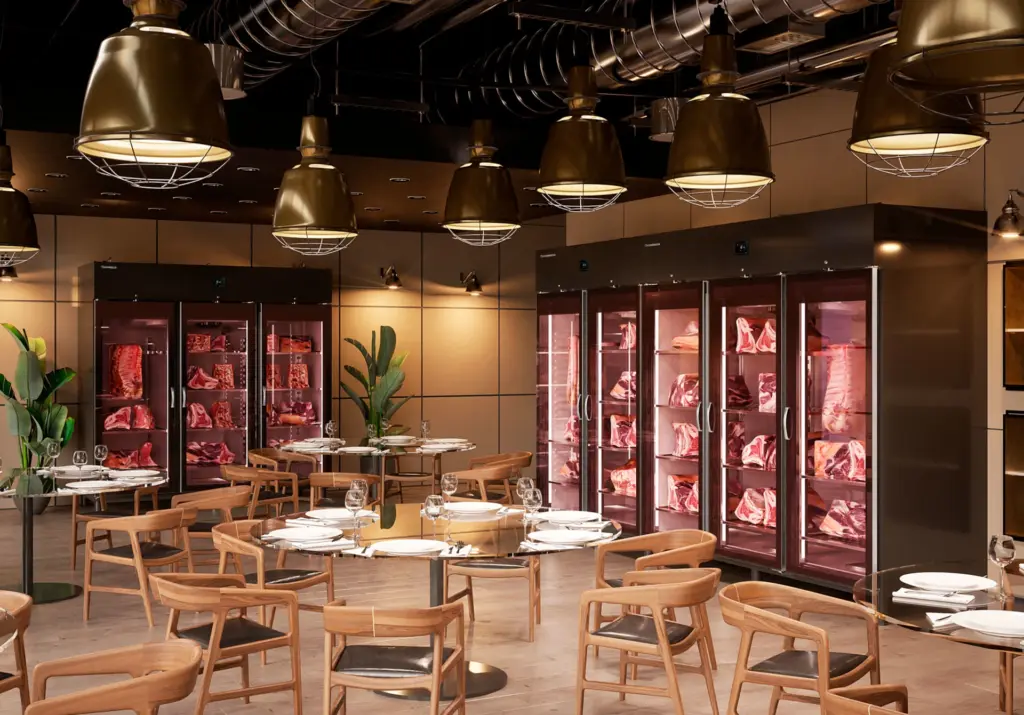
- the cold that forms part of the visible universe.
Not to confront them, but so that everyone can do their job properly.
What usually helps in this type of business
- a solid base for replenishment and preservation;
- specific cupboards by category;
- stable visual order;
- convenient access points;
- consistency between the product, its use and the space.
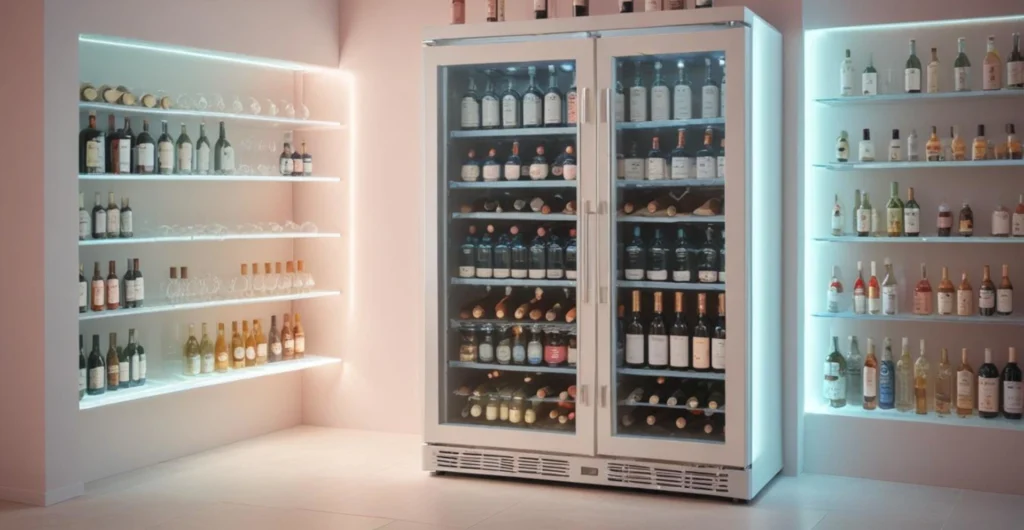
When wine is part of the offering, it may be worth considering a specific storage and serving solution such as the guide to the use of wine cellars in restaurants and gourmet shops. And if the project needs to be turned into a specific product, you can refer to documents such as EBRW-751 o DAW-400, two models designed specifically for the storage and preservation of wine, offering a more suitable approach than that of a general-purpose unit.
When the business deals with products that require longer maturation or storage
It is worth making a clear distinction here.
Not all cupboards are designed for the same range of uses.
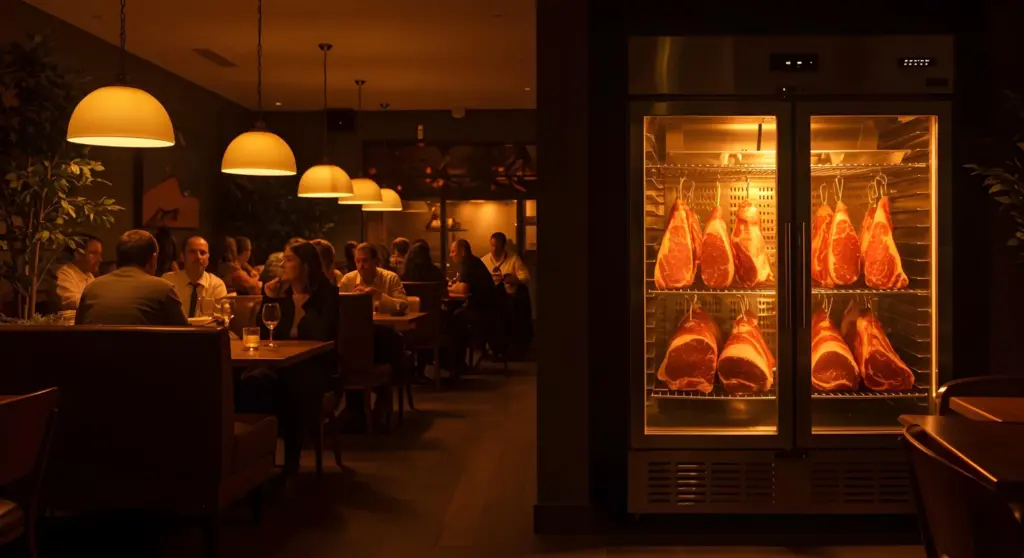
A daily storage cabinet meets one need. A maturing cabinet serves a completely different purpose: longer, more controlled processes that have a greater impact on the final product.
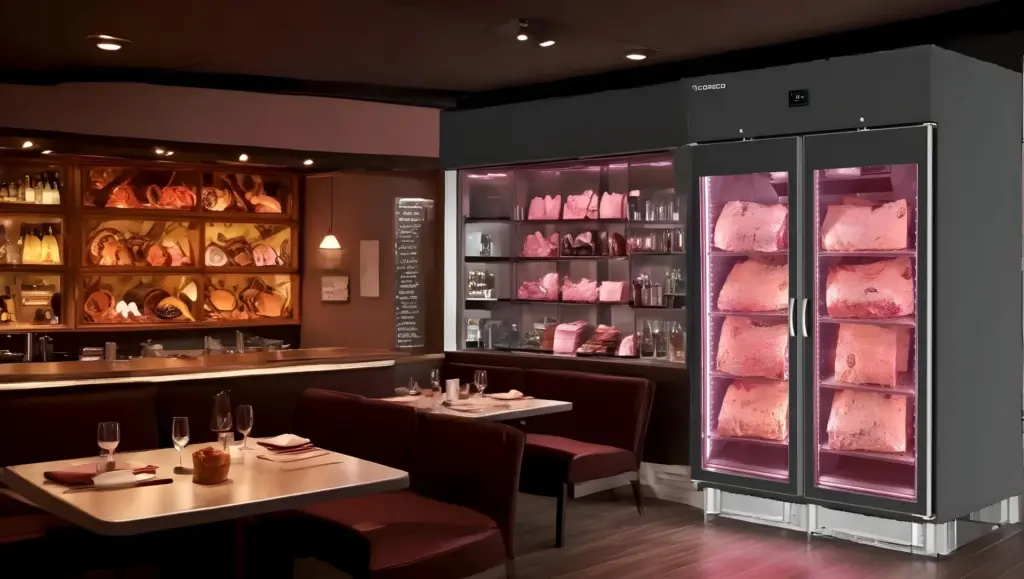
In the case of meat, the Coreco Gourmet maturation cabinets incorporate the device Master Ageing Controller, designed to control seven essential process parameters. This raises the level of precision available and allows us to describe it as a solution of a very high technical standard within its category, in a calm tone and without the need for exaggeration.
Rather than “a nice-looking cupboard for displaying meat”, we are talking about a tool for maintaining a process according to specific criteria: temperature, humidity, ventilation, air velocity, oxygen control, exposure time and gas flow.
If the project requires you to drill down to the record level, it is worth checking, for example, DA-1002, a solution designed for larger items and different ageing processes. In this type of application, moreover, it does make sense to talk about longer-term storage or preservation, because the equipment is no longer simply intended for day-to-day use, but rather to support a specific product strategy.
And if your business specialises in cured meats or meat curing, you might also want to take a look at fact sheets such as ASCV-1302, where the system’s logic is already calibrated to respond to controlled temperature and humidity levels for a specific process.
What role can CORECO, the distributor and the installer play?
We need to be very clear on this point.
The final decision rests with the business owner, as they are the ones who know their business, its pace and its priorities best. But that does not mean they should decide alone.
The brand, the distributor and the installer can all provide very useful information to help inform the decision and make it more justifiable.
What sort of information is usually really helpful?
- to translate the business operations into a reasonable technical proposal;
- explain what role each team should fulfil;
- distinguish between day-to-day maintenance, operational support, stock management, decommissioning or a specific process;
- to discuss the product’s consumption, maintenance, accessibility and lifecycle;
- Check whether the project is designed for today or also to accommodate future changes to the business.
This approach usually works better than a discussion focused solely on price or solely on stated capacity. Not because price doesn’t matter, but because it is worth placing it within a broader context.
Some decisions look very different when you look at actual usage
Choosing on the basis of size is not the same as choosing on the basis of function
Two cupboards of similar dimensions can perform very differently if the following change:
- the openings;
- rotation;
- the ambient temperature;
- proximity to the work area;
- the type of product;
- the actual time spent there.
Preserving something is not the same as sustaining a process
A wine cabinet, a maturing cabinet or a curing cabinet are not justified simply by their presence in the dining room. They are justified when they serve a specific business purpose.
It’s not the same to simply cover today’s photo as it is to design with a certain narrative arc
Some businesses change quickly: they expand their menu, increase their delivery service, introduce tasting sessions or strengthen a specific product category. It’s important that the cold storage plan isn’t drawn up without leaving any leeway.
A practical checklist to help you make the best decision
Before finalising an offer, it’s a good idea to have at least the following:
- Business model and service delivery.
- Critical products and sensitive categories.
- Actual turnover and peak workloads.
- Frequency of deliveries and restocking.
- Map or sketch showing routes.
- Ambient temperature and heat sources.
- Space available for installation and maintenance.
- Whether or not a reduction is necessary.
- Conservation work required – visible in the exhibition room.
- Possible growth or changes to the range of products and services on offer.
- Average time the product remains in each zone.
- The level of control required for each process.
Distributor block: how to explain it to a business client
One useful way of explaining it might be as follows:
It’s not about making the decision more complicated. It’s about ensuring the team really fits in with the way the business operates.
Not all restaurants, hotels or gourmet shops use refrigeration in the same way, even though at first glance they might appear to have the same needs.
The aim is not to oversize the installation. Nor is it to undersize it. The aim is to tailor the installation to the specific requirements of the product, the service and the space.
When the purpose is clear, it is also easier to justify the investment, organise maintenance and avoid unnecessary operational strain.
That is often the value of the distributor or installer in a well-executed project: turning a vague need into a sound technical decision.
What changes in practice
- Decisions are made on the basis of more context and less intuition.
- The team is no longer seen as an isolated entity.
- The product is becoming a more prominent topic of conversation.
- The routes and openings are more important.
- Day-to-day operations play a greater role in the decision-making process.
- Maintenance is no longer just an abstract concept.
- Specialised equipment is best justified when it serves a practical purpose.
- The technical proposal becomes easier to defend.
Conclusion
Talking about professional refrigeration in the context of the HORECA business model isn’t about making the purchase more complicated. It’s about organising it better.
Because the same space, the same budget and even the same range of equipment can yield very different results depending on how refrigeration is actually used in the business.
For this reason, before finalising the specifications, it is advisable to clearly define the cold chain, the critical product, stock turnover, peak periods and the role each team is expected to fulfil.
And this is where CORECO, together with distributors and installers, can make a valuable contribution: providing useful information to help each business owner make the decision that best suits their operations, their business model and their long-term strategy.
If you’re reviewing a project or rethinking an installation, it might be a good time to discuss it with your supplier or installer and boil the conversation down to a simple question: What does this business really need to operate more effectively, retain staff more effectively and grow in a more organised manner?.