







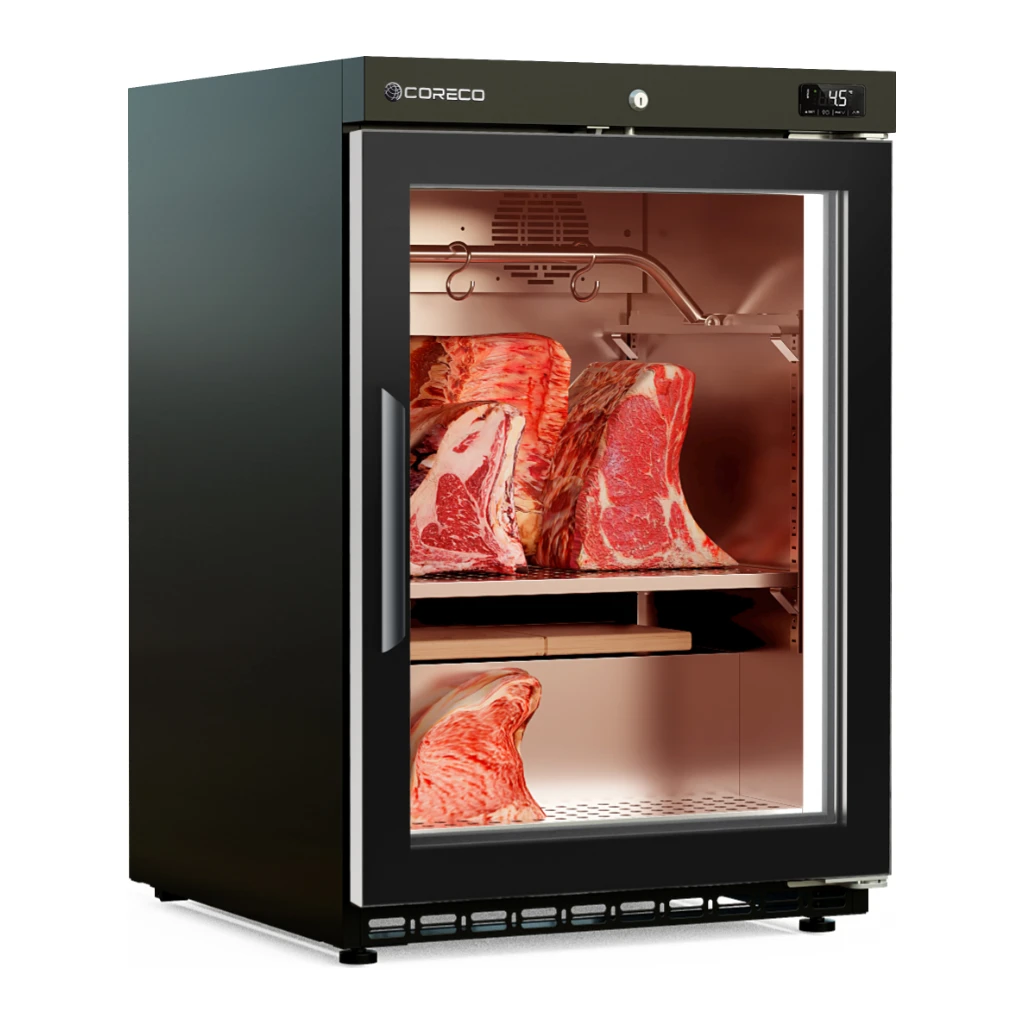
The displaying dry-aged meat It can help the customer better understand the value of the product before trying it out. In a restaurant or specialty butcher shop, a visible display cabinet does not “sell itself,” but can support professional explanation when the product, the room, and the equipment work with the same criteria.
Key data
The display of matured meat does not replace professional explanation. The display cabinet helps to showcase the product, but the value is conveyed when there is process, control, cleaning, and a team that knows how to count it.
Quick response
A visible maturation cabinet helps showcase the meat, order the product narrative, and reinforce the sense of control. Its value lies not only in drawing attention, but in making a process visible that the restaurant or butcher shop must be able to explain clearly.
In a few words
- The wardrobe does not replace the commercial, showroom or counter staff.
- The brochure helps when the product is well explained.
- Visibility must be accompanied by cleanliness, order, and consistency.
- In a restaurant, you can support the customer experience.
- In the butcher shop, you can strengthen specialization and confidence.
To whom it is addressed
This article is intended for distributors, installers, restaurants, specialized butcheries, hotels, steak houses and HORECA professionals who want to understand the visual and commercial role of the maturation cabinet.
This is not a guide for choosing equipment. For that, it is advisable to consult the article on dry ageing cabinet for restaurants or the general guide on Meat maturation cabinets and professional use.
The visible wardrobe does not sell by itself
It is worth correcting a common misconception: a maturation cabinet does not sell by itself.
It can attract attention. It can generate conversation. It can convey expertise. But it needs context.
The customer must understand what they are seeing:
- what kind of meat it is;
- why it is maturing;
- what the process brings;
- how it is integrated into the letter or offer of the butcher shop;
- What difference is there between preserving meat and maturing meat?.
When that explanation exists, the display of matured meat helps. When it does not exist, the cabinet can remain a striking, but poorly utilized, element.
Technical control is also part of what is shown
When a maturation cabinet is visible in the room or on the counter, it not only showcases meat. It also showcases a way of working. In the CORECO Gourmet maturation cabinets, the Master Ageing Controller helps to control the essential parameters of the process, providing a technical basis for the product on display.
For the restaurant or butcher shop, this allows the matured meat to be presented in a more discerning way: it is not just an attractive piece to the eye, but a product processed in a controlled environment and designed for professional use.
What the display of matured meat brings
1. Makes the product visible
Cooked meat has a strong visual presence. In a restaurant or butcher shop, displaying it can help the customer perceive that there is work behind the product.
But the display must be organized. A visible wardrobe requires care in the placement of the pieces, cleaning, the lighting of the space, and the message that accompanies the product.
2. Helps explain the process
Maturation can be difficult to understand for a customer who is not familiar with Dry Aged.
The wardrobe allows the process to be easily identified:
- This meat is not simply stored;
- it is in a controlled environment;
- it has a time of evolution;
- It is part of a specific gastronomic proposal.
If you need an introductory base, you can link to the article about Meat maturation Dry Aged.
3. Strengthens the sense of control
Displaying the product in a specific cabinet can convey order and specialization. But that perception only works if the equipment is clean, well-positioned, and consistent with the space.
A visible closet that is in poor condition, poorly placed, or used as an auxiliary storage room can have the opposite effect.
4. Supports the work of the sales floor or the counter
In a restaurant, the wardrobe can help the service team explain the menu. In a butcher shop, it can help the professional talk about cuts, maturation, and culinary use.
The key is for the team to have a simple, technical and natural speech. There is no need to overdo it. Just explain things clearly.
Restaurant and butcher shop: different uses of the exhibition
The display of matured meat does not exactly fulfill the same function in all businesses.
| Restaurant | Specialized butcher shop |
|---|---|
| Supports the customer experience | Strengthens specialization and advice |
| It can be integrated into the room | It can be part of the counter or sales area |
| Helps explain the letter | Helps explain cuts and maturation |
| It has gastronomic and visual value | It has technical, visual and commercial value |
| It requires coordination with the kitchen and the dining room. | It requires product expertise and customer service |
In both cases, the wardrobe must respond to the real use of the business. The display should not be seen as decoration, but as part of a way of working and explaining the meat.
What should be clear before showing cooked meat
Before placing a visible wardrobe, it is advisable to check a few points.
What product is going to be shown
Not every piece has the same visual value or the same sense within the offer. The business must know what it wants to show and why.
What message is going to be conveyed
The presentation should be accompanied by a simple explanation. If the customer asks a question, the team should answer it confidently, without going into unnecessary technicalities.
Who is going to explain it?
In a restaurant, it will usually be a dining room. In a butcher shop, it will be the professional at the counter. In both cases, it is important that the message is aligned with the cuisine, the management, and the technical expertise.
How the presentation will be taken care of
Presentation depends not only on the wardrobe. The interior order, cleanliness, location and the way the product is presented to the customer also play a role.
What limits should not be promised
It is not advisable to promise closed results, reduction figures, sales increases, or unvalidated features. The value must be explained from the product, the process, and the professional use.
Common mistakes
Saying that the closet “sells alone”
It’s an attractive phrase, but it’s not very precise. The wardrobe helps to show and explain. Sales depend on the product, the team, the discourse, and the customer experience.
Converting exposure into decoration
The wardrobe can have a visual impact, but its function should not be reduced to decorating the premises. It should be part of a product proposal.
Not training the team in the front office or the counter
If the customer asks a question and the team does not know how to answer, the presentation loses its impact. The explanation should be brief, clear and consistent.
Not taking care of visible cleanliness
When the wardrobe is displayed to the customer, cleaning has a technical as well as visual dimension. The customer's perception depends greatly on this point.
Using the closet for other products
A maturation cabinet should maintain a clear function. Using it as an auxiliary storage facility weakens the message and complicates control.
For distributors and installers
For a distributor, this article can help to reframe the conversation with the professional customer. Instead of saying that “the cabinet sells,” it is better to explain that the cabinet helps to better showcase and argue the product.
Useful questions:
- Does the customer want the cabinet placed in the living room, on a counter, or in a technical area?
- What product do you want to show?
- Who is going to explain it to the end customer?
- Does the matured meat form a real part of the menu or the offer?
- Is there a visible cleaning routine?
- Does the location facilitate use and maintenance?
- Is the commercial message aligned with the actual process?
- What technical information should the manufacturer provide through the channel?
For the installer, the exposure also has practical implications. A visible cabinet must be able to be installed, opened, cleaned, and maintained properly. It is not enough that it fits visually into the space.
CORECO works through distributors and installers. In maturation projects, the professional channel helps ensure that the display of matured meat is technically, visually, and operationally sound.
You can consult the range of CORECO Gourmet meat maturation cabinets to review available solutions within this line.
Checklist for a coherent exhibition
Before using the closet as a visible part of the business, it is advisable to check:
- The matured meat is a real part of the offer.
- The team in the reception or counter knows how to explain it.
- The closet is not used as an auxiliary storage space.
- The location facilitates use, cleaning and maintenance.
- The interior presentation is orderly.
- Visible cleaning is especially taken care of.
- The message avoids exaggerations and unverified promises.
- The kitchen, the living room or the counter share the same criteria.
- The distributor understands the customer's objective.
- The installer has reviewed the actual conditions of the space.
Technical closure
The displaying dry-aged meat It can add value when it helps to better explain the product. It does not replace professional judgment, but it makes it visible.
A well-located, clean, and consistent maturing closet can strengthen the customer’s trust. But its function is not “just to sell.” Its function is to support a better conversation: about product, process, control, and specialization.





 Español
 English
 Français
 Deutsch
 Italiano