







The Meat maturation in a restaurant It requires method. It’s not enough to add Dry Aged meat to the menu or install a visible cabinet in the dining room. To work with this product with professional discretion, the restaurant must organize its control, hygiene, handling, and follow-up routines.
Quick response
Good practices in meat maturation help the restaurant operate with more control and less improvisation. The goal is not to complicate the operations, but to define what is reviewed, who reviews it, and how to maintain consistency between the kitchen, the dining room, cleaning, and product monitoring.
In a few words
- Maturity must be integrated into the restaurant’s routine.
- Daily control prevents hasty decisions.
- Cleaning is part of the process; it is not a secondary task.
- The kitchen and the living room should share a common criterion.
- The distributor and the installer can help to arrange the actual use of the equipment.
To whom it is addressed
This article is intended for restaurants, steak houses, hotels, distributors, installers and technical managers who already work or want to work with matured meat in a professional environment.
This is not a guide for choosing a wardrobe. For that, it is advisable to consult the article on dry ageing cabinet for restaurants.
Here the focus is on another aspect: how to better manage the day-to-day aspects of maturation.
Maturity does not end when the equipment is installed
One of the most common mistakes is to think that the maturation process is complete when the wardrobe is installed.
The team is important, but the process does not work alone. Aged meat requires a professional routine: checking, recording, cleaning, handling properly, and maintaining minimal coordination among the people involved.
In our experience, when a restaurant defines that routine well, everything becomes clearer:
- The kitchen knows which product is available;
- sala understands what can explain to the customer;
- Maintenance knows which points to check;
- the management can better assess the real rotation;
- The distributor or installer can provide more context.
What it means to work on maturation through good practices
Working with good practices does not mean adding unnecessary bureaucracy. It means reducing doubts.
Good practice is any criterion that helps keep the process under control: how the parts are placed, when they are inspected, who cleans, how an incident is communicated, and what information the room staff needs to know.
In the Meat maturation in a restaurant, These criteria are especially important because the product has gastronomic, economic and visual value.
How Master Ageing Controller helps with daily monitoring
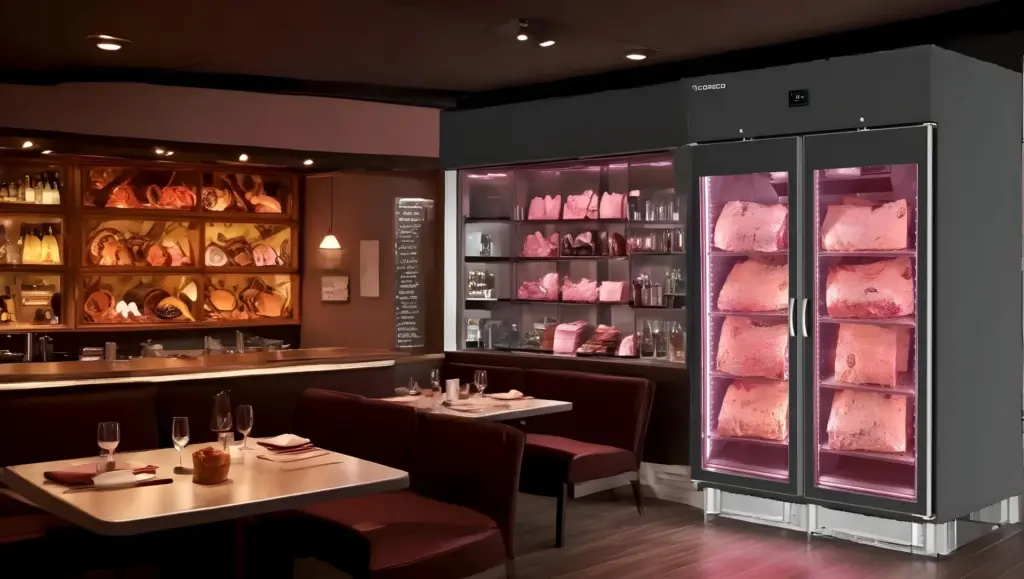
In the CORECO Gourmet maturation cabinets, the Master Ageing Controller helps to control the essential parameters of the process and facilitates more orderly maturation. In the day-to-day operations of a restaurant, this does not replace the review of the equipment or the cleaning routine, but it provides a technical basis for working with less improvisation.
For the kitchen, the room, and the technical staff, the key is to understand that technology helps when it is part of a method: identifying the pieces, controlling openings, checking the condition of the cabinet, and communicating any issues in a timely manner.
Points that are worth reviewing in daily use
1. General condition of the closet
The restaurant must visually inspect the overall condition of the equipment and the product. It is not about performing a complex technical inspection every day, but about detecting obvious changes or situations that it is advisable to consult.
Basic points:
- internal order;
- visible cleanliness;
- correct closing of doors;
- placement of the pieces;
- absence of elements extraneous to the process;
- normal team behavior;
- any change that draws attention.
If something doesn't fit, the prudent thing to do is to note it down and consult with the internal responsible person, the installer, or the technical support through the appropriate channel.
2. Placement of the parts
The placement influences the product’s tracking and the internal circulation of air.
It is advisable to avoid an improvised load. The pieces must be placed in an orderly manner, with sufficient space and following the criteria defined by the restaurant and the available technical documentation.
Not all ingredients are processed the same way. Therefore, the kitchen team must be clear about what goes in, when it goes in, and with what gastronomic purpose.
3. Control of openings
In a restaurant, the pace of service can lead to opening the wardrobe more times than necessary. This can affect the stability of the environment.
It is not about preventing the normal use of the equipment, but about using it wisely:
- avoid unnecessary openings;
- organizing the loading and removal of product;
- not use the closet as auxiliary storage;
- Keep their role clear within the operational framework.
A maturation cabinet should not become a support piece for any product.
4. Hygiene and cleanliness
Cleaning must be defined from the beginning.
In a Dry Aged environment, hygiene cannot depend on “when there is time”. It must be part of the restaurant’s routine and adapted to the actual use of the equipment.
It is useful to define:
- who cleans;
- when it is cleaned;
- which parts are reviewed;
- which products or methods are compatible with the manufacturer's documentation;
- which incidents must be reported;
- which tasks require technical support or professional review.
To expand on this point, you can consult the guide on cleaning a Dry Aged cabinet.
5. Product follow-up
Every restaurant should have a clear way of knowing what piece is in process, when it is being prepared, and where it is going.
It can be done with a simple system, but it must exist.
The minimum information that is worth monitoring:
- date of entry;
- type of part;
- supplier or internal batch, if applicable;
- location within the closet;
- intended destination;
- responsible for follow-up;
- Relevant observations.
It is not about creating an excessive administrative burden. It is about preventing the process from relying solely on the memory of the computer.
The kitchen and the living room should share the same criteria.
Cooked meat doesn’t only live in the kitchen. In many restaurants it is also explained in the dining room.
Therefore, it is advisable for the kitchen and the dining room to share a common language. The dining room team does not need to become a technical expert, but they must be able to explain the product clearly and without exaggeration.
Ideas worth passing on:
- what is matured meat;
- why the restaurant employs her;
- what it adds to the gastronomic proposal;
- why it is exposed, if the closet is visible;
- What difference is there between preserving and maturing?.
If the team needs a simple base, it can rely on the article about Meat maturation Dry Aged.
Common operational errors
Using the closet for other products
A maturation cabinet should maintain a clear function. Using it as an auxiliary storage space can lead to clutter and make it difficult to keep track of things.
Not identifying the parts
If it is not known when a piece entered or what its destination is, the process loses control. Identification does not have to be complex, but it must be consistent.
Improvising the cleaning
Cleaning must be assigned and planned. If no one knows exactly who is responsible, when it is done, or what is being checked, the routine becomes weakened.
Opening the closet without criteria
Openings are part of normal use, but it is advisable to avoid them when they do not add anything. In the hall, in addition, use must be especially careful.
Explaining too much to the customer
The sales team should explain the product naturally, without turning maturation into an excessive technical discourse or an exaggerated commercial promise.
Not reporting incidents
If you cook detects something strange and doesn't report it, the problem can grow. A small incident, noted in time, helps to make better decisions.
Key data before ordering the routine
Before defining good practices, the restaurant should clarify these points:
| Data to be reviewed | Why it matters |
|---|---|
| Type of processed meat | Helps organize follow-up and handling |
| Normal volume of parts | It conditions loading, cleaning, and control |
| Location of the closet | It affects access, the living room, the kitchen, and maintenance |
| Internal responsible | Avoid making control depend on everyone and no one |
| Frequency of use | It influences opening and cleaning |
| Paper in the letter | Helps coordinate the kitchen and the dining room |
| Team formation | Reduce incorrect or exaggerated explanations |
| Support from the installer | It allows for resolving questions about use and maintenance |
For distributors and installers
For a distributor, this article can help explain something important: selling a maturation cabinet doesn’t end with the delivery of the equipment. The professional customer needs to understand how to use it.
Useful questions to ask before closing a project:
- Who will be the internal responsible for the process?
- Will the wardrobe be in the living room or in the kitchen?
- Which parts are going to be worked on?
- What rotation does the restaurant expect?
- How will each piece be identified?
- What cleaning routine will be followed?
- Does the team in the room need a basic explanation of the product?
- What information should the restaurant consult in the manufacturer's documentation?
- What points should the installer check during commissioning?
For the installer, the key is to ensure that the equipment can be used and maintained properly in the real world. Accesses, location, opening, ventilation, and maintenance are practical points that are worth checking before closing the project.
CORECO works through distributors and installers. In maturation projects, the professional channel helps to turn a gastronomic idea into a clear, safe, and sustainable operation in the day-to-day operations of the restaurant.
You can consult the range of CORECO Gourmet meat maturation cabinets or expand general criteria in the article about Meat maturation cabinets and professional use.
Checklist of good practices in restaurants
Before working with cooked meat, it is advisable to check:
- The wardrobe has a clear function.
- It is not used as auxiliary storage.
- The parts are identified correctly.
- There is a person responsible for the follow-up.
- The cleaning routine is defined.
- The kitchen and the living room share a coherent explanation.
- Openings are made with discretion.
- Incidents are recorded and communicated.
- The installer has reviewed the location and accessibility.
- The team consults the technical documentation when necessary.
- The distributor knows the actual use of the customer.
Technical closure
The Meat maturation in a restaurant It works better when the process is organized. The team matters, but routine, hygiene, follow-up, and internal coordination also matter.
A restaurant that works with Dry Aged with discretion not only needs the right equipment. It also needs to know how to use it, who will control it, and how to integrate that product into its daily service.




 Español
 English
 Français
 Deutsch
 Italiano