







The cleaning a Dry Aged cabinet It is part of the professional process of meat maturation. It is not a secondary task or a maintenance procedure: it helps maintain the equipment in suitable conditions for use, facilitates daily control, and reduces operational errors in restaurants, specialized butcheries, and gourmet spaces.
Key data
Cleaning a Dry Aged cabinet is not just a visible hygiene task. It is part of the professional maturation process and must follow a clear routine compatible with the manufacturer's documentation.
Quick response
A Dry Aged cabinet should be cleaned using a clear routine compatible with the manufacturer's documentation and adapted to the actual use of the business. The key is knowing which parts to inspect, who performs each task, and when it is advisable to consult the installer or technical service.
In a few words
- Cleaning must be planned from the very first day.
- It is not advisable to improvise products, methods, or frequencies.
- The interior of the closet should be kept neat and free of extraneous items.
- The parts, trays, supports and surfaces must be inspected using a method.
- Technical tasks must be coordinated with a qualified installer or service provider.
To whom it is addressed
This article is intended for distributors, installers, technical managers, restaurants, specialized butcheries, hotels, and HORECA professionals who work with Dry Aged cabinets or advise professional customers on meat maturation.
This is not a guide for choosing a wardrobe. For that, it is advisable to consult the article on Meat maturation cabinets and professional use.
Why cleaning is part of the Dry Aged process
In meat maturation, the cabinet is not just a cold space. It is a working environment where product, air, humidity, surfaces, supports, and handling all coexist.
Therefore, cleaning should be integrated into the method of use. It’s not about cleaning “when it looks bad.” It’s about having a routine that helps keep the process organized.
In our experience, problems usually appear when cleaning is left undefined:
- No one knows exactly who is in charge;
- Products without checking compatibility are used;
- elements accumulate that should not be there;
- no trays, supports or gaskets are checked;
- Cleaning by the user is confused with technical maintenance.
A simple routine, well explained, usually avoids much of this situation.
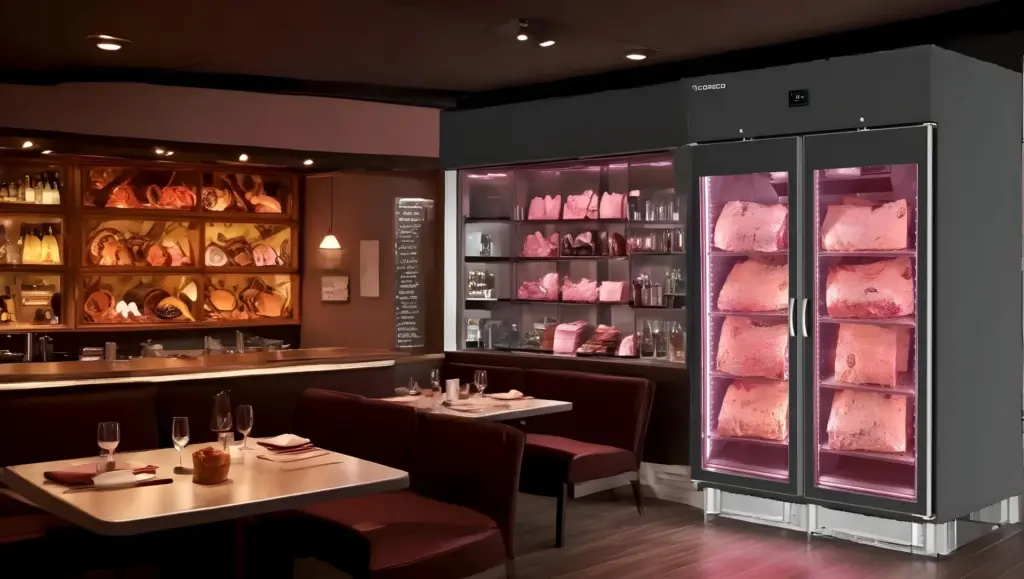
In the CORECO Gourmet maturation cabinets, the Master Ageing Controller helps to control the essential parameters of the maturation process. Nevertheless, cleaning still depends on a well-defined professional routine: surfaces, supports, joints, doors and areas of use must be inspected methodically and in accordance with the manufacturer’s documentation.
What to check before cleaning
Before defining the cleaning a Dry Aged cabinet, It is advisable to review three aspects.
1. Documentation from the manufacturer
The technical documentation should be the main criterion. If there are specific instructions regarding cleaning, compatible products, disassembly or inspection of components, these should be followed.
Data not available in the documentation provided: specific products, specific methods and exact frequencies for each model. Therefore, they are not detailed here.
2. Real use of the equipment
Not all businesses use the wardrobe the same way.
There are differences between:
- a restaurant with a visible wardrobe in the dining room;
- a specialized butcher shop with frequent rotation;
- a hotel with more planned use;
- a technical space that is not visible to the customer;
- a team with a high product load;
- a team with more occasional use.
Cleaning must adapt to that real use, without losing the technical criteria.
3. Internal responsibilities
It should be clear who cleans, who checks and who reports incidents.
If responsibility is distributed in an imprecise way, routine is weakened. It is better to have a simple procedure and a responsible person or team than to rely on “someone else to do it”.
Parts of the closet that need to be checked
The review must be ordered. It is not necessary to turn it into a complex inspection, but it is advisable to have a clear approach.
Inside the closet
The interior must be kept clean, organized, and dedicated to its intended purpose. It is not advisable to use the closet as an auxiliary storage space or to introduce items unrelated to the maturation process.
Review:
- interior walls;
- inner floor;
- support areas;
- visible remains;
- accumulations or spots;
- General order.
Trays, bars or supports
The pieces of meat are usually supported or hung on elements that have direct or indirect contact with the product.
Review:
- visible state;
- accumulated remains;
- correct placement;
- ease of withdrawal if necessary;
- Cleaning after each use cycle, according to internal criteria and technical documentation.
Joints and closing zones
The gaskets help the equipment close properly. They can also accumulate dirt if they are not checked.
Review:
- visible cleanliness;
- remains in folds;
- correct closure;
- Possible deformations or apparent wear.
If a closing problem is detected, it is advisable to notify the installer or technical service.
Doors and windows
In visible cabinets, the door and the glass have a dual function: hygiene and presentation.
Review:
- external markings;
- fingerprints;
- interior remains;
- product visibility;
- General condition of the door.
Exterior cleaning should not be forgotten when it comes to interior inspection.
Disposals, bins or collection areas
If the team incorporates pick-up areas, they must be reviewed according to the manufacturer's documentation.
It is not advisable to manipulate technical elements without discretion. If there are doubts, it is better to consult the installer or the technical support department.
Technical areas
Technical areas should not be manipulated as part of a routine cleaning unless otherwise specified in the documentation.
Here the rule is simple: anything that belongs to technical maintenance must be checked by the appropriate person.
Recommended cleaning routine
The routine can be organized into three moments: before use, during use, and after removing product or closing a cycle.
Before introducing the product
It is worth checking:
- clean interior;
- prepared supports;
- absence of extraneous elements;
- doors and seals in good condition visible;
- sufficient space to place the pieces;
- Identification routine prepared.
This moment helps to start the process in an orderly manner.
During use
During use, cleaning should focus on control and prevention.
It is worth reviewing:
- that there are no unnecessary remnants;
- that the parts are placed correctly;
- that no foreign products are introduced;
- that openings be made with discretion;
- that any incident is reported.
It’s not about constantly intervening. It’s about observing and maintaining order.
After withdrawing product
When a product is retired or a cycle of use ends, it is a good time to clean and review it.
It is worth checking:
- interior surfaces;
- tray or support;
- committees;
- door;
- support areas;
- visible remains;
- the need for technical revision if anything anomalous is detected.
Each business must adapt this routine to its work system and the technical documentation available.
What to avoid when cleaning a dry-aged wardrobe
Using unvalidated products
It is not advisable to use aggressive, perfumed or incompatible products with the equipment without prior confirmation. The choice of products must comply with the manufacturer's documentation and the internal protocol of the establishment.
Improvising disassembly
If a part requires technical disassembly, it should not be handled without clear instructions. Incorrect disassembly can affect the equipment or make it difficult to maintain.
Clean only what is visible
In cabinets exposed to the customer, it is easy to focus on the glass or the exterior. But relevant cleaning also takes place inside, in the supports, seals and contact areas.
Using the closet as an auxiliary storage space
A Dry Aged cabinet must have a clear function. Introducing products outside the process complicates cleaning and monitoring.
Not registering incidents
If a closing problem, an abnormal odor, persistent dirt, unusual accumulation, or strange behavior of the equipment is detected, it must be noted and reported.
User cleaning and technical maintenance are not the same thing
This difference is worth explaining clearly to the professional client.
| User cleaning | Technical maintenance |
|---|---|
| It is carried out by the assigned staff of the business | It is performed by the installer or technical service |
| It focuses on hygiene, order and visible revision | It focuses on operation and components |
| It is part of the daily or periodic routine | It follows a specific technical criterion |
| It should not involve complex manipulation | It may require disassembly or professional repair |
| Helps detect incidents | It helps to solve them technically |
Both tasks are necessary, but they should not be confused.
For distributors and installers
For a distributor, cleaning is a useful point to explain the professional value of the equipment without exaggeration. It’s not just about showing the cabinet, but about helping the customer understand how to use it.
Questions that are worth asking:
- Who will be responsible for cleaning?
- Will the wardrobe be in the living room or in the technical area?
- What products and methods does the manufacturer's documentation allow?
- How often should the interior be inspected based on actual use?
- Who will report incidents?
- What tasks do the user perform?
- What tasks should be left to the installer or technical service?
- Will the equipment be used solely for maturation or is it also intended to be used as a storage support?
For the installer, cleaning also affects the installation. It is advisable to check the accessibility, opening of doors, space for handling parts, the possibility of external and internal cleaning, and ease of future maintenance.
CORECO works through distributors and installers. In maturation projects, the professional channel helps the customer not see cleaning as a burden, but as a natural part of proper use of the equipment.
You can expand the operational focus in the article about good practices in the maturation of meats in restaurants.
Dry Aged Wardrobe Cleaning Checklist
Before accepting the routine as correct, it is advisable to check:
- There is a person or team responsible for cleaning.
- The manufacturer's documentation is respected.
- Unvalidated products are not used.
- The closet is not used as an auxiliary storage space.
- The pieces are placed in an orderly manner.
- Trays, bars or supports are inspected using a method.
- The joints are visually checked.
- Doors and windows remain clean.
- Technical areas are not manipulated without discretion.
- Incidents are recorded and communicated.
- The installer or technical service intervenes when necessary.
- The kitchen and dining room team knows the basic routine.
Technical closure
The cleaning a Dry Aged cabinet It should be understood as part of the professional maturation process. A clean, organized, and well-reviewed team helps work with more control and less improvisation.
The key is not to complicate the routine, but to define it well: what needs to be cleaned, who is doing it, what should not be handled, and when it is advisable to seek support from the professional channel.






 Español
 English
 Français
 Deutsch
 Italiano