







In many HORECA businesses, refrigeration is still purchased as if it were a one-time investment. The entry price is compared, dimensions are reviewed, the finish is validated, and the operation is closed. But the real profitability is not played out there alone. It is played out every day in consumption, in stability, in openings, in cleaning, in recovery after intensive use, in incidents, and in losses.
That is why it is worth changing the approach: the cold is not just a machine. It is a continuous cost line. European regulation has been pushing the market towards more efficient and comparable equipment for years, and the European Commission estimates significant savings for commercial refrigeration users thanks to eco-design and labeling measures. At the same time, Eurostat shows that electricity for non-domestic consumers remains a sensitive line after the big jump in 2022, although it has partially corrected it afterwards.
If we add the F-Gas 2024 framework, which already applies and accelerates the market transition around refrigerants, quotas and restrictions, the purchasing decision no longer just becomes “what equipment do I put in place” but becomes “what cost will I carry for years to come”.
In other words: Cold as an invisible fixed cost in HORECA It's not a theoretical idea. It's a more realistic way of understanding profitability.
When the purchase price no longer explains the real cost
There is a very common mistake in HORECA projects: reducing the comparison to two budgets and assuming that the cheapest team is the most profitable option.
It usually doesn't work that way.
A team can enter with better price and leave worse in operation if it consumes more, if it recovers worse after openings, if it requires more interventions, if it complicates cleaning, if it speeds up small repeated deviations or if it generates more stress in service. And those differences don’t always appear in the first month. They appear throughout the year, when the business is already running and correcting them costs more.
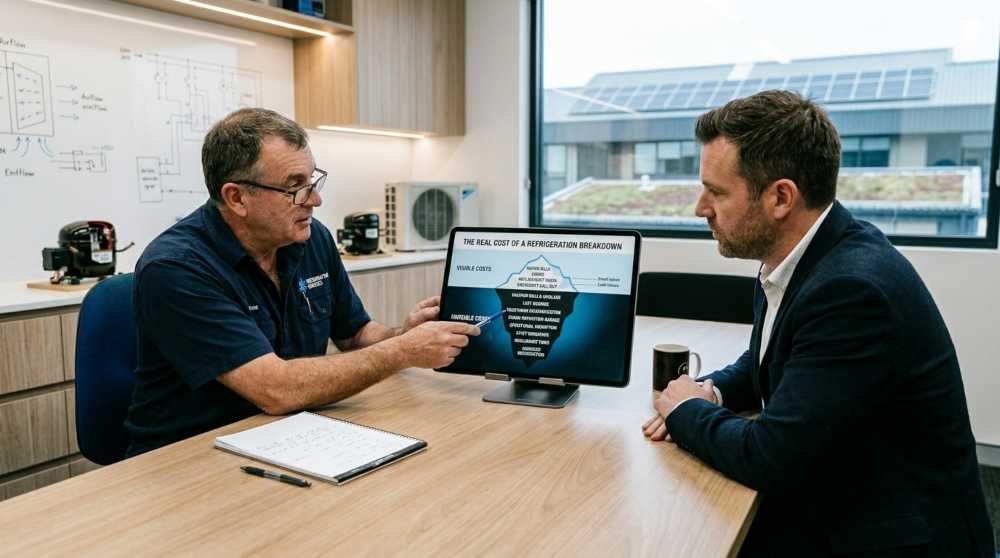
| Visible cost when buying | Costs that appear later |
|---|---|
| Equipment price | Accumulated energy consumption |
| Transport and installation | Averías, technical visits and stops |
| Launch | Loss of product and silent decline |
| Finish or aesthetics | Extra operating and cleaning time |
| Technical specifications | Future risk of maintenance and servicing |
This connects directly to the approach of How professional refrigeration impacts the real profitability of a HORECA business and also with How to sell industrial refrigeration equipment without relying solely on the technical specificationsThe problem is usually not the isolated data, but what that data causes in real use.
What is really happening in the day-to-day operation
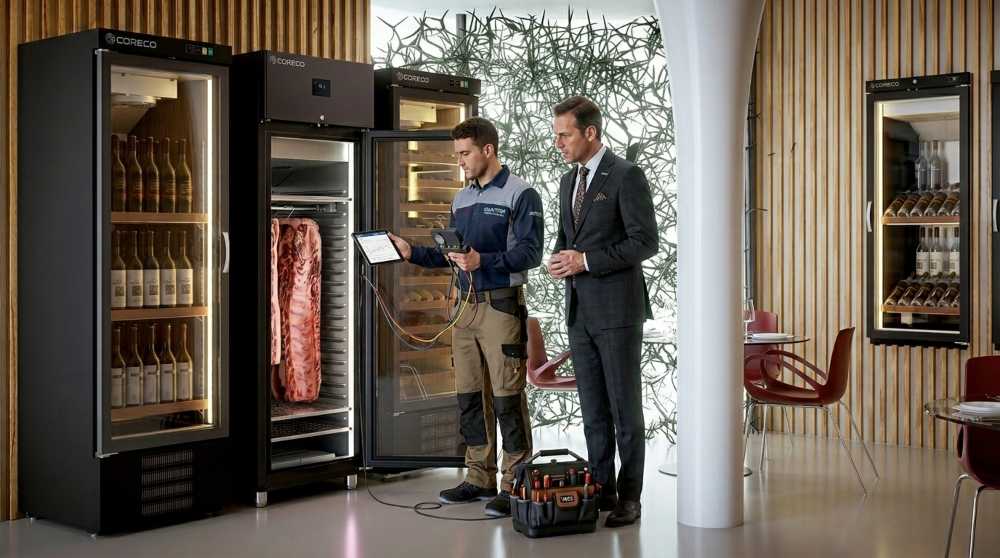
In the kitchen, bar, dining room or preparation area, cold doesn’t “show” when it’s working properly. It becomes visible when something goes wrong:
- The temperature takes longer to recover
- the door opens more than expected
- The condenser gets dirty at peak workload
- The camera is well-sized in liters, but poorly used
- The critical product rots worse than it seemed flat
- Conservation, support and exhibition are combined in one team
- Cleaning takes longer than the operational team can handle
That’s where the silent losses begin. They don’t always come as a serious malfunction. Sometimes they come as small, repeated inefficiencies: more opening seconds, more frost formation, more compressor stress, more ambient heat around, more mess in the replenishment, more product that “holds up,” but worse.
The economic result usually appears in four places: energy bill, service calls, lost time, and unproductive time of the human workforce.
Diagnostic questions that are worth asking before deciding
Before talking about references or ranges, it is advisable to pause and take a look at the operations.
Diagnostic questions
- What is the most sensitive product that will depend on that equipment?
- Will the team keep the service, support it, expose it, or do several things at the same time?
- How many actual openings will there be during peak hours?
- What ambient temperature will it withstand in normal use, not under ideal conditions?
- Does the planned rotation coincide with the actual rotation of the business?
- What cost does an hour of downtime at that point in the process entail?
- What is the distortion today and where exactly does it appear?
- What part of the problem is equipment and what part is installation, cleaning, charging, or usage habits?
- Is there a record or is it just perception?
- Is the initial price being compared or the accumulated cost?
These questions greatly change the commercial conversation. They force us to move away from “how much does it cost?” and into “what is going to cost me to keep this decision alive?”. That shift in perspective is one of the most useful for the distributor, installer, and professional customer.
What to ask for so as not to make a decision blindly
If there are no minimum data, the purchase is made with too many assumptions.
Practical checklist
- type of business and real usage range
- critical product and daily volume
- plan with holes, ventilation and access
- usual ambient temperature in the working area
- estimated number of openings by segment
- loading, replenishing and closing times
- planned cleaning system
- Preventive maintenance available or not
- background of incidents at the premises
- Main criteria for decision-making: consumption, reliability, aesthetics, capacity or control
- Expected lifetime of the installation
- forecast of growth or change of business model
When this tab is missing, there are many “correct purchases in the catalog” but weak ones in operation. That’s why it makes sense to also check. The role of the professional refrigeration manufacturer in HORECA Gourmet projects y Regulations in professional refrigeration and how they influence purchasing decisions in HORECA. The clearer the initial clarity, the fewer expensive corrections are needed later on.
Where the continuous cost is generated
Energy: the cost that repeats without asking permission
Energy is not just a bill. It is an indicator of how the system is working.
A team may consume more than expected for several reasons:
- Poor heat dissipation
- dirt in condensation
- Very frequent openings
- un unfavorable location
- insufficient isolation in the practice of use
- Poor control of cycles
- overdemand due to a mix of functions
European regulation insists precisely on this aspect: eco-design, labeling and comparability are not just a formal issue. They are a way to reduce uncertainty and push for less blind decisions. The European Commission includes professional refrigerated cabinets, evaporators, condensing units and process chillers within these frameworks, and attributes these measures to significant savings for users of commercial refrigeration on an EU scale.
Averías: they don't just cost for the repair
A malfunction rarely costs only the technical part.
It also costs in:
- service reorganization
- committed genre
- hours of unproductive team work
- Urgency for purchases or transfers
- Operational tension
- wear and tear in the relationship with the end customer if the distributor responds
Therefore, in a professional environment, reliability is not an abstract quality; it is an economic variable.
Diminution: the loss that is often not attributed to the cold
Not all shrinkage comes from cold, but many sensitive products depend on their stability.
Sometimes loss is not “wasteful product”. Sometimes it is product that loses its condition, shelf life, texture, perceived safety, or consistency among services. That degradation costs money, although it is not always seen as a defect.
Here the classic mistake is to think that as long as it’s “cooling off,” everything is fine. Not always.
Operation: the human cost also counts
There are teams that force everyone to work around the team; and there are teams that help to organize the work.
The difference appears in:
- Ease of loading and unloading
- Cleaning
- access to product
- control reading
- replacing
- discipline of use
- reaction time to a diversion
That time is also an expense. Only that it doesn't always come out in a separate line.
Plausible example: two teams, two different results
Assumption: A restaurant compares two solutions for positive preservation in the preparation area. Option A is cheaper. Option B is better controlled, has better cleaning accessibility, and better recovery in intensive use.
If the business has high turnover, frequent openings, and a demanding environment, it is reasonable that the cheapest option ends up generating more consumption, more operational stress, and more minor incidents. It doesn’t take a major breakdown to lose money. Just a system that every day forces you to “compensate” with more attention, more time, or more product to the limit.
That is the type of ongoing cost that usually falls outside the initial budget.
What mistakes are repeated when buying cold products just because of the price?
Error 1: comparing only the front panel
They compare liters, power, price and finish, but not the logic of real use.
Error 2: not separating conservation from exhibition
When the same team tries to solve too many functions, it usually penalizes some of them.
Error 3: Ignoring openings and peaks
The camera “locks” well in the flat position, but not in use.
Error 4: neglecting maintenance and cleaning
The cost doesn't appear on day one, but it does appear.
Error 5: Buying without a clear regulatory horizon
F-Gas 2024 and the efficiency framework make some decisions more influential than others.
Error 6: treating the cold as an accessory
In many HORECA concepts, cold holds the pace, quality and margin. It is not peripheral.
The real role of professional refrigeration
It is worth saying it simply: professional cold does not on its own fix a bad operation. But it does support processes.
He claims:
- Thermal stability
- control
- repeatability
- lower operational risk
- Better incident reading
- better organization of work
That’s why the right conversation isn’t “which machine meets the requirements.” The right conversation is “which system helps ensure this process is stable and profitable.”.
And this links to another clear evolution of the sector: the operation increasingly demands more control, more traceability, and less delayed reaction. Professional refrigeration connected in HORECA kitchens: control and traceability It follows this line: detect earlier, record better, and decide with less intuition when the margin tightens.
How to turn theory into a real operating system
Step 1. Identify the critical point
Not all teams weigh the same. It is necessary to identify which one affects the product, service or image the most.
Step 2. Measure openings and actual load
Without that measurement, the sizing is often insufficient or poorly oriented.
Step 3. Review installation and environment
Location, ventilation, heat sources, circulation, and access all greatly affect actual performance.
Step 4. Establish a minimum maintenance routine
Cleaning, visual inspection, joint control, loading order and response to an alarm.
Step 5. Separate responsibilities
What does the user do, what does the installer check, what does the SAT validate, what should the technical manager monitor.
Step 6. Review the total cost at regular intervals
Not just consumption. Also issues, downtime, dead time and ease of operation.
Recommended minimum operational routine
Diario
- check working temperature and visible deviations
- reviewing loading order and anomalous openings
- confirm correct closure and basic cleaning
Weekly
- Check for visible dirt, drainage, and usage habits
- detecting small repeated patterns
Monthly
- reviewing consumption, incidents, and peak behavior
- decide whether a habit, installation, or maintenance needs to be corrected
Quarterly
- evaluate whether the team continues to respond to real-world usage
- compare the expected cost vs the observed cost
Block for distributors: how to explain it to the professional customer
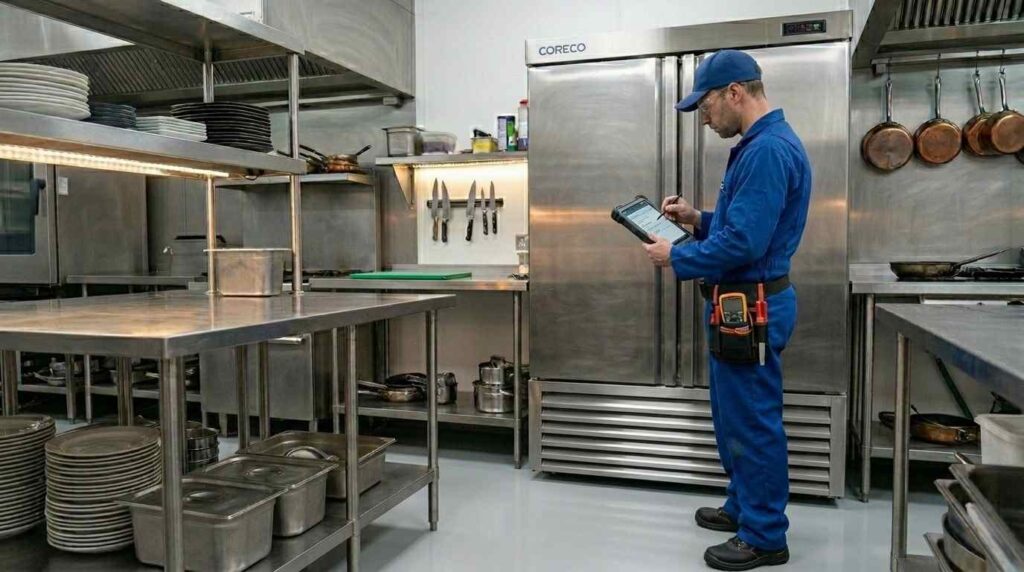
When the customer says “this voucher is worth less”, many times they are not asking for a discount. They are asking for reassurance to justify a decision.
A useful way to explain it is this:
The price is paid once. The operation is paid for every day.
We are not just comparing a refrigerator. We are comparing how much it will cost you to maintain, work on, and repair it over the years.
If the team consumes more, recovers worse, or has more issues, the initial difference can be erased very quickly.
Professional, cheap and profitable cold are not always the same thing.
The question isn’t how much it costs to buy it. The question is what the total cost is when the business is actually working.
This type of argument is especially well suited to customers who have already suffered at least one of these three problems: energy bills, outages, or reduced performance. And it matches what many distributors value when selling: reliability, reparability, technical support, and the ability to defend the decision beyond the initial price.
What information should the distributor ask for to better size the product?
- most sensitive product
- Actual volume per band
- peak hours
- ambient temperature
- opening frequency
- Team role within the process
- history of problems
- customer priority: consumption, control, aesthetics, reliability or price
- Growth forecast
- maintenance available
With this base, the conversation changes from “give me a price” to “give me discretion”.
What changes in practice
- Purchasing cold as a one-time expense is no longer done, and reading is instead seen as a continuous cost.
- Energy is gaining in importance, but not in isolation: it adds to breakdowns, downtime and time lost.
- Stability becomes an economic criterion, not just a technical one.
- Preventive maintenance no longer becomes “optional” if the margin is narrow.
- The distributor adds more value when interpreting usage and risk, not just the catalog.
- The regulations weigh more because they affect efficiency, comparability, and the service horizon.
- Useful connectivity gains importance when it helps detect deviations before product is lost.
- Profitability improves when cold is integrated into the process, not when it is chosen as insulation.
FAQ
Why do we talk about invisible fixed costs and not just consumption?
Because the accumulated cost of cold includes energy, yes, but also breakdowns, downtime, technical visits, cleaning, idle time, and operational stress.
Does a more expensive team always perform better?
No. The team that fits best with usage, installation, maintenance, and business goals performs better. The mistake is believing that the initial price alone explains profitability.
Where does loss usually appear first?
Normally in consumption, small repeated deviations, worse work organization or incidents that do not lead to serious damage but wear down the operation.
How do I know if I am buying the wrong product?
When the comparison is made solely by feature and price, without a critical product, without real openings, without an environment, and without a routine of use.
Does the regulation really influence the cost?
Yes. It affects minimum efficiency, comparability between devices, future availability of certain solutions, and the cost of service associated with the regulatory framework.
What can the distributor do to sell more effectively?
Requesting better information, translating the total cost and not sticking to isolated specifications. That’s where it really gains value compared to a purely price comparison.
Is connectivity worth it in all cases?
Not always at the same level. But even a basic level of alarms, recording, or visibility can help detect a silent loss sooner.
What should a HORECA business with recurring incidents first check?
Real use, openings, cleaning, installation, ambient temperature and maintenance. Often the problem is not just the “machine”.
Glossary
Total cost of ownership (TCO)
Sum of the purchase cost and the accumulated cost of use, maintenance, incidents and operation.
Thermal recovery
The team's ability to return to its work range after openings or loading.
Merma
Economic loss due to a product that is deteriorated, degraded or unusable.
Eco-design
European framework that sets minimum efficiency and design requirements for certain categories of products.
Energy labeling
System that allows comparing certain equipment based on efficiency and consumption criteria within the applicable regulatory framework.
F-Gas
European regulation on fluorinated greenhouse gases, with impact on quotas, restrictions and technological transition.
Refrigerant
A fluid that enables the refrigeration cycle. Its choice affects performance, safety, service, and regulatory horizon.
Preventive maintenance
Set of reviews and routines that seek to prevent failures before they lead to downtime or losses.
Thermal stability
The ability to maintain consistent conditions in real use, not just under ideal conditions.
Traceability
Ability to record, track, and justify relevant operational data, especially useful when importing control and evidence.
CORECO Integration
At CORECO we understand this point in a very concrete way: professional refrigeration must help distributors and installers make informed decisions, not just through a catalog. That’s why it makes sense to discuss operation, maintenance, control, regulations, and profitability within the same conversation.
It’s not about promising that a team “resolves everything.” It’s about recognizing that a well-defined cold chain reduces uncertainty, supports processes, and helps protect margins in businesses where every misstep ends up costing money.
Close
When it is understood Cold as an invisible fixed cost in HORECA, The conversation changes.
No longer just buying a team. A decision is made:
- How much operational risk is accepted
- How much consumption is being dragged along
- How much decline is tolerated
- How much correction time is incorporated into everyday life
- and how much real margin is wanted to be protected
That change in focus usually improves both the technical and the commercial decision-making.
If you are considering a new installation or are reviewing a replacement, talk to your trusted dealer or installer and consider purchasing the product on a total cost basis, not just the price at the initial stage. That is usually when a better decision can be made.




 Español
 English
 Français
 Deutsch
 Italiano