






The wine cabinets for restaurants and gourmet shops They should not be chosen solely for aesthetics or capacity. When wine is part of the business’s offering, it matters how it is preserved, organized, and served. That’s why a good decision doesn’t start with the model but with real use.
In the hospitality and gourmet retail sectors, a cava can help to better preserve the wine, organize the stock, facilitate service, and enhance the perception of quality. But that only happens when the team fits the rotation, the space, the menu type, and the daily operations.
The essentials in a few lines
Wine cavas for restaurants and gourmet shops: what they are and what they serve for
The wine cabinets for restaurants and gourmet shops They are designed to preserve bottles in more stable conditions than a general-purpose refrigerator or a bottle cooler designed for quick service. Their value lies not only in cooling, but also in helping to maintain temperature better, protect the product, and streamline wine management in the business.
.In practice, they usually fulfill three main functions:
It is advisable to set a clear difference from the beginning: it is not the same thing to have wine stored and ready for immediate service. Nor is it the same thing to have a specific cava for wine versus a bar bottle or a conventional refrigerator. If you want to delve deeper into that comparison, you can see it here. Store the wine in a bottle opener or refrigerator.
Conservation of wine in refrigerated cellars
The Conservation of wine in refrigerated cellars Importing because wine is sensitive to its environment. When stored with fluctuations, constant openings, or unstable conditions, it may lose some of its expression and arrive at service in less consistent conditions.
Temperature: the variable that most influences the result
Temperature is the most visible reference when talking about wine, but it’s important not to simplify it. Not all wines are made the same way and the same goal isn’t always pursued: one thing is to preserve and the other is to serve. Therefore, when the range of products is varied, it may make sense to check whether a single area is sufficient or whether the business needs a more flexible setup.
If you want to fine-tune this part, you can expand on the guide about optimal temperature for wine in chilled cavas.
Humidity: important, but within a stable system
Wine does not depend solely on cold temperatures. It is also important that the environment is neither excessively dry nor cluttered. In corked bottles, poorly-maintained preservation can damage the closure and affect the product over time. It is not necessary to turn this guide into an oenological manual, but it is worth remembering that cava should help reduce deviations, not multiply them.
The Light: a visual advantage should not be at the expense of the product
In a restaurant or gourmet shop, a visible bottle of cava can add commercial value and strengthen the image of the business. But that visual advantage must coexist with its preservation function. If a bottle of cava is chosen solely for aesthetic reasons and not for actual use, the result is often insufficient.
The importance of proper wine conservation
Good conservation not only protects the wine; it also protects the consistency of the business's offering.
In a restaurant, it influences:
In a gourmet store, you can influence:
When wine becomes an active part of the business, improvising its preservation often comes at a cost. Sometimes not in breakdowns or visible incidents, but in small accumulated errors: bottles placed in the wrong place, confusing rotation, forgotten references, or inconsistent service.
Benefits of using refrigerated wine coolers in restaurants and gourmet shops
The real benefits of a well-chosen cava are not limited to “having better wine”. In day-to-day operation, a good decision can help several things at once.
| Benefit | What It Brings In Practice |
| Better Conservation | Helps maintain more stable conditions for the wine |
| More Order | It facilitates the organization of the stock and the rotation of bottles |
| More Consistent Service | It allows the wine to be worked on better more often. |
| Best Presentation | Strengthens the image of quality in the room or in the store |
| More Commercial Criteria | Helps work with premium references more safely |
Improves the customer experience
When wine is served in better conditions, the customer's perception also changes. It's not just about temperature, but about consistency and care.
It helps to organize the menu and the stock
A well-used cellar can simplify access to references, prevent forgotten bottles from being lost, and make the management of operational inventory more clear.
It strengthens the image of the business
In gourmet settings, wine also communicates. A well-integrated and sophisticated cava conveys order, specialization, and meticulous attention to product quality.
Durability and low maintenance
The wine cellars of Coreco Gourmet are built to last. We use high-quality materials that guarantee a long lifespan and low maintenance requirements. This means restaurant and shop owners can focus on what they do best: offering an excellent experience to their customers, without worrying about maintaining their refrigeration and wine storage equipment.
It brings more criteria to expand the offer
When conservation is better resolved, it is easier to work on a somewhat more ambitious selection without improvising the storage.
New products in the Wine range in 2026
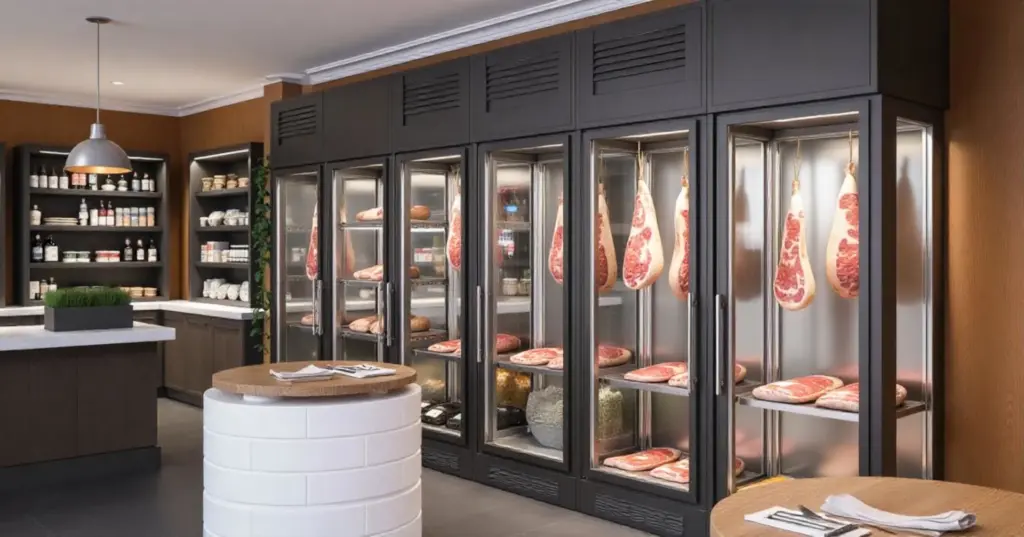
In 2026, the CORECO Wine range is expanded with a clearer logic of use and project. The novelty lies not only in incorporating new references, but also in organizing the proposal into three complementary lines: Vinotecas LUX for spaces where the preservation and visual presence of the wine play an important role, wine display cabinets to strengthen the visibility of the product, and wine cellars for projects where conservation, exhibition and integration into the local environment must coexist in a single solution.
Within that evolution, the Vinotecas LUX they provide a more versatile proposition for restaurants, wine bars and gourmet retail: they operate in a range of +5 °C to +18 °C, They are available in two heights, They allow you to configure the capacity according to the type of shelf and offer bi-temperature option with a separator and independent controller. To this is added a construction designed to improve the visual reading of the product, with LED perimeter lighting and different shelf solutions depending on how the bottle is to be preserved and presented.
How to choose the ideal wine cava
Choosing a good cava starts with defining the need, not by looking at isolated technical specifications.
Diagnostic questions before deciding
Before comparing models, it is advisable to answer the following question:
What information is worth gathering before choosing
| Date | Why It Matters |
| Reference Number | Define the actual scope of the letter |
| Volume of Bottles | Helps calculate useful capacity |
| Types of Wine | It affects the criteria of conservation and service |
| Rotation Media | Choose whether to prioritize fast access or more stable preservation |
| Location | It conditions openings, visibility, and usage |
| Available Space | Avoid choosing a solution that doesn't fit later on |
| Business Priority | It helps to decide whether conservation, service or exhibition is more important. |
Useful capacity versus theoretical capacity
One of the most common mistakes is to only look at the theoretical number of bottles. In real operation, it matters a lot how the interior is organized, what formats are handled, and what accessibility the equipment needs. A very large cellar that is poorly used can perform worse than a more tightly fitted cellar, but one that is well planned.
One area or several
It’s not always necessary to complicate the decision. But if the business sells several types of wine or combines preservation and service with some intensity, it’s worth reviewing whether a single configuration is sufficient.
Tips to maximize the use of a wine cellar
A well-chosen cava can be disastrous if used as an improvised storage space. That’s why it’s worth translating theory into concrete routines.
In everyday life
Every week
Every certain time
Common mistakes when using wine corks in restaurants and gourmet shops
| Problem | Probable cause | What to Review | Recommended Action |
| The Cava Is Chosen Only for Aesthetics | Image is prioritized over usage | Real function of the team | Check whether the cava is designed to be preserved, served or displayed |
| The Stock Is Disorganized | There is no rotation policy | Interior distribution | Reorganize by usage and frequency of output |
| The Team Is Short-Staffed or Overstaffed | It was chosen without data | References, volume and space | Resize with real information |
| It is Used as a Replacement for a Bottle Holder or Refrigerator | Functions are combined | Type of service and maintenance | Clearly distinguish between conservation and service |
| Operation No Companion | Lack of routine of use | Frequency of opening, ordering, replenishment | Defining responsibilities and basic guidelines |
Profitability from the beginning
Block distributors
How to explain it to the professional client
What information to ask to properly dimension the product
Quick checklist before deciding
Frequently asked questions about wine cavas for restaurants and gourmet shops
No. They may coincide in part in their use, but they do not respond equally to conservation, service, and stability. If you want to delve deeper into that difference, you can see it in Store the wine in a bottle opener or refrigerator.
It depends on the variety and the use. When the mix is varied, it is advisable to review the configuration and thermal criteria.
Yes, if the wine is part of the customer experience and if the operation supports that decision.
Both things matter. One without the other usually leads to a mediocre solution.
Yes, especially if you want to improve the product and strengthen the perception of specialization.
Choosing the team without first defining the actual function it must fulfill.
Basic glossary
Cava De Vino
A device designed to preserve wine in more stable conditions.
Storage
Maintaining wine in a suitable environment during its storage. Equipment designed to preserve wine in more stable conditions
Service
Preparation of wine for consumption or immediate sale. Equipment designed to preserve wine in more stable conditions
Rotation
Speed of entry and exit of bottles.
Thermal Zone
Space or range of the equipment configured for a specific temperature.
Usable Capacity
Space really usable in daily operation.
Display
Use of the cava as a visible part of the offer.
Stability
The team's ability to maintain consistent conditions.
What is important to be clear about before deciding
In a wine list or in a gourmet shop, a cava should not be chosen solely based on design or the number of bottles. What makes the difference is that it fits the actual use of the business: type of wine, rotation, space, service, and level of exposure to the customer.
At CORECO Gourmet we often see that when that decision is made with a clear mind from the beginning, it is easier to better preserve the wine, to organize the operation and to give more consistency to the business proposal. If you also want to review the more specific part of temperature, you can expand on it. optimal temperature for wine in chilled cavas. And if you want to see the related product family, you can check it out refrigerated wine.
Before deciding on a solution, it is advisable to review these data with your distributor or installer. If the need is well defined, it is also easier to get the right capacity, configuration, and usage method.




 Español
 English
 Français
 Deutsch
 Italiano