







An efficient winery is not defined solely by the number of bottles or by the aesthetics of the cava. In a restaurant, it works well when the wine is brought in, stored, located, served, and replenished without friction. In other words: when space, capacity, and operation work in the same direction. This guide explains how to set up an efficient winery in a restaurant step by step: space, capacity, flow, and equipment.
If what you need is a general foundation on conservation, use and choice of equipment, it is advisable to start with this. guide to the use of wine cavas in restaurants and gourmet shops. In this article we will focus on another part of the problem: how to design an efficient wine cellar in your restaurant, from the space, implementation, capacity, and operational flow.
What is an efficient wine cellar in a restaurant?
An efficient winery is one that responds well to the real use of the business. It is not just about preserving wine; it is about making it compatible with the service, the rotation of references, the available space, and the experience that the restaurant wants to offer.
In practice, an efficient winery should help to:
- Keep the wine organized and locatable.
- Avoid unnecessary travel during service.
- Better separate the operational stock from the support stock.
- Reduce openings, errors, and unnecessary manipulations.
- Integrating the conservation of wine within the real logic of the restaurant.
When that is not defined, the bodega ceases to be a system and becomes a collection of bottles distributed among the bar, the cabinets, the kitchen and the warehouse.
Warehouse design in a restaurant: what to decide before choosing equipment
Before considering a specific cava, it is advisable to define the role that the winery will play within the restaurant. This preliminary step often determines the quality of the result more than the technical specifications alone.
Diagnostic questions
- Does wine have an important commercial role or does it serve a more supporting function?
- Is the stock running out quickly, or is there a portion of the stock that remains for weeks or months?
- Does the restaurant sell more by the glass, by the bottle, or in a mixed format?
- Is wine actively recommended in the dining room or is it consulted less?
- Does the operation require quick access or does quiet preservation take priority?
- Is there room to separate visible stock and support stock?
- Should the cellar be seen or should it work in the background?
What the cellar design should cover
| Decision | What is the advantage of defining it? |
|---|---|
| Function | Conservation, service, exhibition or a combination of the three |
| Location | Hallway, bar, back office or mixed solution |
| Capacity | Working capital, supporting stock and growth margin |
| Flow | Reception, storage, replenishment and service |
| Integration | How the team lives with the space and the staff |
Space for an efficient wine cellar in a restaurant
Space is not just a matter of meters. It is also a matter of routes, ambient temperature, accessibility, and the logic of work. An efficient warehouse begins to take shape when it is decided where it should be located.
When is it advisable to bring part of the wine into the room?
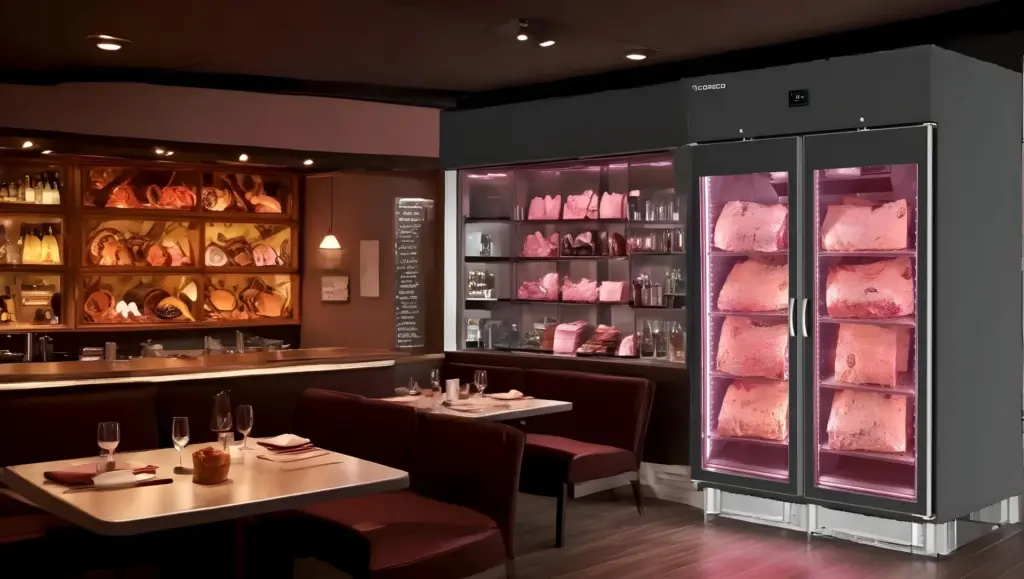
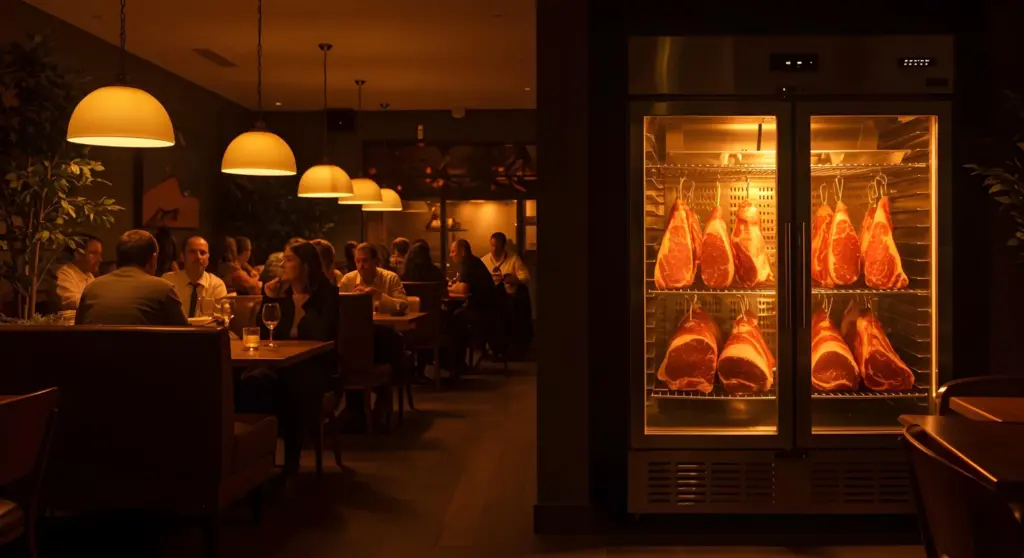
The room makes sense when wine is part of the customer experience, when recommendation plays a role in sales and when visual presence helps reinforce the restaurant's offering.
It can work well in these cases:
- Restaurants with a curated and visible wine list.
- Wine bars or concepts where wine takes center stage.
- Restaurants that want to use cava as part of the ambiance or the story of the establishment.
But it also has requirements:
- More openings.
- More exposure to the rhythm of service.
- More need for visual order.
- More discipline in restocking and cleaning.
When is it advisable to bring the warehouse to the back office?
The back office usually works better when stability is prioritized, when the stock is larger, or when the restaurant needs to work more calmly on replenishing supplies and maintaining internal order.
It is usually useful in these scenarios:
- Restaurants with a significant portion of the wine out of the customer's sight.
- Operations with more supporting references than exhibition ones.
- Places where the room does not allow for a clean integration of the equipment.
When a mixed solution is advisable
In many restaurants, the most effective solution is not choosing between the front office or the back office, but rather distributing functions.
For example:
- A portion of the wine visible and accessible for recommendation or immediate service.
- Another part in support for replenishment, slow deliveries or wider stock.
This logic usually helps balance image, conservation, and operational aspects.
Quick comparison: room, back office or mixed model
| Location | When it fits | Advantages | Limitations |
|---|---|---|---|
| Sala | Wine is part of the experience and the sale | Visibility, recommendation, image | More openings and greater visual demands |
| Back office | Primary conservation, order and support stock | More stability and internal control | Lower direct commercial impact |
| Mixed | Service and maintenance are to be combined | Better balance between operation and image | It requires more organizational acumen |
Capacity of an efficient winery in a restaurant
One of the most common mistakes is to calculate the cellar by theoretical number of bottles. That gives an initial orientation, but it does not solve the operation.
The useful capacity depends on more things:
- Actual number of active references.
- Rotation of each family of wines.
- Bottle formats.
- Need for access during service.
- Separation between operational stock and support stock.
What is actually worth calculating
Rather than just thinking about “how many bottles fit”, it’s better to calculate three layers:
- Operational stock
The wine must be ready for sale or regular service. - Support stock
The wine replenishes the operation, but it does not need to be always available. - Margin of maneuver
The space prevents saturation when the card changes, a special purchase is made, or the rotation increases.
A useful reference for thinking about capacity
| Set | What usually needs to be done |
|---|---|
| Short letter and high turnover | More access and less immobilized volume |
| Half-sheet menu and mixed sales | Balance between access, order and some stock of support |
| Broad letter or more specialized one | More organizational discretion and better separation between visible and backing |
Do not mix capacity with density
Filling a cava too much does not mean using it well. When the organization makes it difficult to locate bottles, replenish them, or work with different formats, the capacity ceases to be an advantage and becomes a problem.
Operational flow of wine in the restaurant
In an efficient restaurant cellar, flow is the first thing to be arranged.
An efficient cellar is not designed just from the storage aspect. It is designed from the entire journey of the wine within the restaurant.
Basic flow that is worth ordering
- Reception
Where the wine comes from and who checks it. - Classification
How it is separated by type, rotation, or destination. - Location
Which part will be visible in stock and which part will be support. - Repositioning
When and how does the wine pass from the support to the operational area. - Service
How the bottle gets to the waiter or the point of departure without any fuss. - Control
How to detect out-of-stock, broken, or out-of-stock references.
What happens when the flow is not defined
- Bottles distributed in various places without a clear plan.
- Too many openings of the same cava.
- Personnel searching for references while on duty.
- Late or improvised repositioning.
- More risk of errors and less consistency in the letter.
Warehouse implementation: how to integrate wine in the warehouse or back office
It’s not just about “putting some cava on the table”. It’s about deciding how the team should live with the space and the daily work.
Integration in the classroom
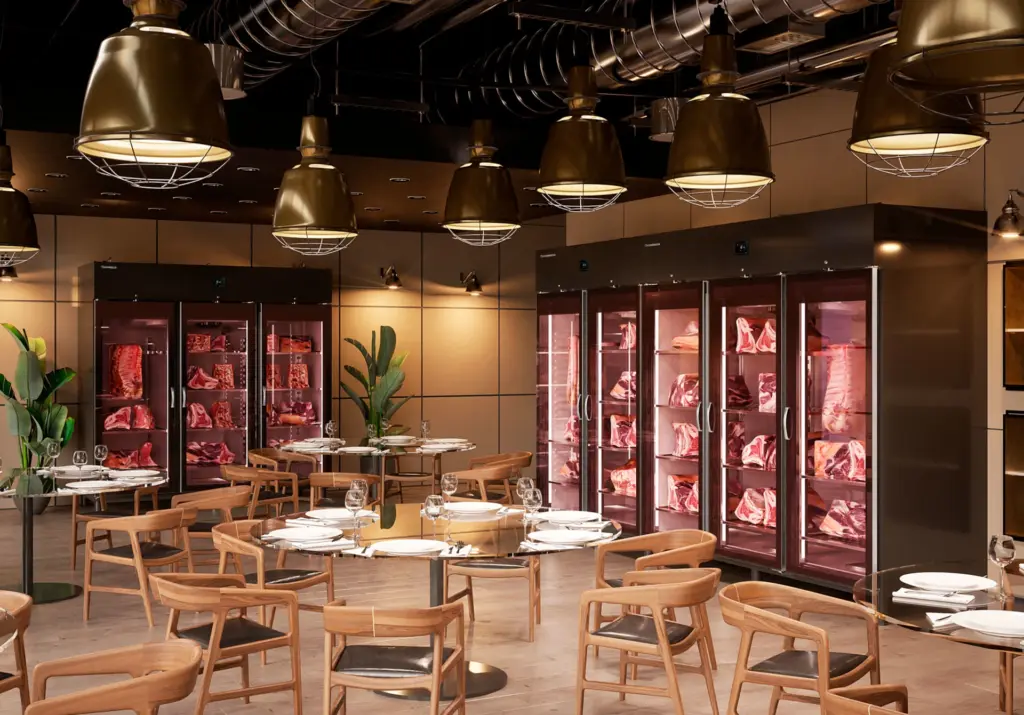
When the cellar is in the room, the installation must take care of both:
- The visual reading of wine.
- The circulation of personnel.
- Accessibility during service.
- The aesthetic coherence with the premises.
In this type of project, the team not only acts as storage; it also forms part of the restaurant's perception.
Integration in the back office
In the back office, the focus changes. The important thing is that the team helps to work better:
- Convenient access.
- Clear repositioning.
- Order by families or rotation.
- Lower exposure to unnecessary openings.
Mixed integration
When there is a visible part and another supporting part, the main criterion is that both areas are connected by a simple logic. Otherwise, the system becomes complicated unnecessarily.
What should be reviewed during implementation
- Distance between the winery and the service point.
- Proximity to heat sources or very busy areas.
- Ease of opening and restocking.
- Real visibility of important references.
- Compatibility with the furniture and the layout of the room equipment.
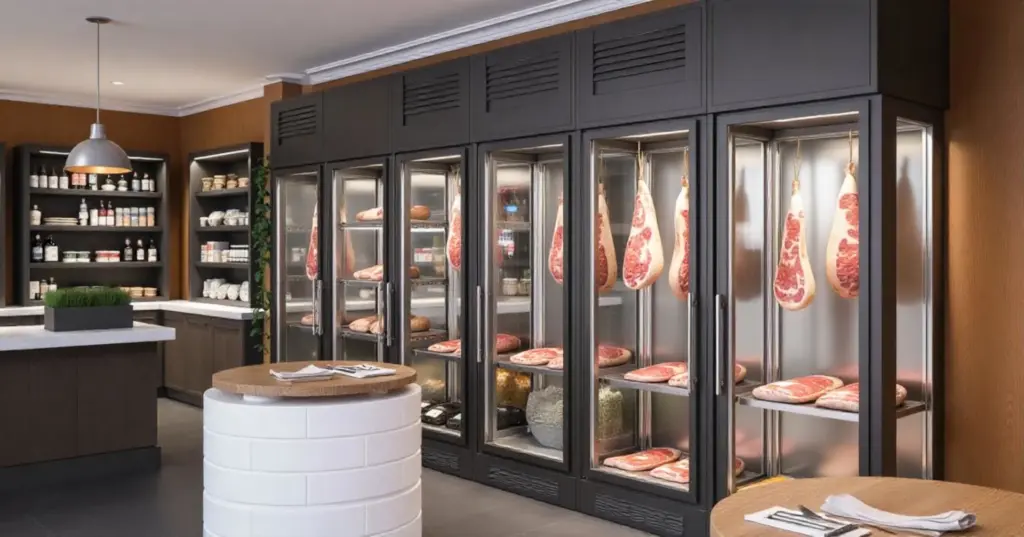
How chilled cavas fit into an efficient winery
In this article it is not necessary to repeat the entire section on general use and maintenance, because that has already been covered in the previous section. The ultimate guide to wine cavas for restaurants and gourmet shops. Here, the important thing is to understand the role of cava within the system.
A well-integrated refrigerated cellar can help to:
- Providing stability to the references that matter most.
- Better separating conservation and service.
- Visually arrange a part of the menu.
- Reduce improvisation in daily work.
If you also want to review the family of related solutions, you can view it in refrigerated wine.
What data is worth collecting before projecting the cellar
With these data, the efficient restaurant cellar is sized without incurring any additional costs.
| Date | What it is for |
|---|---|
| Number of active references | Define the actual size of the letter |
| Rotation by type of wine | Helps decide between access versus storage |
| Sold by the glass or by the bottle | Changes the logic of the operational stock |
| Available space | Conditions implantation and course of travel |
| Level of exposure to the customer | It helps to decide on a room, support or mixed model |
| Bottle formats | It affects the useful capacity and organization |
| Personnel who will handle the wine | It influences the ease of use that the system requires |
Example of guidance
A restaurant with a 40-item menu decides to display part of the wine in the dining room. The first idea is to concentrate everything into a single visible bottle of cava. On paper it seems orderly. In practice, it isn’t always the case.
If the rotation is uneven and some of the references are very low, putting everything in the same solution can create two problems: too many openings on the same team and an internal organization that is not agile enough for service. In such a case, it usually works better to separate a visible part for active sales and a supporting part for replenishment and slower stock.
An indicative example does not replace a specific analysis of the case.
Common mistakes when designing an efficient restaurant cellar
| Problem | Probable cause | What to check | Recommended action |
|---|---|---|---|
| The cellar looks nice, but it works poorly | It was designed from aesthetics rather than from operation | Tours, access, and replenishment | Redefining functions by zone |
| There is insufficient usable capacity | It was calculated using theoretical bottles. | Formats, rotation and real stock | Recalculating from real usage |
| Staff waste time searching for wine | There is no clear organization | Group by family or departure | Rearrange operational stock |
| There are too many openings | All the wine is concentrated in a single area | Service, replenishment and support | Separating the operational area and the backup area |
| The wine doesn't blend well with the decor | The implantation was not thought out with the space | Location, circulation and furniture | Reconsidering the team's position and reading |
What changes in practice when the cellar is well organized
- The wine is located faster.
- The service gains in fluidity.
- The replenishment becomes simpler.
- The letter is handled with more order.
- Improvisation in the room is reduced.
- Space works better for the team.
- The commercial recommendation is more natural.
- The distributor can dimension the product more carefully.
Block distributors
How to explain it to the professional client
- An efficient winery depends not only on the equipment, but also on how it integrates into the operation.
- The space and the journey of the wine weigh as much as the capacity.
- A visible cava does not always solve the entire system.
- Separating operational stock from support stock often greatly improves the result.
- When the implantation is well thought out, the wine sells better and the work is better done.
What information to ask to properly dimension the product
- Number of active references.
- Average rotation per type of wine.
- Type of service: glass, bottle or mixed.
- Available space in the room and support.
- Distance to the service point.
- Need for visibility in front of the customer.
- Bottle formats.
- Real priority of the project: image, conservation, agility or balance among them.
Quick checklist for projecting an efficient winery
- I have defined whether the bodega should preserve, serve, display, or combine functions.
- I know which part of the wine should be operational and which part should remain for support.
- I reviewed the actual route of the wine within the restaurant.
- I have considered whether a room, a back office, or a mixed solution would be appropriate.
- He calculated useful capacity and not just theoretical capacity.
- I have taken into account bottle formats and rotation.
- I have reviewed access points, openings, and replenishment.
- I have thought about how the team will coexist with the space.
- I have compared the decision with the distributor or installer.
- I am clear about who will manage the winery on a day-to-day basis.
Frequently asked questions
Is an efficient winery the same thing as having good cava?
No. The cellar is a part of the system. An efficient winery also depends on space, organization, and operational flow.
Is it always advisable to place the wine cellar in the living room?
No. It makes sense when the wine is an active part of the experience and the restaurant can maintain that exposure well.
Which usually works better: a room, the back office, or a combination?
It depends on the business. In many cases, the mixed solution is the most balanced because it distributes functions.
How do I know if I lack capacity or lack organization?
If the problem isn’t just space, but also search times, excessive openings, or confusing restocking, there’s usually a lack of organization before there are liters.
Should all the wine be at the same point?
Not necessarily. Many operations improve when they separate operational wine from supporting wine.
What weighs more here: conservation or service?
Both things are important, but in this piece the focus is on how to make them coexist within the restaurant's operation.
Where do I see the general part on use and maintenance?
In the guide to the use of wine cavas in restaurants and gourmet shops and, for the comparison of solutions, in Store the wine in a bottle opener or refrigerator.
Glossary
Efficient winery
A wine storage and service system that works well in terms of space, capacity, and operation.
Operational stock
Set of bottles that must be available for normal service.
Support stock
Bottles that serve to replenish the operational stock without always being on the front line.
Implantation
The way the team integrates into the real space of the restaurant.
Useful capacity
A really usable space for working, not just theoretical volume.
Back office
Internal support area where the customer does not interact directly with the team.
Display
Use of wine or equipment as a visible part of the venue's offering.
Operational flow
Wine tour from reception to service.
What is important to be clear about before deciding
If the goal is to create an efficient wine cellar in your restaurant, the question shouldn’t just be what wine to buy. The right question is how you want the wine to work within the business.
At CORECO we often see that the difference between a correct solution and a truly useful solution lies in this point: defining the system well before choosing the equipment. When space, capacity and flow are clear, it is much easier to integrate a warehouse that conserves well, operates with order and truly supports the service.
Check these data with your distributor or installer before deciding. If the warehouse is designed based on actual use, it is also easier to determine its size, capacity, and layout.
If you need help sizing the equipment, the Manufacturer Coreco He can advise you on the project.




 Español
 English
 Français
 Deutsch
 Italiano