







The Law 1/2025 on the Prevention of Food Loss and Waste, better known as the Food Waste Act It requires many operators in Spain to prevent waste and manage surpluses according to a hierarchy: first, prevent waste; if there is a suitable surplus, prioritize human consumption. In practice, compliance is ensured through processes, proper storage, and, when applicable, operational evidence (records and traceability)—not just through a document.
Key Provisions of Law 1/2025 on Food Waste
- The law affects a large part of the supply chain: production, manufacturing, distribution, retail, hospitality/restaurants, institutional food service, and charitable organizations.
- Section 6 of that law sets forth operational obligations (hierarchy, prevention, and, in certain cases, donation agreements).
- In the hospitality and restaurant industry, Article 8 requires establishments to allow customers to take home uneaten food (with exceptions such as all-you-can-eat buffets).
- Key date: MAPA (Ministry of Agriculture, Fisheries, and Food) clarifies that the measures in Article 6 must be implemented one year after publication: April 3, 2026.
- For CORECO (through distributors/installers), its key role is to support “operational compliance”: better maintenance, better record-keeping, and anticipating deviations through alarms.
Updated: March 2026.
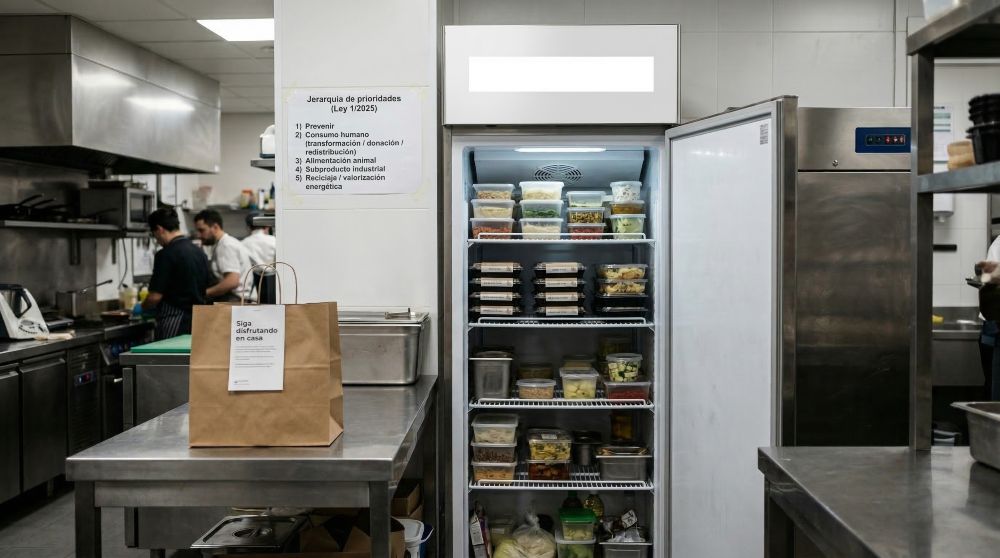
Why is this Food Waste Law Changing the Conversation in the Commercial Refrigeration Industry?
Law 1/2025 aims to reduce losses and waste throughout the food chain and establishes a hierarchy of priorities for action.
This affects day-to-day operations because many losses do not stem from malicious intent: they result from actual operations (opening packages, restocking, overproduction), improper storage, and a lack of documentation during inspections, audits, or donations.
As a professional refrigeration manufacturer that works with distributors and installers, what we see in the field is fairly consistent: when the refrigeration system operates stably and operations are well-organized, preventable waste decreases. And when there is also Logging and Alarms, it's easier to spot deviations before they become a bigger problem.
“This law isn’t just about a piece of paper: it’s about preventing losses and being able to demonstrate a stable process when necessary.”
1) Who is actually affected (and why it's a good idea to check)
The law applies to activities carried out in Spain by food chain operators, including the hospitality and restaurant industries and other food service providers (institutional food service providers).
From a practical perspective in the HORECA and food sectors, the following are typically more prominent:
- Food Retail (supermarkets, stores)
- HORECA (bars, restaurants, hotels)
- Catering and Institutional Services (central kitchens, school cafeterias, hospitals, nursing homes)
- Recipient Entities and Redistribution (food banks, social service organizations)
- Food Industry (storage, shipping, processing)
Diagnostic Questions (Quick and Useful)
- Where does the shrinkage occur: receiving, warehouse, sales floor, service, or returns?
- Is there a recurring surplus (and could it be redirected for human consumption)?
- What evidence is available today: temperature logs, incident reports, and records of donations received and distributed?
- Is the refrigeration equipment easy to maintain (access, ventilation, cleaning), or is it “overworked”?
What to ask for so as not to make a decision blindly
- Routine for Opening and Restocking During Peak Hours
- Simple flowchart: receipt → storage → preparation → service
- Photos of the equipment's location (heat sources, air vents, access points)
- Actual Cleaning/Maintenance Routine (Who, When, How)
2) What does Law 1/2025 on Food Waste actually require?.
2.1 Article 6: General Obligations in Operational Mode
The law requires prioritizing prevention and applying a hierarchy of actions, and it encourages adopting a prevention-oriented approach and, in certain cases, promoting agreements to donate suitable surplus food (or justifying why this is not feasible).
In practice, this results in a verifiable system:
- identify areas of loss
- reduce losses in purchasing, receiving, storage, and service
- Determine what to do with eligible surplus
- maintain minimal and accountable records
2.2 Article 8: Hotels and Restaurants
In the hospitality and restaurant industry, Article 8 requires businesses to allow customers to take home uneaten food, clearly inform them of this policy, and use appropriate containers (with exceptions such as all-you-can-eat buffets).
In operations, the key is flow: where it is prepared, who manages it, and how to prevent excess inventory from “arising” due to poor forecasting or slow turnover.
If you want to read the full text and the rest of the provisions, Here is a link to the full text of the law.
3) Key Dates in 2026: Why It's Important to Plan Ahead
This issue depends on the time frame. The law was published in the Official State Gazette (BOE) in April 2025.
And MAPA clarifies that the measures set forth in Article 6 shall take effect one year after publication: April 3, 2026.
“2026 is the year to move from intention to action: prevention, surplus management, registration, and traceability.”
4) How to Realistically Follow Through: From a “Plan” to a System That Stands the Test of Time
The typical mistake is to write a plan and then let it gather dust in a drawer. What really works is a system with routines and assigned responsibilities.
4.1 Minimum Compliance Framework (7 Steps)
- Decline Map (where value is lost)
- Internal Rules to apply the hierarchy (what is prevented, what is redirected)
- Prevention Plan with measures by phase (purchase, receipt, storage, preparation, service)
- Eligible Surplus Protocol (internal transformation / donation / redistribution)
- Basic Records (few, but useful)
- Operational Training (basic routine, no technical jargon)
- Documentary evidence for inspection, audit, or specifications
4.2 What the plan should “really” include
- scope (centers and activities)
- those responsible
- Causes of shrinkage (2–3 main ones)
- Preventive Measures by Phase
- Criteria for eligible surplus (when it is separated and how it is preserved)
- simple indicators (2–3)
- Periodic review and archiving of evidence
Common Mistakes (and How to Avoid Them)
- Too complicated → It is not currently in operation.
- No one in charge → No one runs or reviews it.
- Lack of maintainability → The equipment's performance declines, and avoidable waste increases.
- Registration without a decision → It is measured, but no action is taken.
5) Where Professional Cooling Makes a Difference and How to Make the Case for It
It’s important to be clear here: Professional refrigerators are not designed to comply with the Food Waste Act on their own. Professional refrigeration supports processes that help ensure compliance.
5.1 Prevention: Better preservation reduces avoidable waste
In actual operation, they typically weigh:
- Thermal stability
- Recovery After Openings
- consistency in preservation
- Order of loading and rotation (FEFO when applicable)
- access and cleaning (maintainability)
“If the cold chain remains intact after being opened and is kept clean, the product loses less value before it is sold or served.”
5.2 Donation and Redistribution: Consolidation Point, Timing, and Record-Keeping
When an establishment consistently generates surplus food, the problem is rarely that they “don’t want to donate.” What usually goes wrong is the process: the surplus sits on a table, passes through several hands, isn’t set aside in time, and no one knows how long it’s been out or at what temperature it’s been kept.
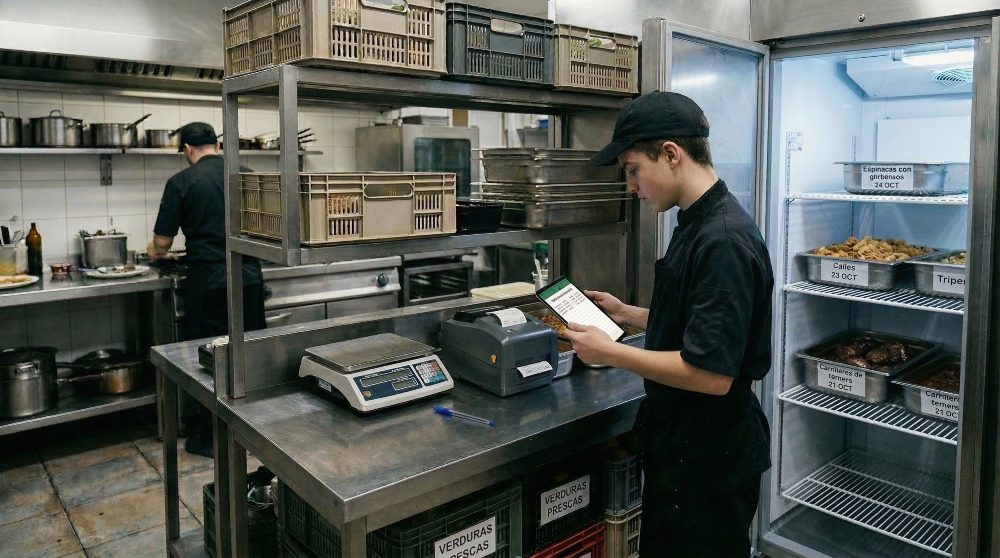
That's why it helps to create a consolidation point: a fixed location where the suitable surplus is Sort, label, and store until pickup. If the food needs to be kept cold, that point must be refrigerated. In addition, it is advisable to set maximum times (when they come in, when they leave) and keep track of a simple registration (source/destination). This makes the donation repeatable, secure, and easy to verify.
Diagnostic questions
- When is something determined to be eligible surplus?
- Where does it set, and how long does it take before it can be picked up?
- What is recorded (even if it's minimal)?
6) The benefits of a system with logging and alarms: control, documentation, and fewer surprises
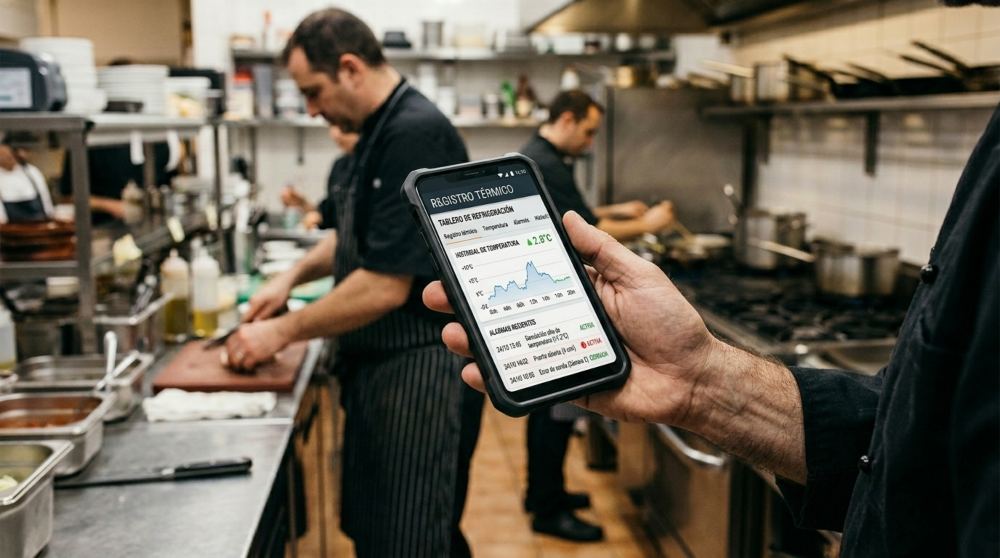
Here's the key point: it's not about “more technology” just for the sake of it. It's less uncertainty. A team with thermal record, alarms and, when applicable, connectivity, helps maintain day-to-day control and provides a record of what has happened in the event of an audit, donation, or internal review.
A team with Temperature logging, alarms, and connectivity It offers three practical benefits:
A) Detect deviations earlier (operational foresight)
- door left open too long
- temperature outside the range more than expected
- Recurring incidents during certain times (peak operating hours)
- Recurring failures after cleaning or replacement
Actual Benefit: Action is taken before the product deteriorates or a major incident occurs.
(This is not a legal guarantee; it is a reduction in operational risk through early detection.)
B) Demonstrate control (evidence)
- temperature history
- log of alarms/incidents and corrective actions
- Support for audits, donations, and—in particular—contracts and services involving document control
“If they ask you for audit evidence tomorrow, you don’t have to rely on your memory: you have a record of what happened and when.”
C) Improve decision-making (useful data, not red tape)
- identify the teams that have been “hit the hardest”
- Adjust routines: opening procedures, restocking, preventive maintenance
- prioritize investment where it actually reduces waste
What to ask for so as not to make a decision blindly
- Who will receive alerts, and what will they do with them?
- What are reasonable thresholds for that location (to avoid false alarms)?
- How is evidence filed (monthly/quarterly)?
At Coreco, we understand that if you want to move from “reacting when something goes wrong” to detect deviations early, it usually helps to understand what the Connected Professional Refrigeration in HORECA Kitchens: automatic temperature logging, configurable alarms, and an incident log that makes it easier to document corrective actions. It does not replace the operator’s responsibility, but it does make it easier to maintain daily control and provide evidence during audits, donations, or internal reviews.
Professional Refrigeration Ecosystem
When we talk about the law, it’s tempting to think of it as “a requirement.” In practice, the outcome depends on the ecosystem: equipment + installation + operation + maintenance. If your organization already operates according to this logic (for example, in the cold chain pillar of the HORECA sector), this law reinforces it: operational compliance is based on actual use, not on ideal conditions.
What Changes in Practice for the HORECA Sector Under Law 1/2025 on Food Waste
- Prevention (rotation, portions, foresight) becomes part of the design of the cooling system and the flow.
- Excess inventory requires rules: when to set it aside, how to store it, and how to record it.
- Donations and redistribution (when applicable) drive the cold chain and basic traceability.
- Local governments and the public sector are facing increased documentation requirements due to bid specifications and audits.
- Minimum preventive maintenance is no longer “optional” if you want stability and less waste.
- Logging and alarms (when applicable) help detect deviations and preserve evidence.
- A formal exemption does not eliminate the economic interest: less waste usually means lower costs.
- The distributor/installer is playing an increasingly important role as a coordinator of operational processes (without getting into legal advice).
FAQ on Law 1/2025 on the Prevention of Food Loss and Waste
1) What is Law 1/2025 on Food Waste?
It is the Spanish framework for preventing food loss and waste in the food chain and regulating the management of surplus food, prioritizing prevention and human consumption when the surplus is suitable.
2) Who does this apply to in the HORECA sector and institutional settings?
Applies to the hospitality and restaurant industry and other food service providers (for example, facilities with cafeterias or catering services).
3) What does Article 6 mean in practice?
Implement prevention and prioritization within a system: waste reduction map, phase-by-phase measures, responsible parties, and minimum documentation requirements; and, when appropriate, channel suitable surplus materials.
4) What is the key date under Article 6?
MAPA clarifies that the measures in Article 6 must take effect one year after publication in the Official State Gazette (BOE): April 3, 2026.
5) What does Article 8 require of restaurants?
Make it easy for customers to take home uneaten food, clearly inform them of this option, and use appropriate containers, with exceptions such as all-you-can-eat buffets.
6) Does the law require the purchase of new equipment?
No. It drives operational results. Teams help when they ensure stability, maintainability, and evidence.
7) What benefits do the temperature log and alarms provide?
They help detect deviations earlier, document incidents, and preserve operational evidence (audit/donation/contract). They do not replace the operator's responsibility.
8) What minimum records are usually helpful?
Loss due to cause, conservation incidents, and—if a donation is involved—incoming/outgoing items and conservation conditions.
9) What role can CORECO play without promising “guaranteed legal compliance”?
Provide technical resources and operational documentation (through distributors/installers) to help ensure better maintenance, better record-keeping, and more controlled operations.
Glossary of Terms
- Food waste: food intended for human consumption that ends up as waste for preventable reasons.
- Food losses: losses in stages prior to consumption (production/processing/logistics).
- Priority hierarchy: An order of priority that emphasizes prevention first and, if there is a suitable surplus, human consumption.
- Eligible surplus: Safe food that can be redirected for human consumption through processing, donation, or redistribution.
- Prevention Plan: Measures, accountability, and review to reduce losses and waste.
- Cold chain: Maintenance of appropriate temperature conditions during storage and transport, when applicable.
- Traceability: the ability to record entries and exits, as well as associated conditions when applicable.
- Thermal record: temperature and event history (manual or connected).
- Alarms: Alerts for deviations (temperature, door, incidents) to enable timely action.
- Corrective action: documented response to an incident (e.g., process adjustment, review, recall).
- Maintainability: The ability to easily clean, access, and maintain equipment to ensure continued performance.
If you're figuring out how to implement Law 1/2025 in your operations, it usually helps to start with a shrinkage map, a basic routine, and a simple record-keeping system. To assess the scope of solutions for stable inventory management, temperature logging, and alarms, Check with your dealer and have your regular installer check the installation.
This article is informative and practical. Each company should determine which obligations apply to its specific situation and, if necessary, consult with its legal counsel.





 Español
 English
 Français
 Deutsch
 Italiano