







Professional refrigeration for the HORECA business model should not be seen as a stand-alone equipment choice. It should be seen as an operational decision: which product needs to be preserved, how it moves, at what times does the business work most efficiently, and what level of stability each area needs.
A fine dining restaurant, a buffet hotel, a dark kitchen, a central kitchen or a gourmet store can share part of the equipment, but they do not share the same rhythm, the same openings, the same rotation, or the same service logic. That is why, when the business model changes, the correct way of dimensioning cameras, cabinets, cold counters, drop-down systems or specific conservation solutions also changes.
If you have already read it How professional refrigeration impacts the real profitability of a HORECA business, Here we put that idea into a very concrete decision: how to adjust the cold to the real operational needs of the business so that the installation makes sense from day one and also over time. And if you want to expand the financial aspect, it is also worth linking it to Cold as an invisible fixed cost in HORECA.
The underlying idea is simple: it’s not about choosing “more equipment” or “less equipment”. It’s about choosing the right equipment, well distributed and well justified.
Why it is advisable to dimension the system based on the reality of the business
In our experience, many projects do not need as much of a longer list of references as a more precise reading of the operation.
Before comparing capabilities, measurements, or finishes, it is advisable to understand at least these variables:
- which product is preserved;
- how much it rotates;
- what real openings each team will have;
- where the heat points will be;
- what peak workloads the installation must handle;
- which part of the cold is in back and which part is part of the visible space;
- How much growth or change in the letter may occur in the coming years.
When this analysis is done well, the conversation changes. It no longer revolves around what is feasible or what the initial cost is, but around what flow it supports, what workload it absorbs, and what stability it brings on a daily basis.
The cold map: before the reference, the product’s journey
A useful way to start is to draw the business’s cold-weather map.
We're not just talking about linear meters or liters. We're talking about distance.
A basic cold map should at least list these things.
| Zone | Main function | What it's worth checking |
|---|---|---|
| Reception | Entry and first organization of the product | Delivery frequency, waiting times, unloading |
| Storage | Stock maintenance | Rotation, categories, openings, stability |
| Production | Cooking preparation and support | Closeness, tours, support for real work |
| Depression | Controlled temperature drop | Lots, times, bottlenecks |
| Service | Support for pass, bar or desk | Intensive openings, quick access, replenishment |
| Room or visible area | Conservation with a presence in front of the customer | Order, visual cleanliness, consistency with the space |
| Expedition | Organized departure of the product | Rhythm, preparation in advance, operational continuity |
This helps to make better decisions because each step of the process requires a different logic. A day-to-day storage cabinet is not the same as a cabinet designed to store wine. A stock room is not the same as a maturation cabinet, where the control of the process and the length of time spent in storage completely change the need.
Questions that help to better size up the situation
Before closing a proposal, it usually helps to calmly answer some simple questions.
About product and rotation
- Which product is more sensitive?
- What comes out every day and what stays around longer?
- Is there any advance production?
- Is work done in batches?
- Are there categories that need to be separated?
About the work rhythm
- Where is the peak of service concentrated?
- How many openings can a wardrobe have in the critical range?
- Is it reset from back several times a day?
- Is there strong seasonality, promotions or campaigns?
About space and installation
- Where will each team be located?
- What real ventilation does the area have?
- Are there any heat hotspots nearby?
- Is there room for maintenance?
- What happens if the business grows or changes part of its offering?
These questions do not complicate the purchase. They clarify it.
Not all HORECA models use cold in the same way
Traditional restaurant
In a fine-dining restaurant, the cold is usually distributed between storage, mise en place, and service support.
It’s not always necessary to grow in volume here. Often what’s needed is to better organize the functions of each team.
What usually works best
- camera or clear area for stock;
- wardrobes or cold tables near the work areas;
- separation between high-turnover product and reserve product;
- reduction if there is advanced production;
- short routes between preparation, conservation and passage.
The goal is not to fill the kitchen with equipment. The goal is to avoid a single cold spot supporting too many different functions at the same time.
Hotel with buffet service, events or banquets
In hotels, the problem is usually not just the capacity, but variability.
There are peaks, rest periods, breakfasts, banquets, support kitchen, internal tours, and moments where a deviation affects many people at the same time.
What is worth prioritizing
- cameras distributed according to the logic of service, not just the main kitchen;
- specific support for buffet or satellite service;
- operating margin for events and groups;
- disruption when there is production in batches;
- Reasonable redundancy in the most sensitive points.
In this type of project, properly dimensioning means absorbing variation without converting each peak into voltage.
Catering and central kitchen
Here, cooling is part of the production infrastructure.
The flow is usually more demanding and more sequential:
Reception → Conservation → Preparation → Slaughtering → Conservation → Shipment
If one of these phases is insufficient, the problem is not always visible at first, but it eventually appears in the form of time delays, bottlenecks, or a loss of control.
What usually weighs more
- actual breaking capacity;
- separation between prior and subsequent conservation;
- accessibility for cleaning and maintenance;
- clear routes;
- batch order and hourly windows.
It's not just about how much space there is. It's about how much the product can move without stopping the operation.
Dark kitchen and compact models
In these projects the space is more limited, but the requirement is no less demanding.
The installation should help to compact without cluttering up the space.
Here it is worth paying special attention
- actual useful capacity of the cabinets;
- ease of cleaning;
- access to maintenance;
- separation of flows;
- alarms or basic control in critical equipment;
- Future growth if the business expands its brands or service lines.
In these environments, a good sizing is usually the one that prevents the venue from always working at “maximum capacity”.
Gourmet shop with tasting
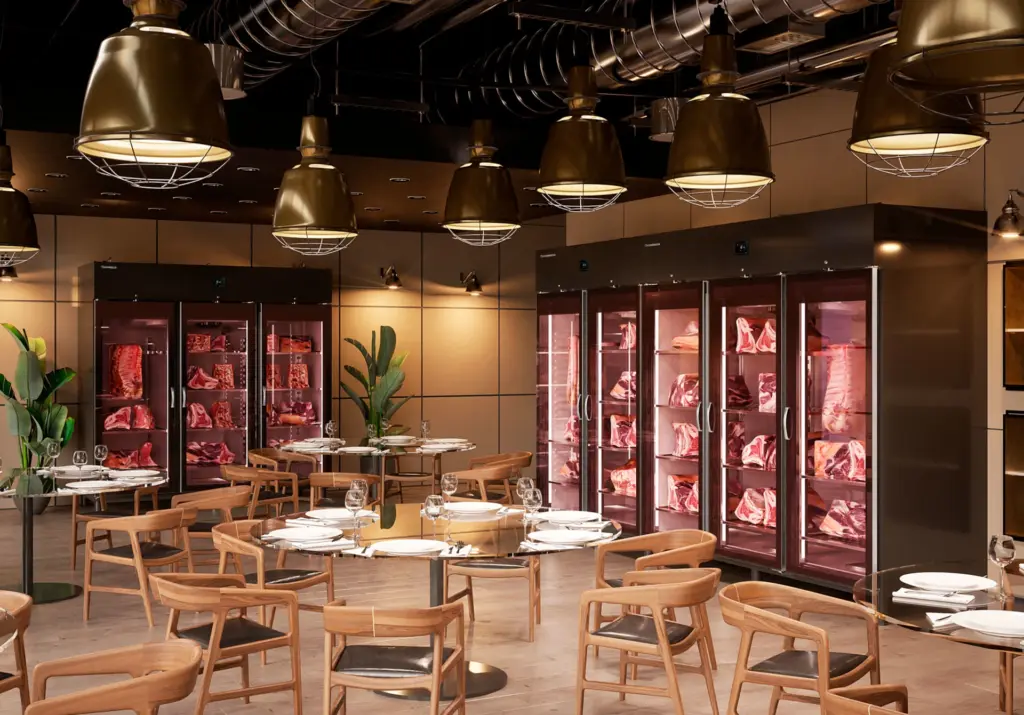
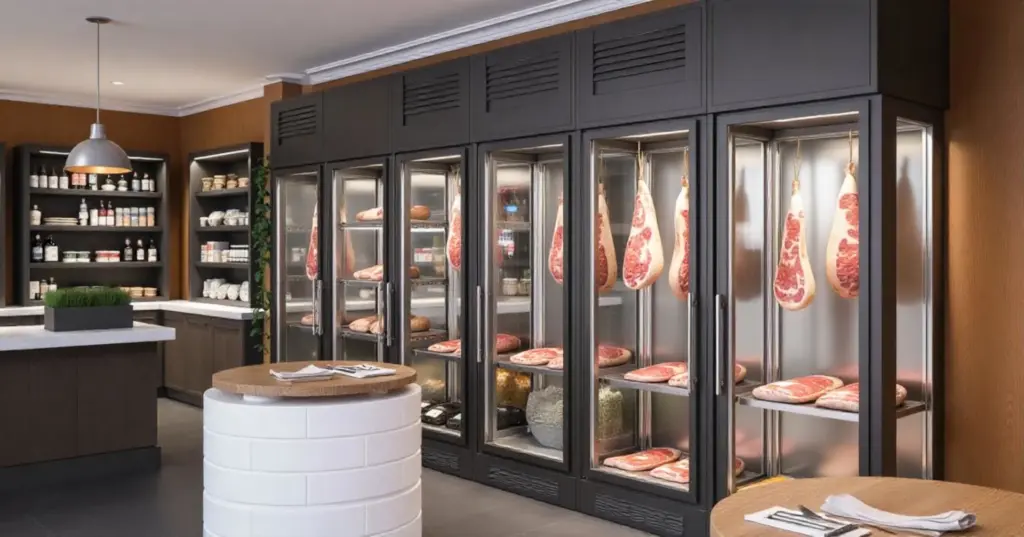
Here, the cold preserves, organizes, and also enhances the perception of the product.
That is why it is advisable to clearly separate two plans:
- the cold that sustains the operation;
- the cold that forms part of the visible space.
Not to confront them, but for each one to do their job well.
What usually helps in this type of business
- solid backing for replacement and preservation;
- specific cabinets according to category;
- stable visual order;
- comfortable access;
- consistency between the product, its use and the space.
When wine is part of the proposal, it may make sense to review a specific solution for preservation and serving, such as guide to the use of wine cavas in restaurants and gourmet shops. And if the project needs to be turned into a concrete product, you can consult the corresponding documents. EBRW-751 o DAW-400, Two references designed for the storage and preservation of wine with a logic more suited to a general-purpose device.
When the business works with longer maturation or preservation
Here it is important to make a clear distinction.
Not all cabinets respond to the same range of uses.
A daily support cabinet solves one need. A maturation cabinet addresses a completely different need: longer, more controlled processes that have a greater impact on the final product result.
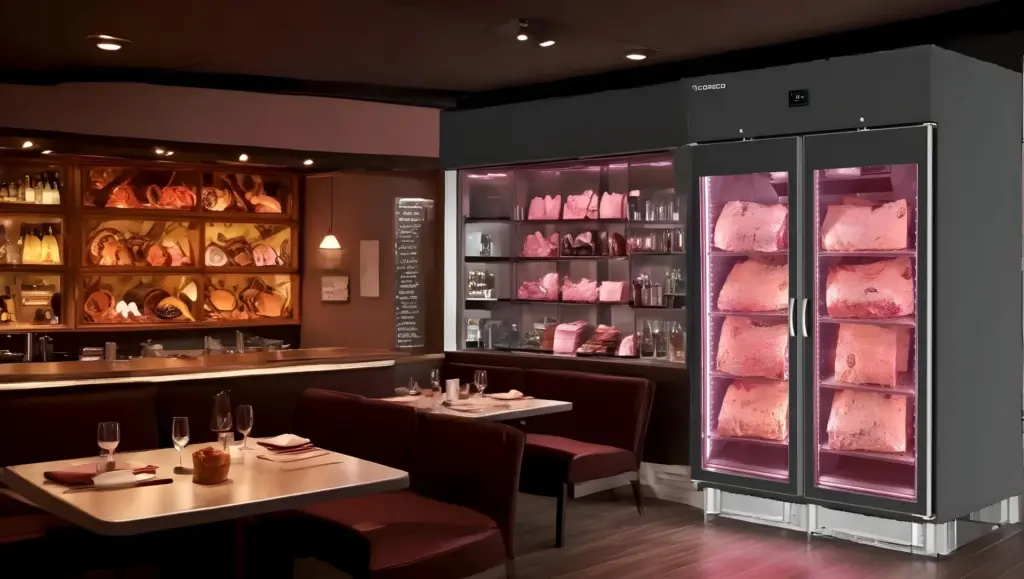
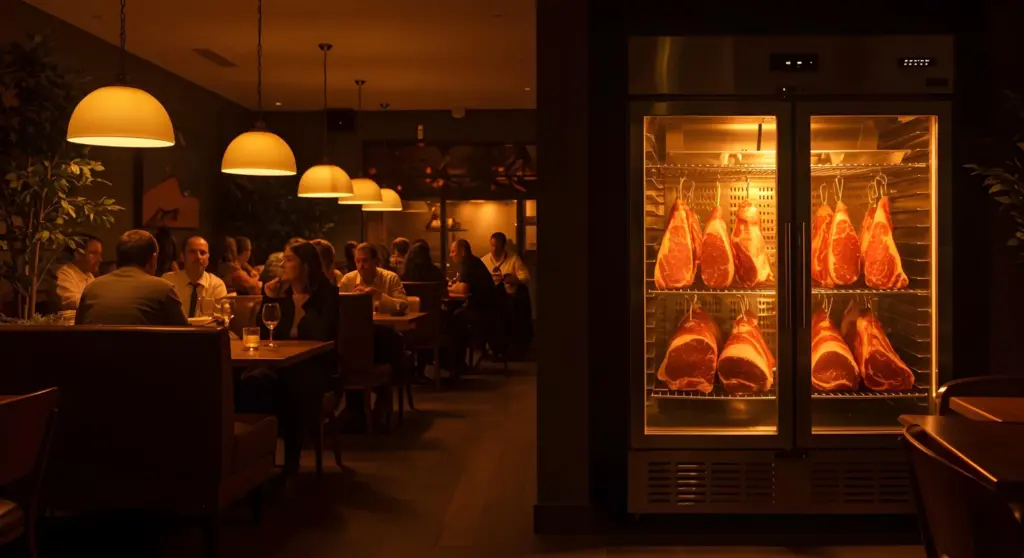
In the case of meat, the Coreco Gourmet maturation cabinets they incorporate the device Master Ageing Controller, It is designed to control seven essential parameters of the process. This changes the level of precision available and allows us to talk about a highly technical solution within its category, with a calm tone and without needing to exaggerate anything.
More than just a nice cabinet to display meat, we are talking about a tool to support a process with precision: temperature, humidity, ventilation, air speed, oxygen control, exposure time, and gas flow.
If the project requires a reduction in staff, it is advisable to review, for example DA-1002, This reference is intended for larger pieces and different maturation processes. In this type of application, it also makes sense to talk about long-term storage or preservation, because the equipment is no longer just used for daily service but for a specific product strategy.
And if the business works with sausages or curing, it may be worth checking out other products such as ASCV-1302, where the team's logic already responds to controlled temperature and humidity for a specific process.
What role can CORECO, the distributor and installer, play?
It is important to be very clear here.
The final decision belongs to the entrepreneur, because he or she knows their proposal, their rhythms and their priorities best. But that doesn’t mean they have to decide alone.
Both the brand and the distributor or installer can provide very useful information to help you make the decision and make it more defensible.
What information usually really helps
- translate the business operation into a reasonable technical proposal;
- explain what role each team should fulfill;
- differentiating between daily conservation, service support, stock, slaughtering, or specific process;
- putting the consumption, maintenance, accessibility and route of the product on the table;
- review whether the project is designed for today or also for future changes in the business.
This approach usually works better than a conversation focused solely on price or only on declared capacity. Not because price doesn’t matter, but because it’s better to put it within a more comprehensive framework.
Some decisions change a lot when you look at the actual usage.
Choosing by size is not the same as choosing by function
Two cabinets of similar dimensions can perform very differently if they are changed:
- the openings;
- rotation;
- the ambient temperature;
- the proximity to the work area;
- the type of product;
- the real time of stay.
It is not the same thing to preserve a process than to sustain it.
A wine cabinet, a maturation cabinet or a curing cabinet is not justified simply by its presence in the room. It is justified when it responds to a specific business logic.
It is not the same to cover today's photo than to design it with a certain route.
Some businesses change quickly: they expand their menu, increase delivery, incorporate tasting menus or strengthen a specific category. It is advisable that the cold menu map not be created without any room for maneuver.
Practical checklist to make better decisions
Before closing an offer, it is advisable to have at least the following:
- Business model and service model.
- Critical product and sensitive categories.
- Real rotation and peak workloads.
- Frequency of deliveries and replenishment.
- Plan or sketch with routes.
- Ambient temperature and heat sources.
- Space available for installation and maintenance.
- Need or not to abate.
- Visible conservation needs in the room.
- Possible growth or change in supply.
- Average time the product stays in each area.
- Level of control required for each process.
Block distributors: how to explain it to the professional customer
A useful way to explain it might be this:
It's not about complicating the decision. It's about the team really fitting in with how the business works.
Not all restaurants, hotels, or gourmet shops use cold in the same way, even though at first glance they seem to need the same thing.
The goal is not to over-dimension the installation. Nor is it to be too modest. The goal is to adjust the installation to the reality of the product, the service, and the space.
When the use is clear, it is also easier to justify the investment, organize maintenance, and avoid unnecessary tensions in the operation.
That is, often, the value of the distributor or installer in a well-executed project: turning a diffuse need into a reasonable technical decision.
What changes in practice
- It is decided with more context and less intuition.
- The team stops being seen as a separate entity.
- The product gains weight in the conversation.
- The tours and openings matter more.
- The daily operation enters into the decision earlier.
- Maintenance no longer remains an abstract idea.
- Specific teams are better justified when they respond to a real function.
- The technical proposal becomes easier to defend.
Conclusion
Talking about professional refrigeration based on the HORECA business model doesn't complicate the purchase process; it makes it easier to order.
Because the same space, the same budget, and even the same equipment can produce very different results depending on how cold is used in the real world of business.
Therefore, before closing deals, it is advisable to clearly define the cold chain, the critical product, rotation, peaks, and the role each team should play.
And that’s where CORECO, together with distributors and installers, can bring something valuable: useful information so that each entrepreneur can make the decision that suits them best based on their operations, their proposal, and their journey.
If you are reviewing a project or redesigning an installation, it may be a good time to talk it over with your distributor or installer and reduce the conversation to a simple question: What does this business really need to work better, conserve better, and grow more efficiently?.




 Español
 English
 Français
 Deutsch
 Italiano