







Refrigerated display cases for tapas and energy labeling
The refrigerated display cases for tapas They are much more than just refrigeration equipment. They represent a precise technical solution, designed to keep ready-to-eat products at optimal temperatures and in optimal presentation conditions. In this article, we explain why this equipment is exempt from mandatory energy labeling, how they align with European regulations, and, above all, what benefits they offer to distributors and professionals in the Horeca sector. Coreco Gourmet, as a leading manufacturer of sustainable industrial refrigeration equipment, offers solutions tailored to this legal and commercial landscape.
What are refrigerated display cases for tapas, sushi, and toppings, and why are they becoming so popular?
Refrigerated display cases for tapas are pieces of equipment that assisted exposure, that is, locked display cases that only the establishment's staff are allowed to open. Their main function is preserve tapas, sushi, toppings, and other ready-to-eat foods at a positive temperature (generally between -1 °C and +5 °C), while maintaining an attractive and appetizing appearance.
Unlike self-service displays, these models:
- They have restricted access (they cannot be opened by the customer).
- They use cooling static (without forced ventilation).
- They have a usable volume of less than 200 liters.
- They are designed to preserve rather than to sell directly.
Refrigerated display cases for tapas, sushi, and toppings are designed to preserve and display prepared foods or ingredients at optimal temperatures, ensuring freshness, food safety, and an attractive presentation. Their rise in popularity in the hospitality sector stems both from the diversification of culinary offerings and the growing demand for fresh, visually appealing products.
What are they?
- Refrigerated display cases for tapas: They keep tapas cold at temperatures between +2 °C and +8 °C, ensuring they stay fresh and preventing the growth of bacteria. They are common in Spanish bars and restaurants, where tapas take center stage.
- Sushi display cases: Specially designed to display sushi and raw fish—delicate products that require stable temperatures and lighting that highlights their freshness and vibrant colors. They feature LED lighting and high-quality materials such as stainless steel and tempered glass.
- Topping display cases: They are used in ice cream shops, yogurt shops, pizzerias, and fast-food restaurants to display ingredients such as fruit, chocolate, or nuts, making preparation and self-service easier.
Key Features
- Modern and versatile design: Available in different sizes and styles (curved, straight, customizable), they can be adapted to the store's image and the available space.
- Durable materials: Made of stainless steel and tempered glass, ensuring durability and hygiene.
- LED Lighting: It improves product visibility and reduces energy consumption.
- Digital temperature control: It allows you to adjust and maintain the optimal range for each type of food.
- Compatibility with Gastronorm trays: It makes it easier to organize and restock ingredients or dishes.
- Easy access and cleaning: Sliding doors and removable trays streamline service and daily cleaning.
Why are they booming?
- Culinary diversification: The rise of sushi, creative tapas, and a variety of toppings in modern dining has increased the need for specialized equipment to store and display these products.
- Submission Requirements: Consumers value visual presentation; display cases allow food to be showcased in an attractive way, driving impulse purchases and improving the perception of quality.
- Food security: Keeping food at the proper temperature is essential for complying with regulations and preventing health risks, especially for delicate items such as sushi or egg-based tapas.
- Service Optimization: They provide quick access to products, streamlining order preparation and self-service—which is key in high-volume stores.
- Energy efficiency: The adoption of energy-efficient technologies and eco-friendly refrigerants addresses the demand for sustainability in the hospitality industry.
In short, refrigerated display cases for tapas, sushi, and toppings are a comprehensive solution for the storage, display, and sale of fresh food in the hospitality industry. Their rise reflects the industry’s shift toward more visually appealing, safe, and efficient offerings.
Main Applications in Gourmet Cuisine
| Primary use | Type of establishment |
|---|---|
| Storing Cold Tapas | Tapas bars, gastropubs |
| Sushi Exhibition | Japanese restaurants, sushi bars |
| Fresh Toppings Showcase | Live-cooking restaurants, buffets |
| Preservation of Ingredients | Open kitchens, plating stations |
These types of display cases allow for a flawless and organized presentation without compromising food safety or the product's visual appeal.
Why are refrigerated display cases for tapas exempt from energy labeling requirements?
Analysis of European Regulations: Regulation (EU) 2019/2018 and 2015/1094
The Delegated Regulation (EU) 2019/2018, regarding the energy labeling of refrigeration appliances with a direct-sale function, clearly defines its scope of application:
- Article 2.1 It stipulates that appliances with direct access by the consumer must include an energy label.
- Article 1.2 y Appendix III They exempt closed, staffed display cases from this requirement.
- The Regulation (EU) 2015/1094, on the other hand, applies only to units with a volume greater than 200 L and equipped with active ventilation systems—requirements that these display cases do not meet.
Therefore, are not subject to energy labeling nor do they require registration in the European EPREL database.
In other words, refrigerated display cases for tapas are exempt from the requirement to display an energy label primarily because, according to European regulations, they are not considered commercial upright or self-service refrigeration equipment, which are subject to this requirement. These display cases are classified as countertop or tabletop display units, designed for the display and temporary storage of food in direct contact with the public, and not for long-term storage as is the case with refrigerators, freezers, or vertical display cabinets.
In addition, many of these display cases have specific features (such as sliding doors, static or ventilated cooling systems, and compact dimensions) that place them outside the scope of the energy labeling regulations for commercial refrigeration. Therefore, even if they incorporate efficient technologies such as LED lighting or eco-friendly refrigerants, they are not required to display the energy label that is mandatory for other types of commercial refrigeration equipment.
Team Table: Which Teams Are Required to Participate, and Which Are Not?
| Type of equipment | Does it require an energy label? | Comment |
|---|---|---|
| Open self-service display cases | ✅ Yes | The customer logs in directly |
| Commercial Refrigerated Cabinets | ✅ Yes | Volume >200 L, forced ventilation |
| Refrigerated display cases for tapas | ❌ No | Attended service, static cooling |
Criteria for Exempting Refrigerated Display Cases from Energy Labeling Requirements
Refrigerated display cases, especially those used for tapas or at bars, may be exempt from the requirement to display an energy label due to various regulatory and functional criteria established in European legislation on ecodesign and energy labeling for commercial refrigeration equipment.
Main criteria justifying the exemption:
- Type of device and specific function:
European regulations (Regulations (EU) 2019/2019 and 2019/2024) applies primarily to medium- and low-temperature refrigerated display cases with a direct-sale function in supermarkets and retail establishments, such as upright refrigerators, freezers, and wall-mounted display cases. Refrigerated display cases for tapas, which are typically tabletop display cases or bar displays, are not considered part of this category because their primary function is temporary preservation and display on bars or counters, not long-term storage or direct self-service sales. - Dimensions and net usable volume:
The calculation of energy efficiency is based on the Energy Efficiency Index (EEI), which relates energy consumption to the equipment’s net usable volume. Small display cases, with limited volumes and specific configurations for toppings or ingredients, have technical characteristics that make it difficult to apply standard tests and calculate the EER in accordance with EN 16825 or UNE-EN ISO 23953-2:2016, which are designed for larger refrigerated display cases intended for intensive commercial use. - Testing and Usage Conditions:
Tapas display cases do not always operate under the environmental conditions or with the airflow specified in energy-labeling standards, since they are used on an ad hoc basis and in areas with direct customer access, which means they have a different opening and loading pattern than standard commercial refrigerators. - Specific exclusions in the regulations:
Some regulations expressly exclude certain types of equipment, such as heated cabinets, display cases with a circular shape, or equipment that does not have an integrated cooling system, as well as equipment that does not operate exclusively on electricity or that is part of special installations (laboratory, medical, transportation). Display cases with lids are generally excluded from the scope of application due to their specific design and function.
Refrigerated display cases for tapas are exempt from the requirement to display an energy label because:
- Refrigerated display cases in supermarkets and standard commercial refrigerators are not considered.
- Its size, function, and conditions of use do not fall within the categories regulated for energy labeling.
- European regulations provide for exemptions for specific types of display cases and particular uses, including tabletop or countertop display cases for tapas.
Therefore, even though they incorporate energy-efficient technologies, they are not required to display the energy label that other larger commercial refrigerators with traditional walk-in capabilities must display.
How to Determine Whether a Refrigerated Display Case Requires an Energy Label
To determine whether a refrigerated display case requires an energy label, several criteria established by European regulations on ecodesign and energy labeling for commercial refrigeration equipment must be considered:
- Equipment Type and Function:
Energy-labeling regulations primarily apply to commercial refrigerated cabinets, wall-mounted display cases for supermarkets, ice cream freezers, beverage coolers, and refrigerated vending machines—especially those with a direct-sale function. Countertop or tabletop display cases for tapas, due to their design and function—which involves temporary storage and display at the counter—are generally excluded from these categories. - Calculation of the Energy Efficiency Index (EEI):
If the equipment is covered by the regulations, the manufacturer must calculate the IEE—which relates the annual energy consumption to the net usable volume of the appliance—in accordance with harmonized standards such as EN 16825 or UNE-EN ISO 23953-2:2016. This calculation determines the energy class (from A to G) that must appear on the label. - Terms of Use and Design:
Custom-made appliances, open cabinets, countertop display cases, heated appliances, appliances with a circular design, or appliances that do not run exclusively on electricity are generally excluded. In addition, display cases that process food (such as ice cream machines) are also not required to have an energy label. - Current regulations:
Regulation (EU) 2019/2018 and the Ecodesign Regulation (EU) 2019/2024 establish the requirements and exemptions. Only equipment that meets the definitions and technical conditions of these regulations must bear an energy label.
A refrigerated display case requires an energy label if it falls into one of the regulated categories (such as upright refrigerated cabinets or wall-mounted direct-sale display cases) and meets the requirements regarding volume, function, and conditions of use specified in the regulations. If it is a countertop or tabletop display case for tapas, it is generally exempt, unless the manufacturer has specifically designed and certified it to comply with energy-labeling regulations.
What benefits does this exemption offer to professionals in the sector?
Operational savings, business agility, and a professional look
Exclusion from energy labeling becomes a technical and commercial benefits. This does not imply lower efficiency, but rather acknowledges its specialized design and professional use.
Key Benefits for the Horeca Channel
- No certification costs: It is not necessary to conduct energy tests or register the equipment on European platforms such as EPREL.
- Administrative Efficiency: The time required for the sale, installation, and commissioning of the equipment is reduced.
- Uncompromised aesthetics: It is not mandatory to display visible signs that disrupt the harmony of the establishment's interior design.
- Guaranteed regulatory compliance: The distributor can assure the end customer that the equipment complies with current legislation without any additional paperwork.
Sales Pitches for Distributors: How to Communicate the Value of These Display Cases
How to Turn a Regulatory Objection into a Business Opportunity
When closing a sale, the distributor or installer faces some key questions:
—Why doesn't this appliance have an energy label?
—How do I know it complies with the regulations?
—Does it have certified energy efficiency?
Here we present clear, persuasive, and technically sound sales pitches to address those concerns.
1. Full compliance with European regulations
“The appliance does not have an energy label because it is not required to have one. It is designed for professional use, with restricted customer access and a capacity of less than 200 liters, which excludes it from the requirements of Regulation (EU) 2019/2018.”
💡 Sales tip: Mention the backing of a manufacturer like Coreco, which participates in European standards committees.
2. Guaranteed food security
“Static refrigeration ensures a stable environment for storing prepared foods. Unlike self-service units, assisted access reduces the risk of contamination and improves safety.”
💡 Emotional appeal: Convey to the customer that they are investing in equipment that protects consumer health.
3. True efficiency without a label
“The display cases are equipped with natural refrigerants—R290 or R600a—and their low energy consumption is ensured by the use of high-efficiency components such as compressors and high-density thermal insulation.”
💡 Sales tip: Show energy consumption comparisons with other similar devices.
4. Quiet Operation and Design: Comfort for the Customer
“Since they don’t have forced ventilation, the noise level is minimal. This makes them ideal for gourmet spaces, tapas bars, tasting rooms, or restaurants with open kitchens.”
💡 Key differentiator: In dining experiences, Silence sells, too.
5. Aesthetic Customization and Modularity
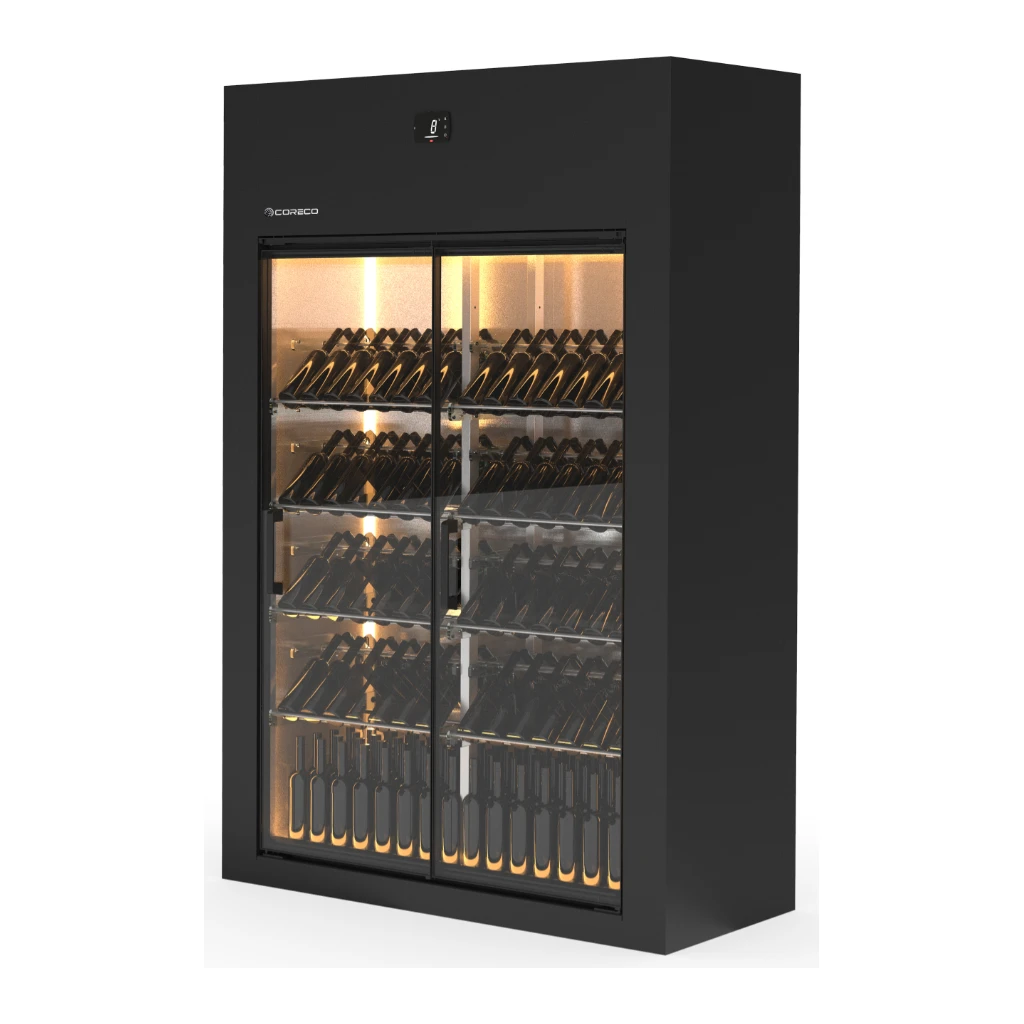
“The display cases are available in a variety of finishes, sizes, and configurations to suit any interior design. They can also be combined with other Coreco products, such as wine cabinets or Grab & Go display units.”
💡 Upselling: Offer modular combinations to expand the installation without compromising design or efficiency.
How do these display cases align with sustainability policies?
Eco-friendly refrigeration compliant with the 2024 F-Gas Regulation
Starting in 2025, the F-Gas Regulation will restrict the use of gases with high Global Warming Potential (GWP). Coreco's refrigerated display cases for lids are already fully adapted, using natural refrigerants:
- R290 (propane) y R600a (isobutane) with a GWP of ≤ 3.
- No forced ventilation = lower energy consumption.
- HFC- and ODP-free injected polyurethane insulation.
Coreco's Environmental Commitment
Coreco manufactures under ISO 14001 certification, using processes that reduce CO₂ emissions at every stage: design, production, and use of the equipment.
How do you choose the ideal refrigerated display case for tapas, sushi, or toppings?
| Factors to Consider | Technical Recommendation |
|---|---|
| Product type | Cold tapas, sushi, sensitive ingredients |
| Required volume | Less than 200 liters in most applications |
| User Access | Store staff only |
| Noise Level | Low or none, ideal for gourmet spaces |
| Aesthetics | Available in black steel, stainless steel, or custom lacquer |
| Applicable Regulations | EU Regulations 2019/2018 and 2015/1094 (not mandatory) |
Frequently Asked Questions About Refrigerated Display Cases for Tapas
Can I install them on counters that are open to customers?
Yes, as long as the customer does not have direct access to the interior. These are self-service display cases.
What kind of maintenance do they require?
- Surface and window cleaning.
- Thermostat inspection.
- Inspection of the compressor and magnetic seals.
Can they be customized?
Yes, at Coreco we offer customizable versions in terms of finishes, dimensions, and components, such as LED lighting or additional shelves.
Conclusion: Refrigerated display cases for tapas—a regulatory, commercial, and operational ally
The refrigerated display cases for tapas These appliances are designed with a specific technical purpose in mind: to store ready-to-eat products with restricted access in a stable-temperature environment, without noise or excessive energy consumption. Their exclusion from energy labeling It is not a limitation, but rather an advantage based on its regulatory expertise.
At Coreco Gourmet, we develop display cases that strictly comply with European standards, incorporate eco-friendly technology, and provide concrete business benefits to distributors. For the Horeca sector, this means efficiency, compliance, and aesthetic distinction, all in one product.




 Español
 English
 Français
 Deutsch
 Italiano